Pethia conchonius
Rosy Barb
Formerly Cyprinus conchonius Hamilton, 1822 · Barbus conchonius Hamilton, 1822 · Puntius conchonius Hamilton, 1822
Last revised 2026Edit this page
On this page13 sections
Quick factsEdit
Difficulty6 of 8 measures
- Space
- large tank
- Water
- flexible
- Temp
- flexible
- Diet
- unknown
- Temperament
- peaceful
- Social
- needs to be in a group
- Compatibility
- fine with others
Other demands
Each of these can raise the rating on its own, whatever the measures above say.
- Hardiness
- unknown
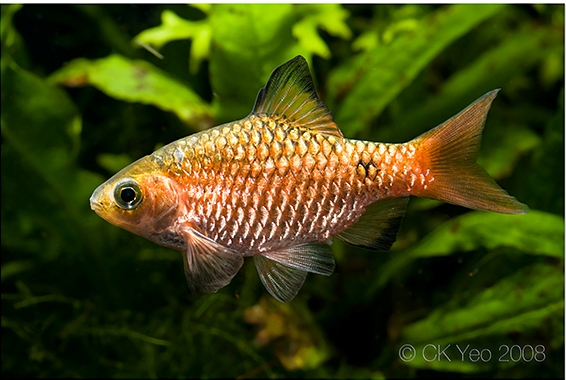
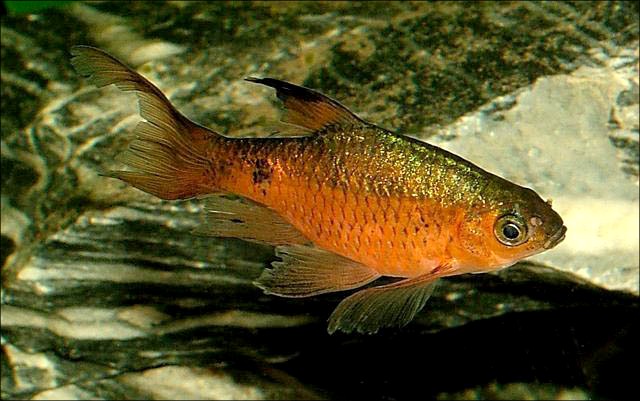
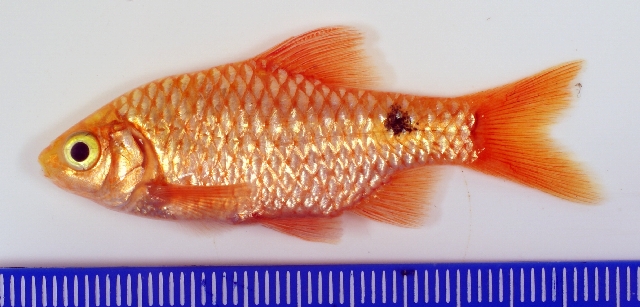
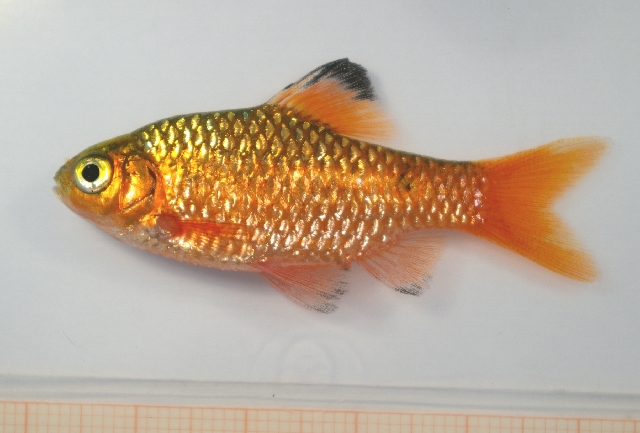
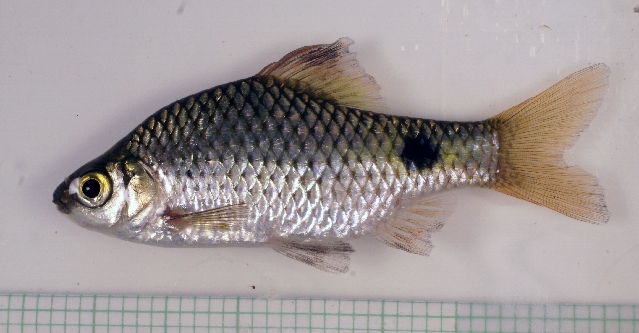
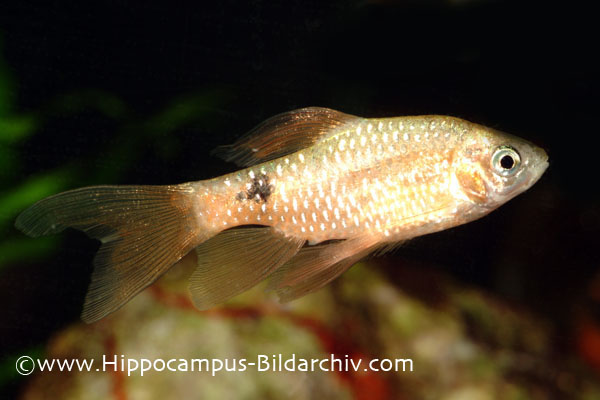
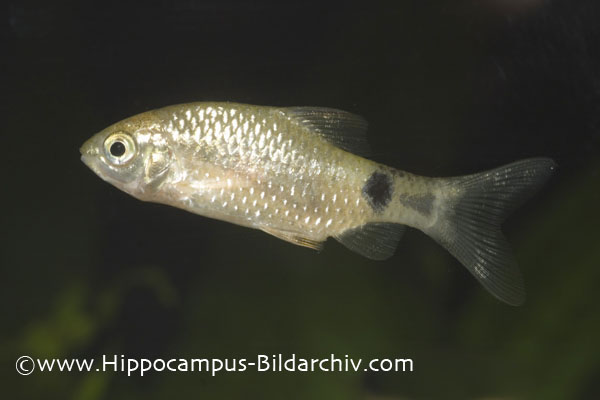
The rosy barb, Pethia conchonius, is a small cyprinid found from Pakistan throughout India, Nepal and Bangladesh. Generally considered one of the hardiest small cyprinids in the hobby, it is an excellent choice for newcomers. Wild specimens are not usually available and the vast majority are commercially bred, with long-finned, 'veil-tail', 'super red', 'neon' and 'golden' strains among the forms selective breeding has produced. Feral populations exist in several countries.
Etymology
EditPethia: the generic vernacular name for small cyprinids in the Sinhala language.
conchonius: appears to follow a local vernacular name for the fish.
Distribution
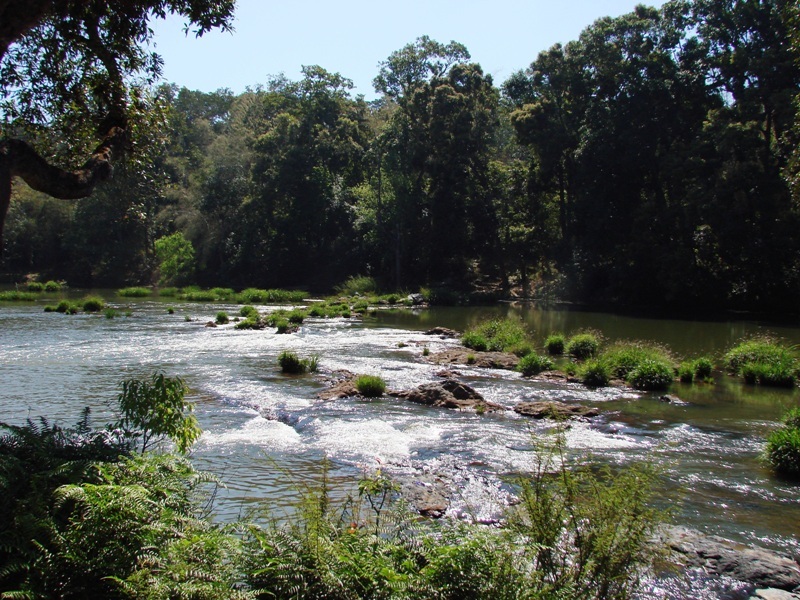
EditDescribed from 'Ponds of northeastern Bengal; Kosi and Ami rivers, India' but according to current knowledge is extensively distributed from Pakistan throughout India, Nepal, and Bangladesh.
Populations exhibit a degree of variation depending on locality, with some forms growing larger than others or exhibting further in colouration and patterning.
For example, fish collected from the Darjeeling area in the Siwalik mountains, West Bengal are said to be particularly well-coloured with highly-reflective scales.
Wild specimens are not usually available in the aquarium trade, though, with the vast majority bred on a commercial basis (see 'Notes').
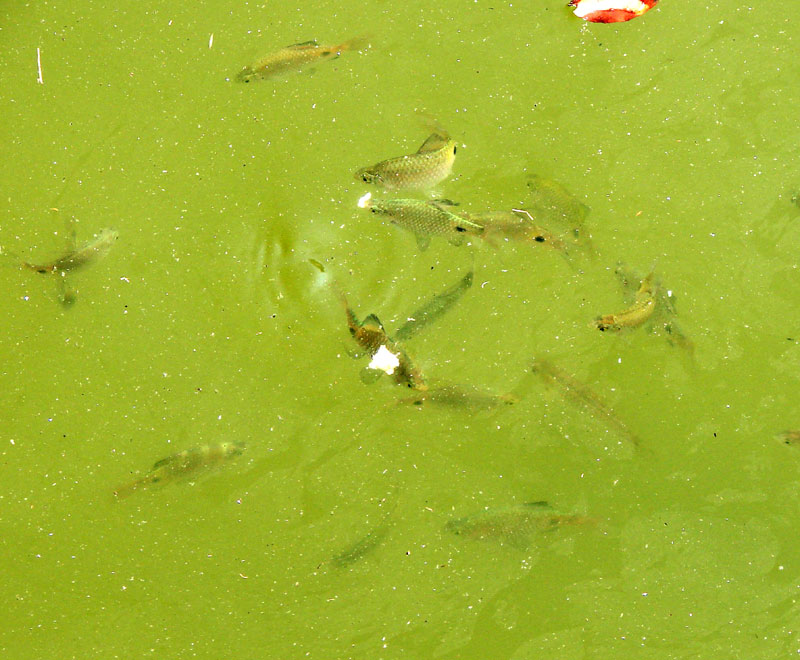
Feral populations exist in several countries, notably Singapore, Australia, Mexico, Puerto Rico, and Colombia.
Habitat
Write a noteEditOccurs in numerous habitat-types, from flowing hill streams and tributaries of rivers to stiller waters such as lakes, ponds, and swamps.
Aquarium size
Write a noteEditBase dimensions of at least 100 ∗ 30 cm39 ∗ 12 in or equivalent are required.
Maintenance
Write a noteEditChoice of décor is not especially critical though it tends to show better colouration in a heavily-planted set-up with a dark substrate.
The addition of some floating plants and driftwood roots or branches to diffuse the light entering the tank also seems to be appreciated and adds a more natural feel.
Filtration does not need to be particularly strong given its natural habitat preferences though it does seem to appreciate a degree of water movement and will also do well in a hill stream-type set-up.
Water conditions
EditThese recommendations come from this profile’s own figures. They contain affiliate links, so we may earn a commission.
Diet
Write a noteEditStudies have shown it to be a generalised omnivore feeding on worms, insects and other small invertebrates, as well as plant material and organic detritus.
In the aquarium it's easily-fed but the best condition and colours offer regular meals of small live and frozen foods such as bloodworm, Daphnia, and Artemia, alongside good quality dried flakes and granules, at least some of which should include additional plant or algal content.
Behaviour and compatibility
Write a noteEditThis species is generally peaceful and an ideal resident of the well-researched community aquarium.
As it places no special demands in terms of water chemistry it can be combined with many of the most popular fish in the hobby including other small cyprinids as well as tetras, livebearers, rainbowfishes, anabantoids, catfishes and loaches.
It's a schooling species by nature and ideally should be kept in a group of at least 8-10 specimens.
Maintaining it in decent numbers will not only make the fish less nervous but will result in a more effective, natural-looking display, plus males will display their best colours as they compete with one other for female attention.
Sexual dimorphism
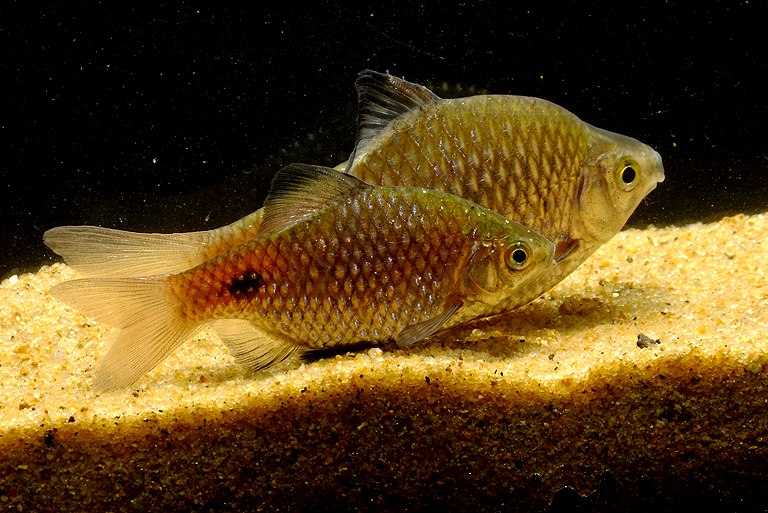
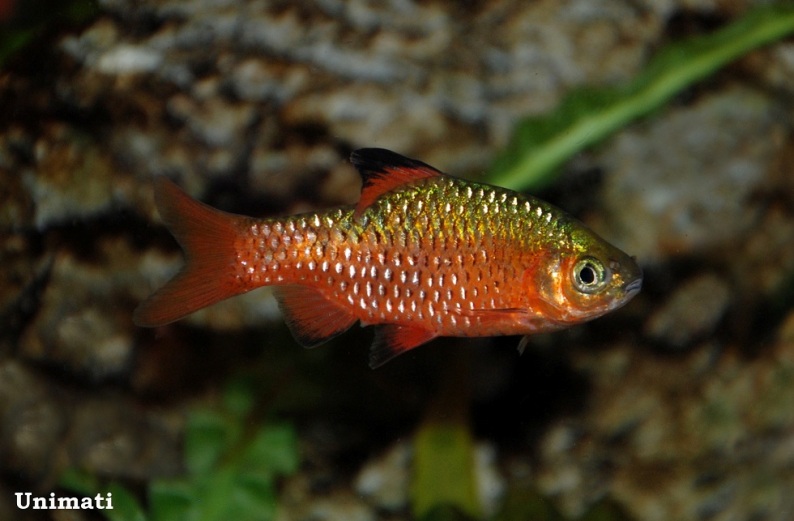
Write a noteEditAdult males are noticeably smaller, slimmer, and more colourful than females, especially during the spawning season when they also develop tubercules on the head and snout.
Some ornamental strains retain bright colouration at all times.
Reproduction
Write a noteEditLike most small cyprinids Pethia spp. are egg-scattering free spawners exhibiting no parental care.
When in good condition they will spawn often and in a mature aquarium it's possible that small numbers of fry may start to appear without intervention.
However if you want to maximise yield a more controlled approach is required.
The adult group can still be conditioned together but a smaller aquarium should also be set up and filled with mature water.
This should be very dimly lit and the base covered with some kind of mesh of a large enough grade so that the eggs can fall through but small enough so that the adults cannot reach them. The widely available plastic 'grass'-type matting can also be used and works well, as does a layer of glass marbles.
Alternatively filling much of the tank with a fine-leaved plant such as Taxiphyllum spp. or spawning mops can also return decent results.
The water itself should be of slightly acidic to neutral pH with a temperature towards the upper end of the range suggested above, and an air-powered sponge filter or air stone(s) should also be included to provide oxygenation and water movement.
When the adults are well-conditioned and the females appear gravid one or two pairs should then be introduced, and spawning should take place the following morning.
An alternative is to spawn the fish in a group with half a dozen specimens of each sex being a good number, although a larger aquarium may be necessary.
In either situation the adults will probably eat the eggs given the chance and should be removed as soon as any are noticed.
These should hatch in 24 - 48 hours with the fry free swimming around 24 hours later.
They should be offered an infusoria-grade food for the first few days until large enough to accept microworm, Artemia nauplii, or suchlike.
Notes
EditGenerally considered one of the hardiest small cyprinids available in the aquarium hobby, P. conchonius is an excellent choice for newcomers.
Selective breeding has produced various ornamental strains including long-finned, 'veil-tail', 'super red', 'neon', and 'golden' forms.
It's also been hybridised with some congeners although apparently the offspring of such experiments are infertile.
It was formerly included in the Puntius conchonius 'group' of closely-related species alongside P. ater, P. bandula, P. cumingii, P. didi, P. erythromycter, P. gelius, P. khugae, P. macrogramma, P. manipurensis, P. meingangbii, P. nankyweensis, P. nigripinnis, P. nigrofasciatus, P. padamya, P. phutunio, P. punctatus, P. reval, P. setnai, P. shalynius, P. stoliczkanus, P. thelys, P. tiantian, and P. ticto, but all of these were moved to the new genus Pethia by Pethiyagoda et al. (2012), as were P. melanomaculata, P. pookodensis, P. muvattupuzhaensis, P. ornatus and P. yuensis.
‘Puntius‘ narayani was not moved to the new genus since it uniquely possesses 9 branched dorsal-fin rays and 6 branched anal-fin rays and is currently of uncertain generic placement.
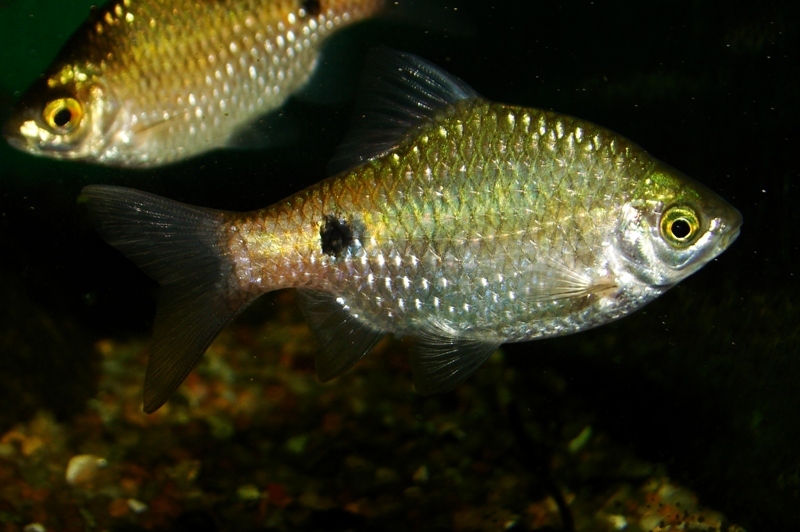
Pethia species are diagnosed by the following combination of characters: rostral barbels absent; maxillary barbels minute or absent; possession of a stiff, serrated last unbranched dorsal-fin ray; presence of a black blotch on the caudal peduncle, and frequently, black blotches, spots or bars on the side of the body; infraorbital 3 deep and partially overlapping the preoperculum.
The genus Puntius was viewed as a polyphyletic catch-all containing over 100 species of small to mid-sized cyprinid for a number of years until Pethiyagoda et al. (2012) published a partial review covering South Asian members.
The majority of sub-Himalayan Puntius species were reclassified and new genera Dawkinsia, Dravidia, and Pethia erected to accomodate some of them, with the remainder either retained in Puntius or moved to the existing Systomus assemblage, though the definition of the latter was altered meaning some Southeast Asian species formerly placed there are no longer members.
It subsequently became clear that the name Dravidia was preoccupied by a genus of flesh fly, therefore the replacement name Haludaria was made available by Pethiyagoda (2013).
No species from Indochina, China, or Indonesia were included in the study meaning a significant number of former Puntius are currently classed as incertae sedis, i.e., of uncertain taxonomic placement, and this also applies to a number of South Asian species of unresolved status.
They’re perhaps best referred to as ‘Puntius‘ for the time being whereby the genus name is surrounded by quotation marks to denote its questionable usage, and that is the convention used here on SF at the moment.
References
- Kullander, S. O. and R. Britz (2008). Puntius padamya, a new species of cyprinid fish from Myanmar (Teleostei: Cyprinidae). Electronic Journal of Ichthyology, Bulletin of the European Ichthyology Society 2, 56-66
- Kullander, S. O. (2008). Five new species of Puntius from Myanmar (Teleostei: Cyprinidae). Ichthyological Exploration of Freshwaters 19(1), 59-84
- Shantakumar, M. and W. Vishwanath (2006). Inter-relationships of Puntius Hamilton-Buchanan (Cyprinidae: Cyprininae) found in Manipur, India. Zoos' Print Journal 21(6), 2279-2283
- Kullander, S. O. and F. Fang (2005). Two new species of Puntius from northern Myanmar (Teleostei: Cyprinidae). Copeia 2005(2), 290-302
- Linthoingambi, I. and W. Vishwanath. (2007). Two new fish species of the genus Puntius Hamilton (Cyprinidae) from Manipur, India, with notes on P. ticto (Hamilton) and P. stoliczkanus (Day). Zootaxa 1450, 45–56
- Hamilton, F. (1822). An account of the fishes found in the river Ganges and its branches. An account of the fishes found in the river Ganges and its branches., i-vii + 1-405
- Pethiyagoda, R., M. Meegaskumbura, and K. Maduwage (2012). A synopsis of the South Asian fishes referred to Puntius (Pisces: Cyprinidae). Ichthyological Exploration of Freshwaters 23(1), 69-95
- Pethiyagoda, R. (2013). Haludaria, a replacement generic name for Dravidia (Teleostei: Cyprinidae). Zootaxa 3646(2), 199
Species images · 14
These photographs are used with each photographer's permission.
Send a photograph