Hobbyist group · Perciformes
Cichlids
Every cichlids profile.
- Species
- 285
- Families
- 1
- Genera
- 109
- Photographed
- 113 of 285
- Difficulty rated
- 282 of 285
Families in this group
Where they come fromnative records only
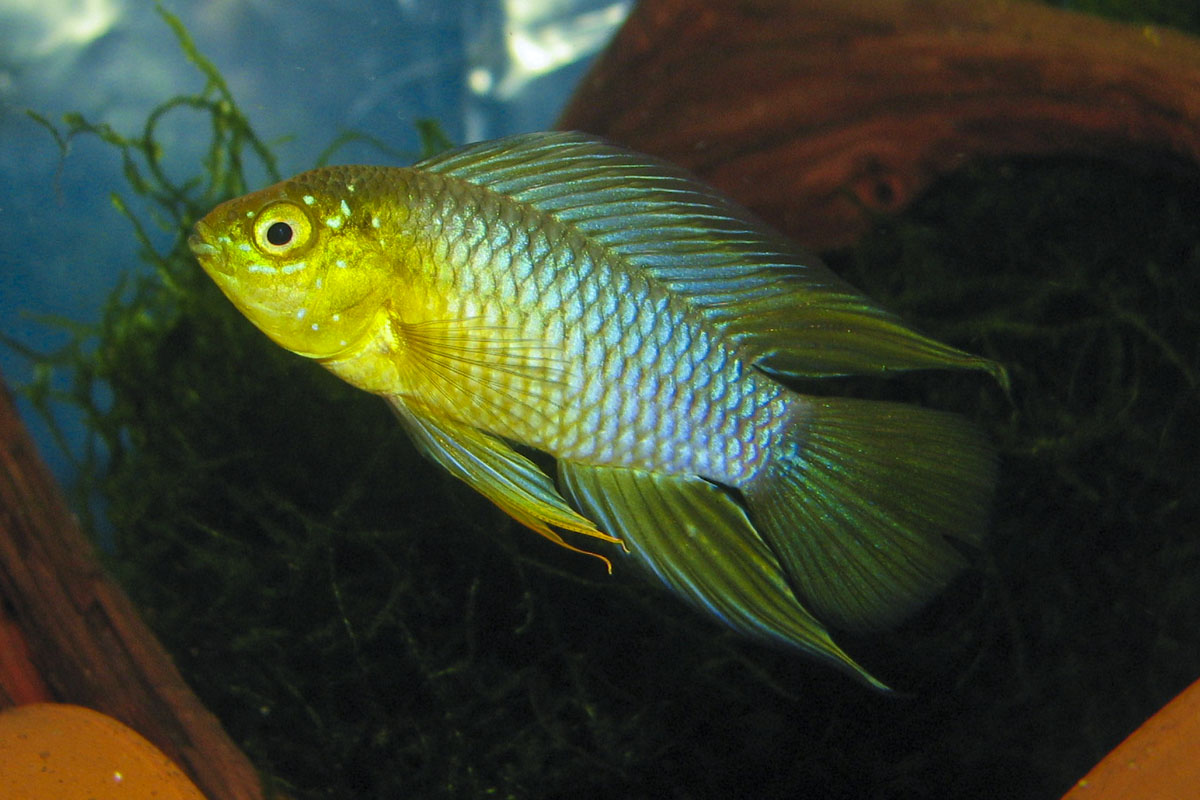
Apistogramma borelliiBorelli's Dwarf Cichlid
Cichlidae · Regan, 1906
Numerous ornamental forms of this species have been selectively-bred for the aquarium trade. It has also been assigned the 'A' number A234 under the DATZ system with possibly conspecific, related forms similarly numbered A103, A104, and A105 depending on locality.
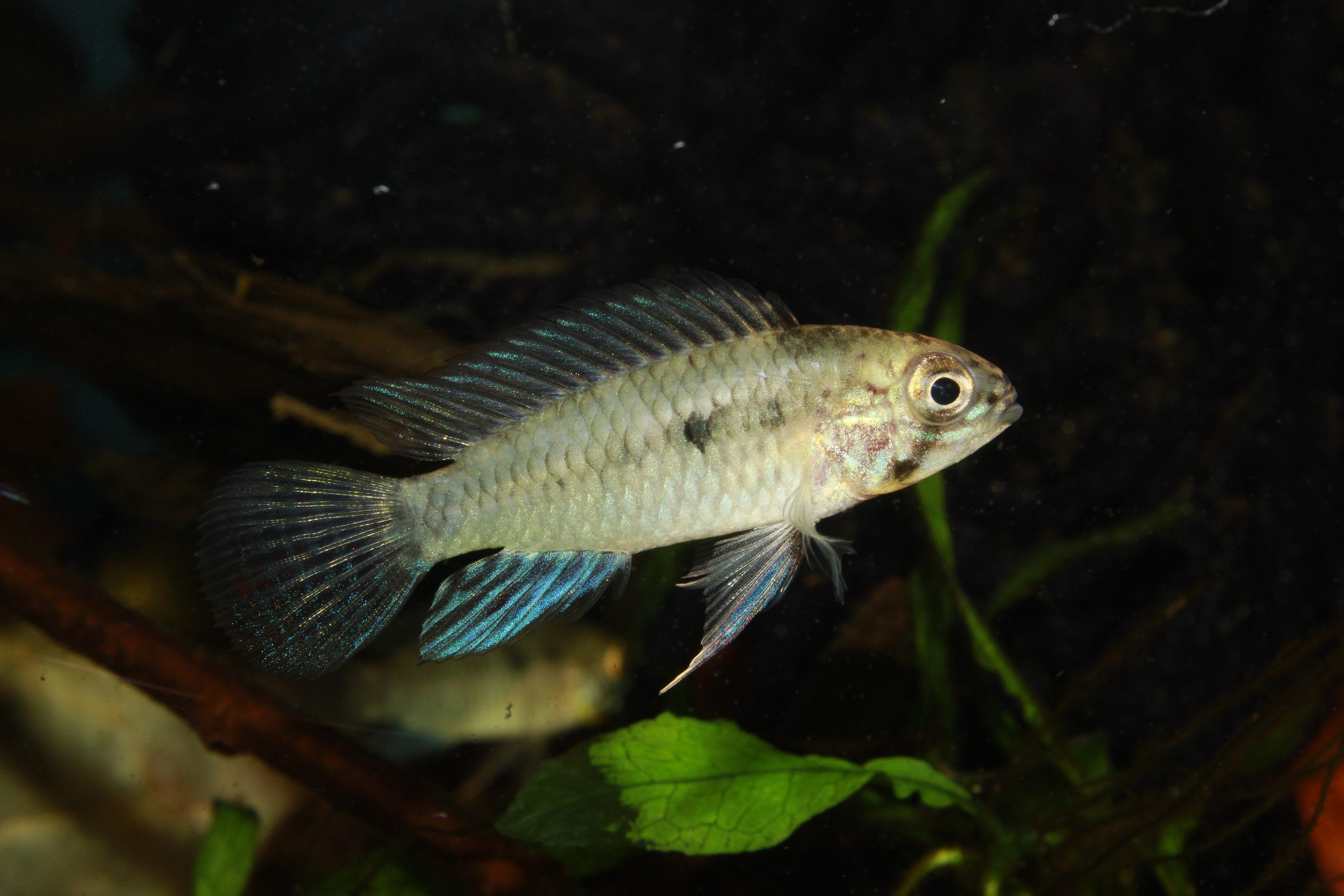
Apistogramma commbraeA93
Cichlidae · Regan, 1906
Apistogramma commbrae and other members of the commbrae complex can be distinguished from congeners by the conspicuous double caudal peduncle spot. This species may also be polymorphic, with some males exhibiting red and blue markings on the cheeks and a yellow gular region.
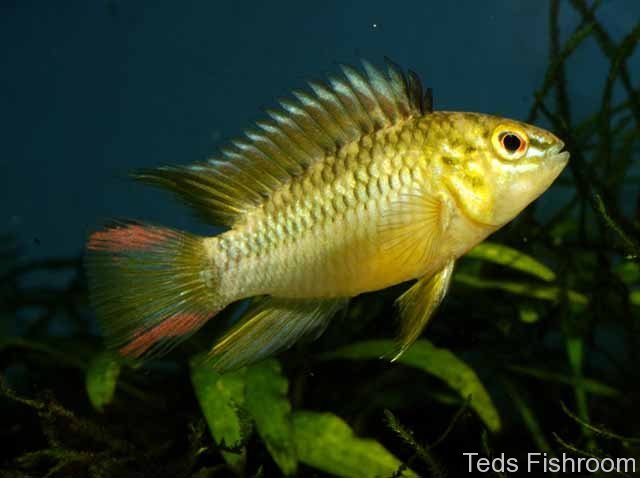
Apistogramma hoignei
Cichlidae · Meinken, 1965
The genus Apistogramma is among the most speciose of South American cichlid genera with around 70 species valid at present but many more awaiting description. In addition many species exist in two or more geographical colour forms which may or may not turn out to be distinct in the future. Hobbyists tend to label these with collection data if available in order to avoid mixing them and the potential of hybridisation. Member species have also been organised into a series of species lineages, sublineages, complexes and groups by authors in order to better separate them.
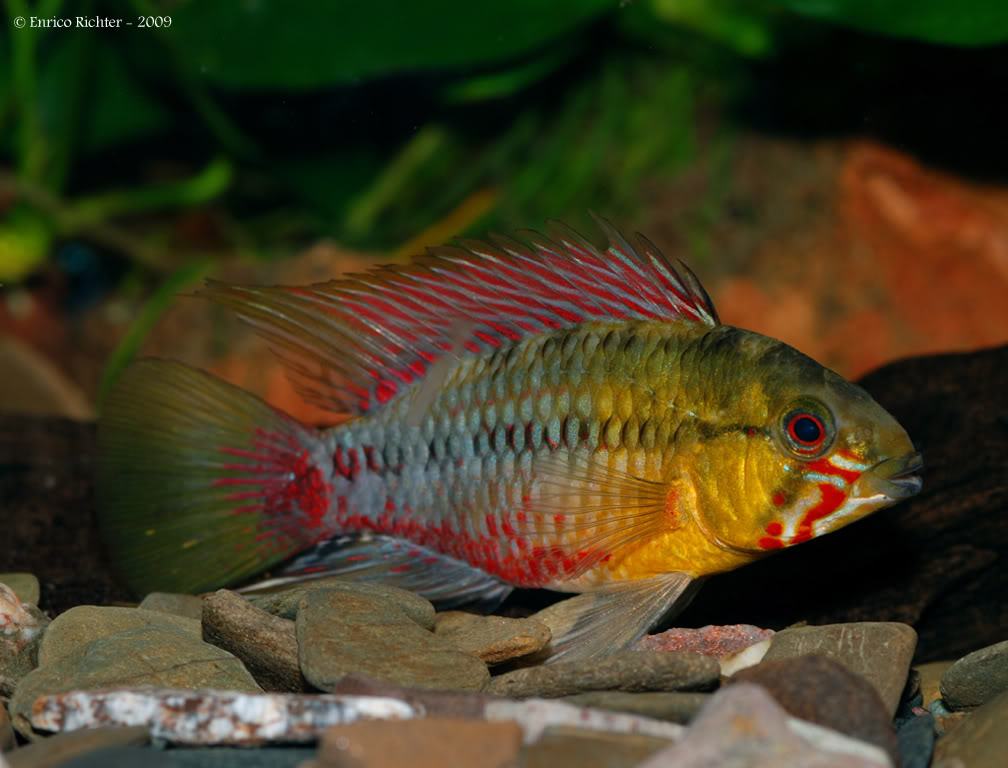
Apistogramma hongsloi
Cichlidae · Kullander, 1979
The genus Apistogramma is among the most speciose of South American cichlid genera with around 70 species valid at present but many more awaiting description. In addition many species exist in two or more geographical colour forms which may or may not turn out to be distinct in the future. Hobbyists tend to label these with collection data if available in order to avoid mixing them and the potential of hybridisation.
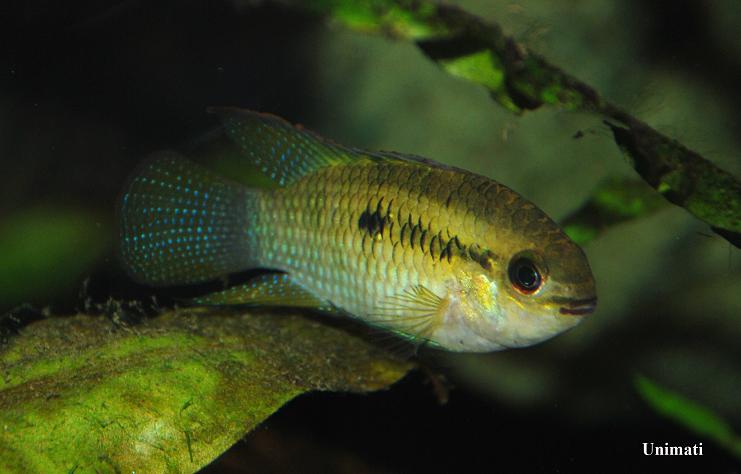
Laetacara curvicepsDwarf Flag Cichlid
Cichlidae · Ahl, 1924
Native to the lower Amazon river basin in Brazil with some populations exhibiting differences in colour pattern to one another, particularly in respect of the degree of red and blue pigmentation on the body and fins. Type locality is given simply as 'Amazon River, Brazil'. Field observations suggest it to display a pref...
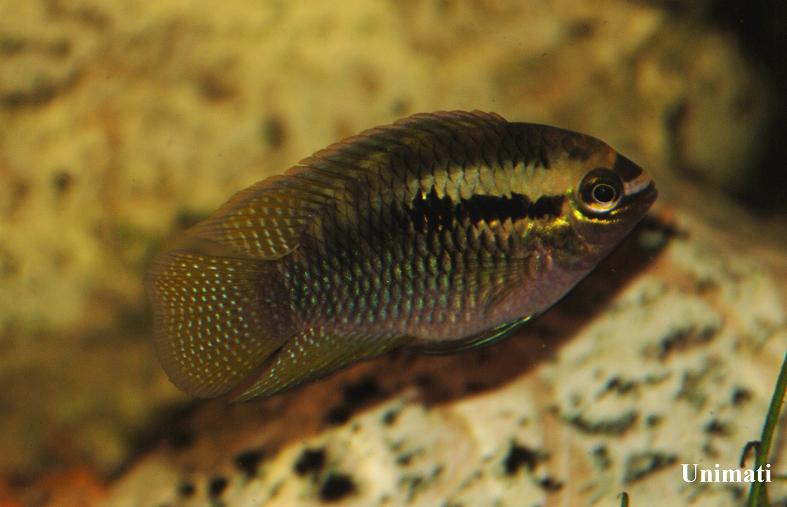
Laetacara dorsigeraRedbreast Acara
Cichlidae · Heckel, 1840
Wild fish are probably foragers feeding on algae, organic detritus, small insects, worms, crustaceans, and other zooplankton. In the aquarium it's easily-fed but the best condition and colours offer regular meals of small live and frozen foods such as bloodworm, Daphnia, and Artemia, alongside good quality dried flakes and granules, at least some of which should include additional plant or algal content.
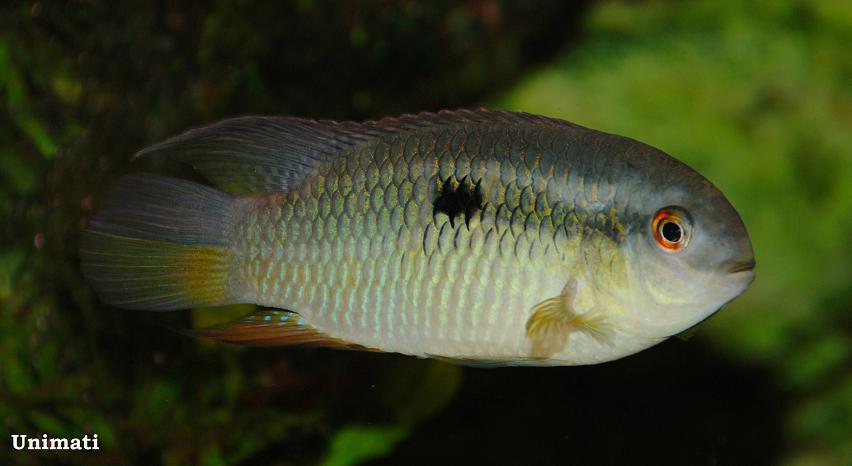
Laetacara fulvipinnis
Cichlidae · Staeck & Schindler, 2007
Has been collected from habitats containing clear, soft, acidic, tea-coloured blackwater, most typically among leaf litter or submerged vegetation in very shallow (10-50 cm depth) water along the margins of streams and other minor tributaries. At a village called El Niñal close to the mouth of the rio Pasimoni in the Casiquiare drainage pH was...
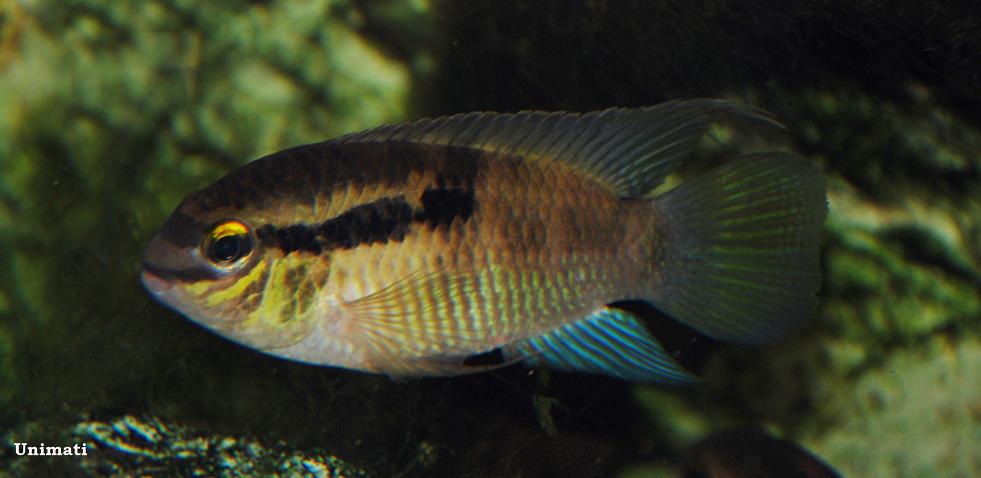
Laetacara thayeri
Cichlidae · Steindachner, 1875
This species is relatively rare in the aquarium trade. It can be differentiated from all congeners by a combination of possessing ctenoid (vs. cycloid) scales on the sides of the head plus lacking a dark spot at the caudal-fin base.
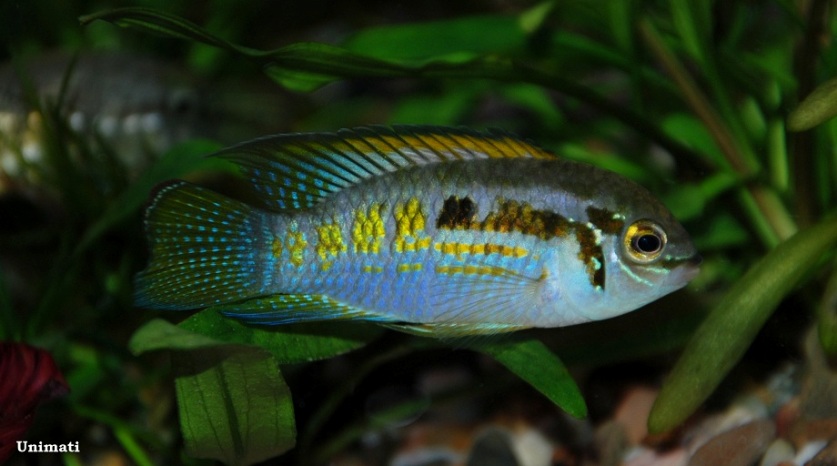
Laetacara araguaiae
Cichlidae · Ottoni & Costa, 2009
This species was known as L. sp. 'Buckelkopf' in the aquarium hobby prior to publication of its official description. It's distinguished from all congeners by possessing 7-8 dorsal-fin rays (vs. 9–10 in L. dorsigera, L. fulvipinnis and L. thayeri, 8–9 in L. curviceps and L. flamannellus, and 9–11 in L. flavilabris).
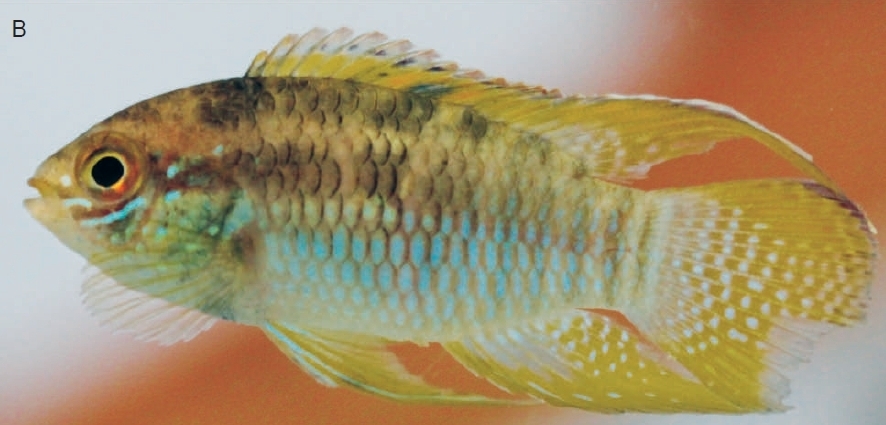
Laetacara flamannellus
Cichlidae · Ottoni, Bragança, Amorim & Gama, 2012
Sympatric fish species in the grasslands include Rivulus schuncki, juveniles of Hoplerythrinus unitaeniatus and an unidentified Nannostomus sp. One contrasting locality was a flowing igarapé with the fish collected from shallow water alongside Apistogramma gossei, Crenicichla inpa,unidentified...
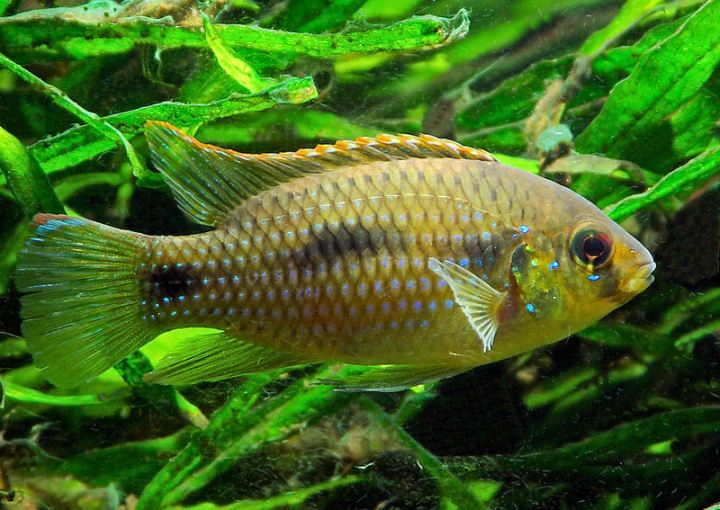
Anomalochromis thomasiAfrican Butterfly Cichlid
Cichlidae · Boulenger, 1915
Often overlooked when seen for sale, as juveniles can appear a little dull, A. thomasi is actually one of the best choices for the newcomer to dwarf cichlids. It is relatively undemanding, peaceful, easily bred and quite beautiful once settled into the aquarium. The species is currently monotypic, although several colour forms are available from time to time. In the future some or all of these may prove to be distinct species....
Apistogramma alacrinaRedspot Dwarf Cichlid
Cichlidae · Kullander, 2004
This species differs from all other described members of the genus by the presence of dark blotches at the dorsal and ventral base of the pectoral fins. Three very similar-looking fishes have been assigned the codes A106, A107 and A108 under the DATZ system and are also known in the aquarium hobby as A. sp. 'rotpunkt' (this form has been in the hobby for decades with its precise origin unclear), A. sp. 'rotpunkt Orteguazas' (the paratype form of A. alacrina) and A. sp. 'rotpunkt Guayas', respectively. It remains to be seen whether they're conspecific with A. alacrina or not since they exhibit some differences in colour pattern and morphology.
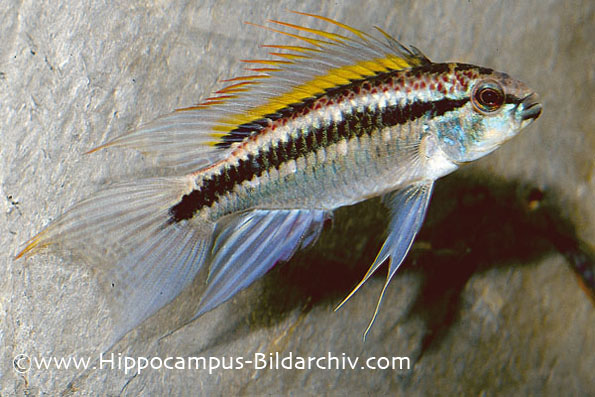
Apistogramma bitaeniataTwo-Striped Dwarf Cichlid
Cichlidae · Pellegrin, 1936
Localities known in the hobby include 'Pastaza', 'Putumayo', 'Requena', 'Río Nanay', 'Rio Napo', 'Maniti', 'Momón', 'Río Tigre', 'Río Ampiyacu', 'Shishita', 'Shushupi', 'Yavari', 'Tefé', 'Manaquiri', 'Lago do Januari', 'Mamori' (often misspelled 'Mamuri'), 'Careiro', 'Manacapuru', 'Juruá', 'Curuaí', and 'Purutu' though we've been unable to find anywhere matching the latter name within the species' known distribution, and in fact several of these names are applied incorrectly on a regular basis.
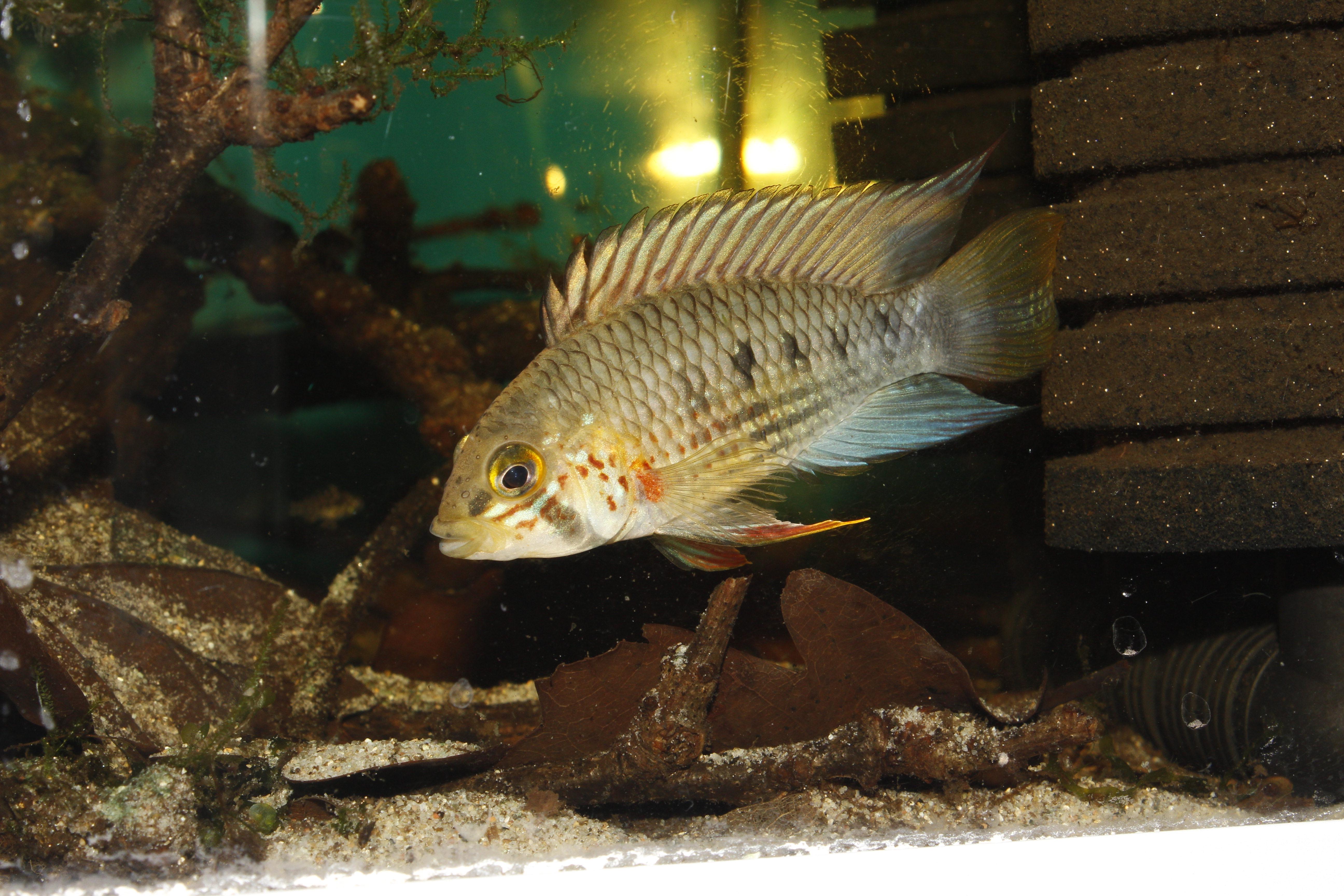
Apistogramma cinilabraAsh Lipped Apisto (A80)
Cichlidae · Romer, Duponchelle, Diaz, Davilla, Sirvas, Catchay and Renno, 2011
Apistogramma cinilabra
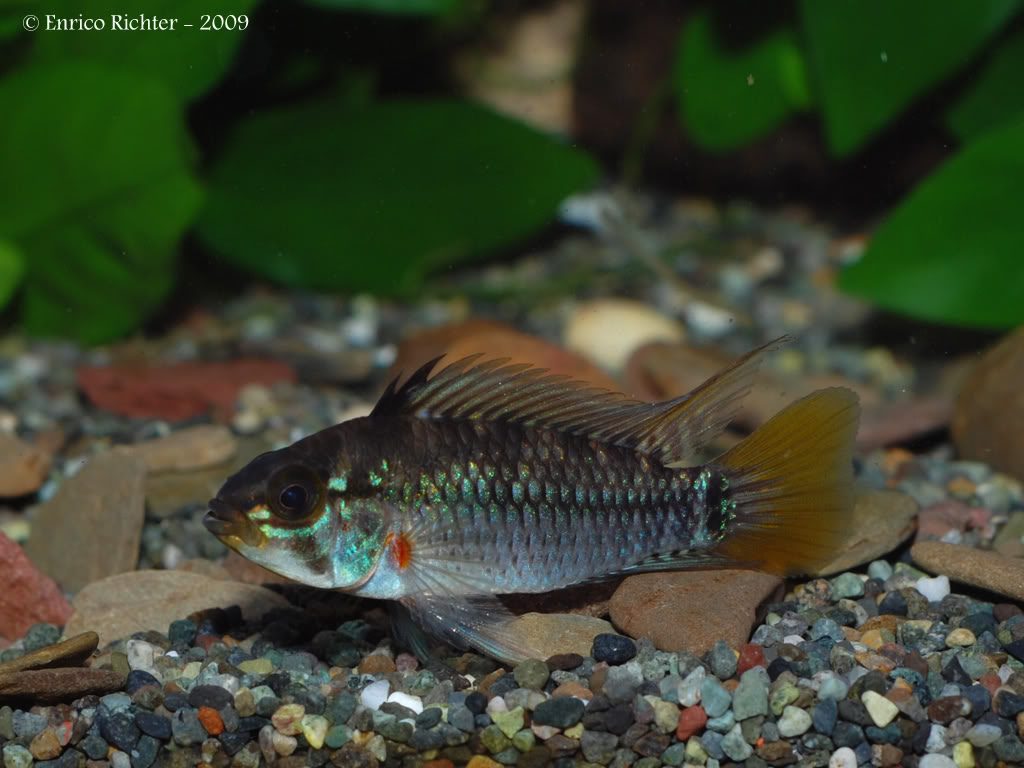
Apistogramma eunotus
Cichlidae · Kullander, 1981
The genus Apistogramma is among the most speciose of South American cichlid genera with around 70 species valid at present but many more awaiting description. In addition many species exist in two or more geographical colour forms which may or may not turn out to be distinct in the future. Hobbyists tend to label these with collection data if available in order to avoid mixing them and the potential of hybridisation.
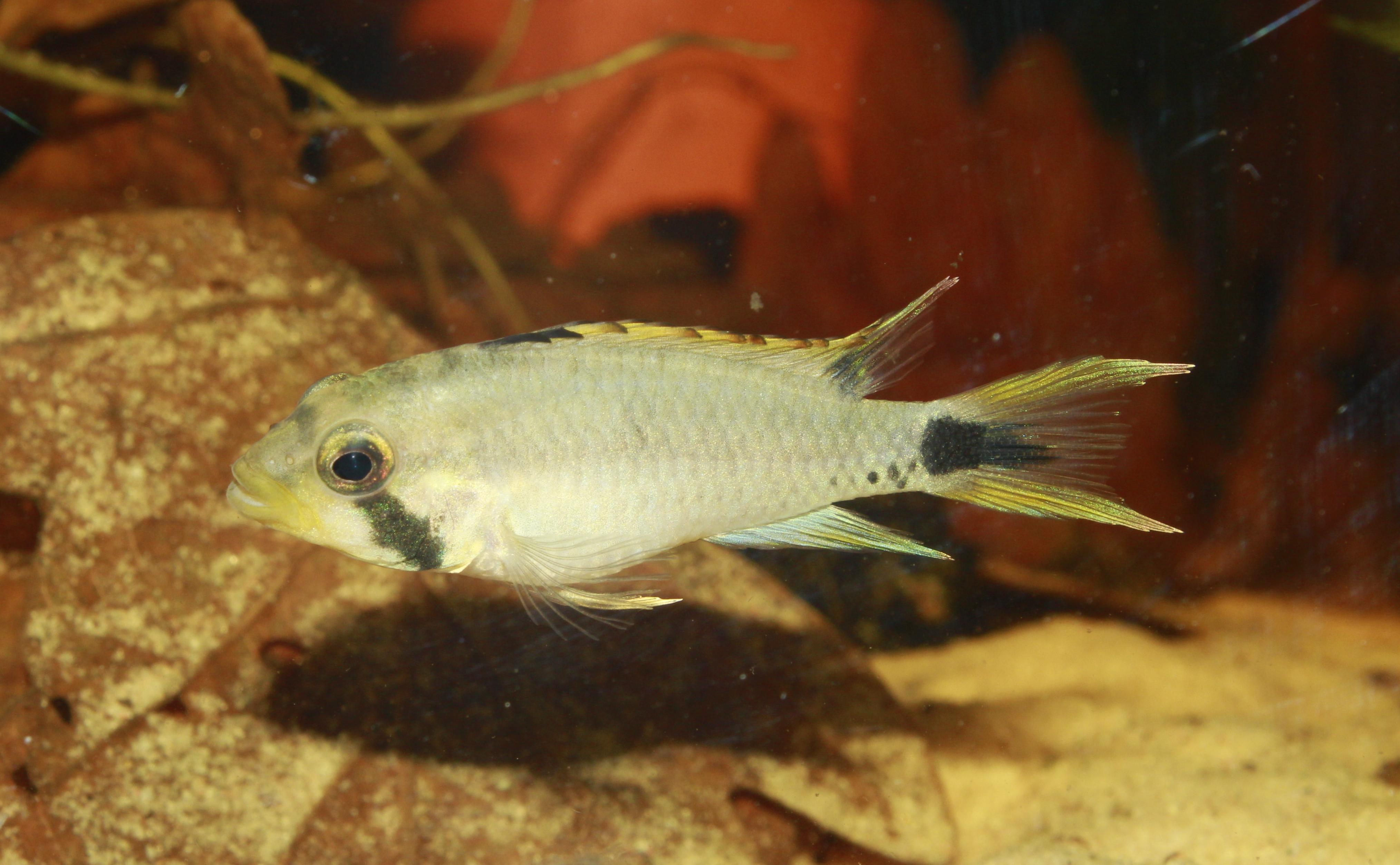
Apistogramma pantaloneA186
Cichlidae · Romer, Romer, Soares & Hahn, 2006
Apistogramma pantalone
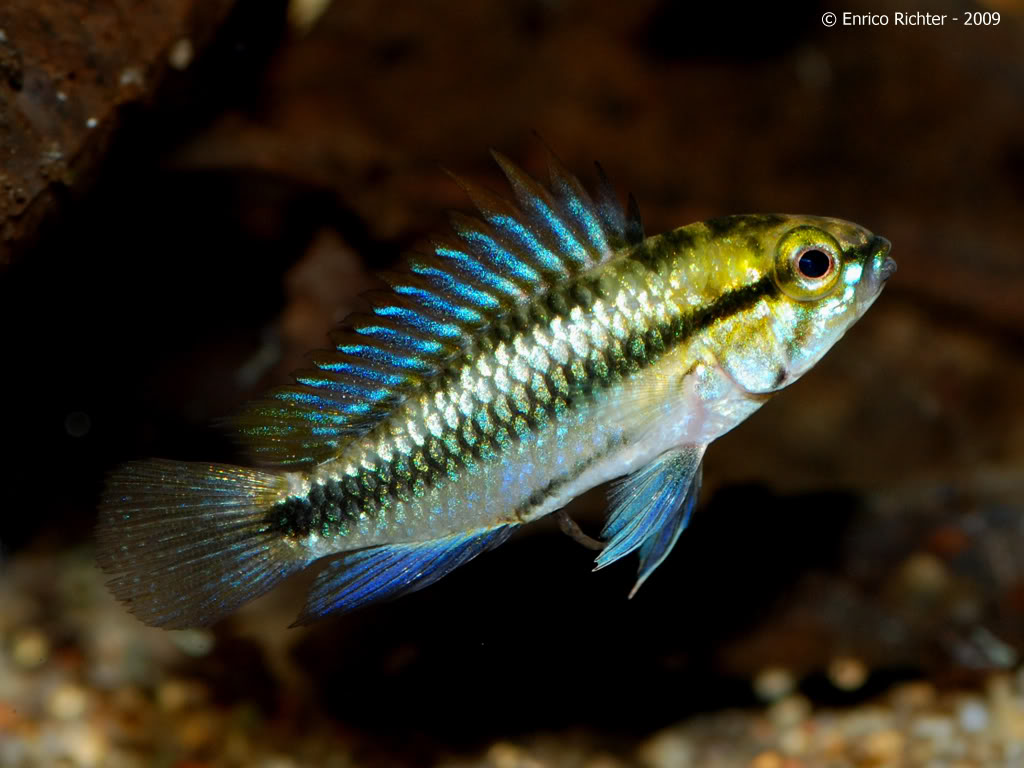
Apistogramma trifasciataThree-striped Apisto
Cichlidae · Eigenmann & Kennedy, 1903
This species is assigned the 'A' number A204 under the DATZ system with possibly conspecific, related forms coded A205 or A206 depending on collection locality and representing populations from Argentina and the rio Guaporé, respectively. The genus Apistogramma is among the most speciose of South American cichlid genera with around 70 species valid at present but many more awaiting description.
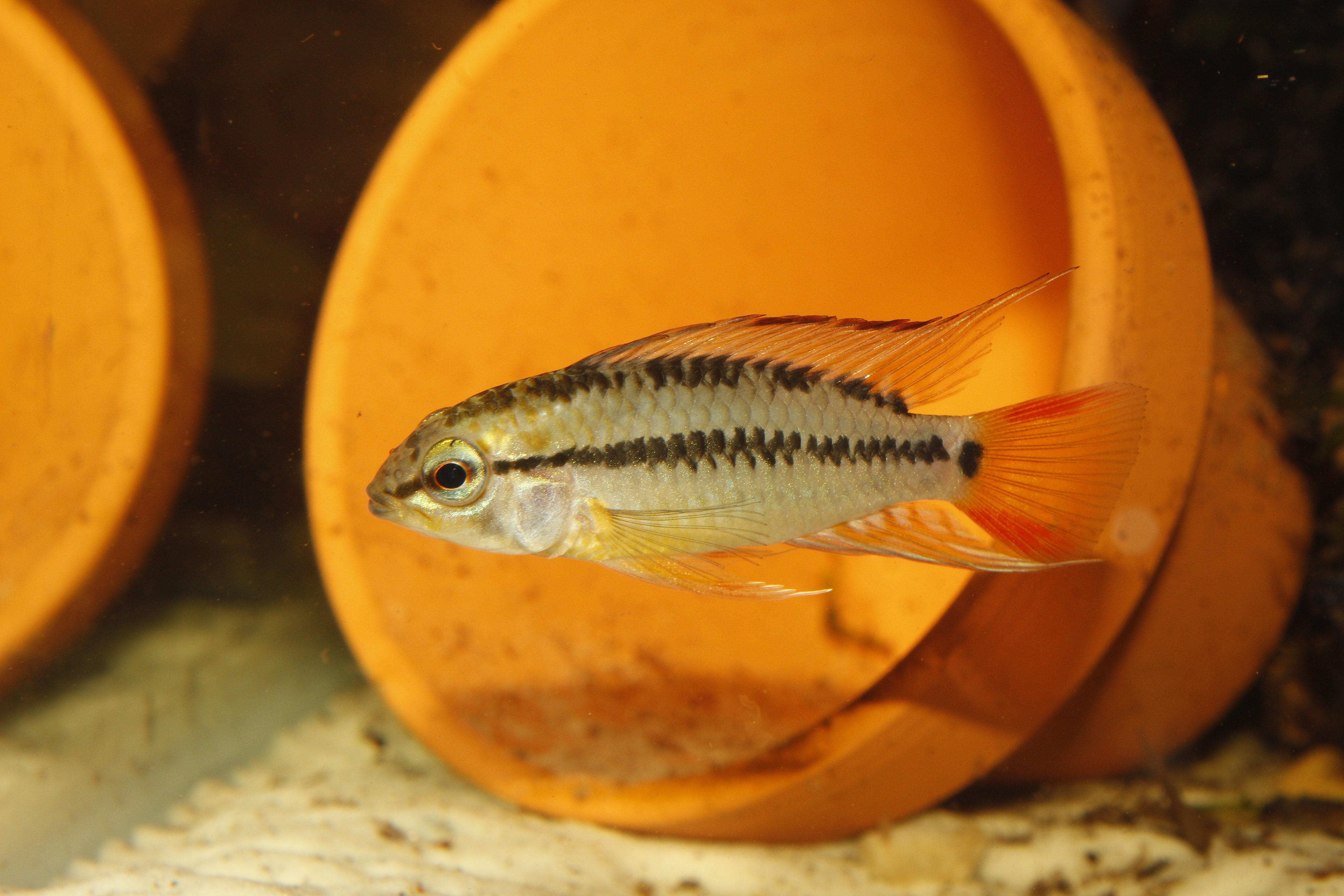
Apistogramma viejitaRed Edge Apisto
Cichlidae · Kullander, 1979
Apistogramma viejita
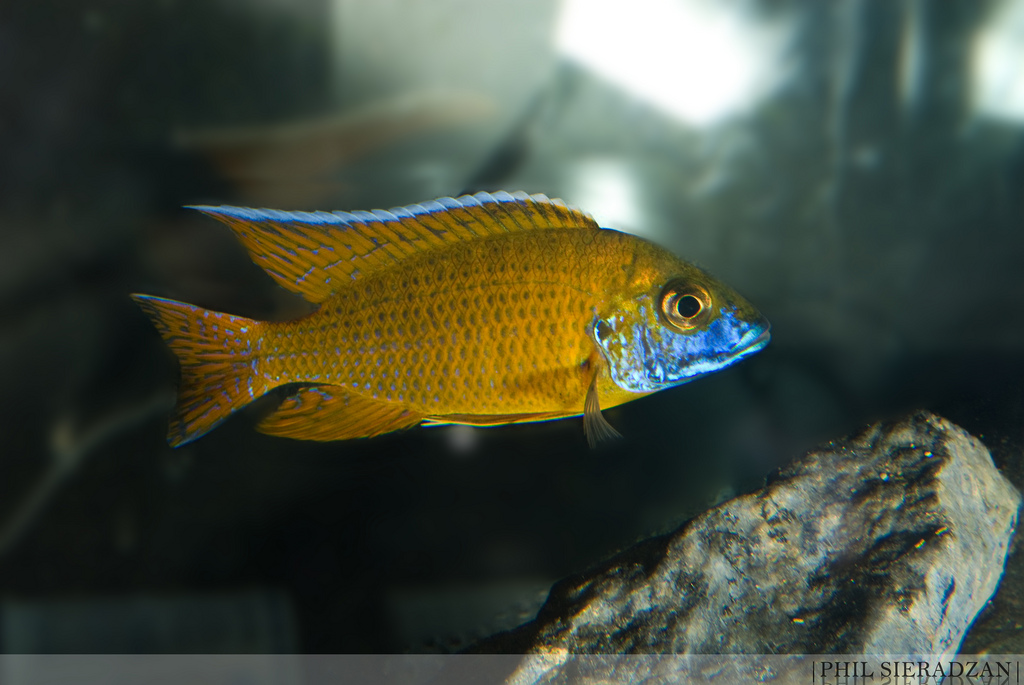
Aulonocara baenschiNew Yellow Regal Peacock
Cichlidae · Meyer & Riehl, 1985
This species may also be sold variously as 'yellow regal cichlid', 'Baensch's peacock', 'sunshine peacock' and 'Nkhomo-Benga peacock'. The easiest way to distinguish it from similar-looking congeners is to look at the profile of the snout, which is steeper and more curved than that of its congeners. Aulonocara spp. are benthophagous by nature employing a method of feeding whereby mouthfuls of substrate are taken and sifted for edible items with the remaining material expelled via the gills and mouth. They're equally-skilled at hunting as grazing, tending to hover above the substrate until tiny movements are detected, and possess enlarged sensory pores on the head which assist in this technique.
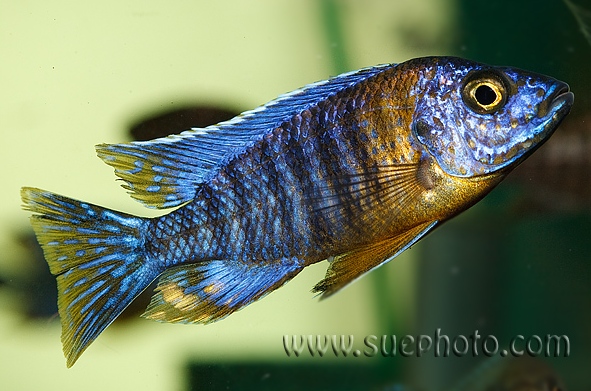
Aulonocara hansbaenschiRed Shoulder Peacock
Cichlidae · Meyer, Riehl & Zetzsche, 1987
Some eminent authors believe this species to be a geographical variant of the highly variable congener A. stuartgranti rather than a distinct taxon but since most popular resources continue to view it as valid we also list it here. At Masinje it has been observed to show a distinct preference for rocky caves and crevices in relatively shallow (3-6 metres deep) water. This is in contrast to most other members of the genus, which tend to forage over sand, but similar to behaviour seen in A. jacobfreibergi.
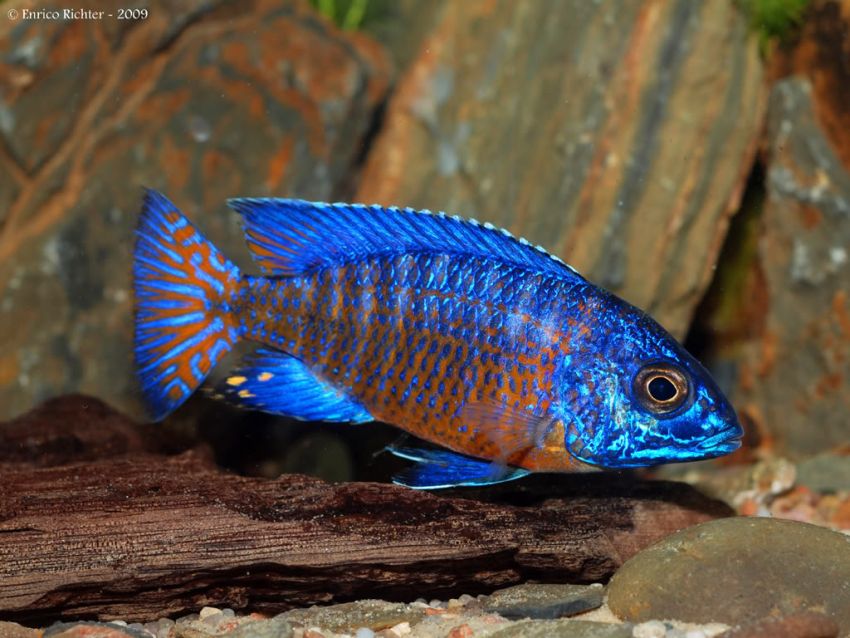
Aulonocara stuartgrantiGrant's Peacock
Cichlidae · Meyer & Riehl, 1985
Males of this species occur in a wide range of colour forms depending on locality, with blue variants being found predominantly (but not exclusively) towards the north of the lake and yellow in the south. This variation, alongside its relatively extensive distribution, has resulted in some taxonomical issues, several of which have not yet been resolved. For example, two forms from the southwest of the lake are referred to as A. sp. "stuartgranti maleri" and A. sp. "stuartgranti mbenji", respectively, and may turn out to be distinct species given their colour patterns an...
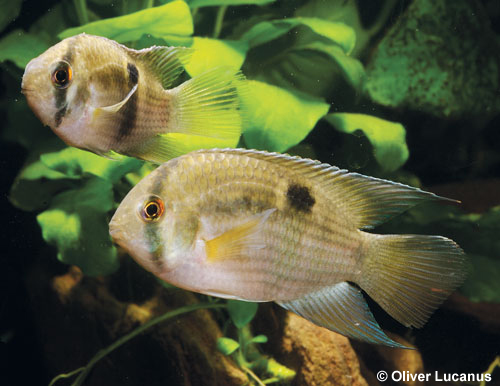
Cleithracara maroniiKeyhole Cichlid
Cichlidae · Steindachner, 1881
This species can be told apart from relatives by the characteristic 'keyhole' shaped marking on each side of the body. It's one of few fishes in which the current generic name is derived from the common name popularised in the aquarium hobby with 'Cleithracara' a combination of the Greek kleithron, meaning lock, and, acará, the Guaraní word for cichlids.
Gnathochromis permaxillaris
Cichlidae · authority not recorded
This species was originally classified in the genus Limnochromis. There are a couple of colour morphs available and these should not be mixed in aquaria, as they may hybridise. In nature, this fish feeds in a similar way to Geophagus species, in that it will sift sand through its gills to extract invertebrates hidden in the substrate. It is a deep water fish and has been recorded foraging at depths of up to 200 metres. These movements seem to be related to the presence of the plankton on which...
Hemichromis bimaculatusJewel Cichlid
Cichlidae · authority not recorded
Not recommended for the beginner or for the general community tank, despite often being sold as such. The Jewel Cichlid is regularly seen in the trade. Recently, Hemichromis lifalili has become the more popular fish. These species can be easily distinguished as H. lifalili have only 2 black spots on the flanks whereas H. bimaculatus has 3, having an extra spot on the caudal peduncle....
Hemichromis lifaliliBlood-Red Jewel Cichlid
Cichlidae · authority not recorded
Often confused with Hemichromis bimaculatus. These species can be easily distinguished as H. lifalili have only two black spots on the flanks whereas H. bimaculatus has three, having an extra spot on the caudal peduncle. It can also be told apart from the similar red form of H. guttatus by comparing the midlateral markings of the two. In lifalli the marking is round and is situated above the lateral line. In guttatus the marking is oval in shape and some of it extends below the lateral line. ...
Herichthys pearsei
Cichlidae · authority not recorded
Like many cichlids, members of the genus Herichthys share something of a confused taxonomic past. Erected in 1854 with H. cyanoguttatus the type species, its members were moved into Cichlasoma by Regan in 1905. However following a review of Cichlasoma by Kullander in 1983 it was once again deemed valid. In 1996 Kullander suggested Herichthys should only contain species "sharing a colour pattern of short vertical bars or black spots posteriorly from the middle of the side, and a unique breed...
Heros efasciatusSeverum
Cichlidae · authority not recorded
The severum is one of the most poular and readily available cichids in the hobby, however not everyone realises that these fish can attain a fairly large size and are therefore not suitable for every aquarium. The fish is normally sold in the standard green variety and also gold. Severums make good fish for a South American community setup, as long as there are no fish small enough for them to eat. They grow quite quickly, so should be housed in an adequately sized tank from the start....
Hypselecara temporalisChocolate Cichlid
Cichlidae · authority not recorded
Test
Lamprologus kungweensisOcellated Shell-dweller
Cichlidae · authority not recorded
L. kungweensis can be distinguished from similar species such as L. hecqui by the gold colour on the top of the eye. It also has a distinctive black spot towards the back of the dorsal fin. It is not often seen in the hobby....
Melanochromis lepidiadaptes
Cichlidae · authority not recorded
This species was originally sold as M. fuscus and then M. sp. "lepidophage. The name refers to the act of lepidophagy, which is the act of a fish eating the scales of another fish. In nature M. lepidiadaptes apparently lives an opportunistic lifestyle, feeding almost solely on the scales of other species, although interestingly not other mbuna. However in aquaria this behaviour has never been witnessed. Do not keep it with other Melanochromis species as they may hybridise....
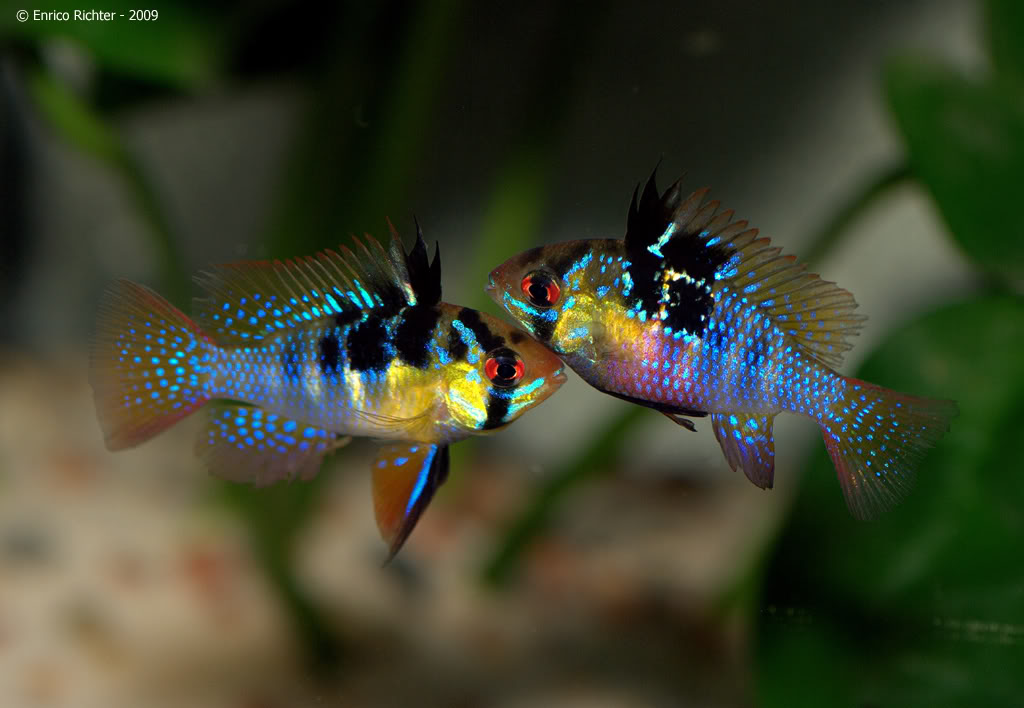
Mikrogeophagus ramireziRam
Cichlidae · Myers & Harry, 1948
M. ramirezi is also known by the names 'Ramirez' dwarf cichlid' and 'butterfly cichlid' and is among the more popular dwarf cichlids in the aquarium hobby. As a result, it is produced on a commercial basis in huge numbers and a number of ornamental strains have been developed including 'gold', 'long-finned' (both blue and gold forms; also traded as 'lyre-tail', 'veil-tail' and 'hi-fin'), 'electric/neon blue', 'super neon blue gold' 'pearl/perlmutt' and 'balloon'.
Nannacara taeniaStriped Dwarf Cichlid
Cichlidae · authority not recorded
Nannacara taenia is rarely seen for sale in local aquatic stores. Largely, because it is a fairly unremarkable fish, tending towards a drab brown appearance. You are more likely to obtain this fish through specialist cichlid dealers or amateur enthusiasts....
Otopharynx lithobatesSulphur-headed Hap
Cichlidae · authority not recorded
O. lithobates is a true rock dweller and is hardly ever seen in open water, even in aquaria. In fact, the scientific name lithobates literally translates as "rock dweller". Breeding males of this species rank among the most stunning of Lake Malawi Haplochromine cichlids. The three characteristic spots on the flanks disappear and are masked by a stunning neon blue patterning. Almost the entireand top of the head turn a deep yellow-orange colour. The most colourful variant is the "...
Parachromis motaguensisFalse Yellowjacket Cichlid
Cichlidae · authority not recorded
Parachromis Motaguensis are a truly stunning fish. They exhibit gorgeous colours, but can be a nightmare to keep. Do not even consider housing any other fish with Motaguensis when they are breeding, as the other fish will be hurt - even if significantly bigger than the pair of False Yellowjackets. Motaguensis make a nice addition to a big central/north American cichlid tank, with similarly aggressive fish - but be careful that you don't choose a compatible pair of Motaguensis or you wil...
Paratilapia polleni
Cichlidae · authority not recorded
Now the only species in the genus Paratilapia, P. polleni is known as the "marakely" to many natives in Madagascar, which means "black fish". As with most Madagascan cichlid species, it is highly endangered in the wild due to habitat destruction and competition from introduced species and all attempts at captive breeding are to be encouraged. There is still some confusion as to the identity of the "true" P. polleni as there are both large and small-spotted forms...
Placidochromis milomoSuper VC 10 Hap
Cichlidae · authority not recorded
Wild caught specimens of this fish possess a truly amazing set of lips! They are massively enlarged and designed for scraping algae and invertebrates from rock surfaces. In nature, these actually develop in direct proportion to the amount of turbidity in a given locality. Fish inhabiting more turbulent waters have larger lips, as the algae in these areas is anchored to the rocks more firmly. In the aquarium, the lips usually recede or, in tank bred fish, do not develop at all, as they are not re...
Protomelas taeniolatus
Cichlidae · authority not recorded
One of the more popular and readily available Protomelas species in the hobby, P. taeniolatus is very similar to P. fenestratus. Several colour forms of both these species exist. Some of the popular morphs of taeniolatus include "Red Empress", "Super Red Empress" and "Blue Fire". It is likely that some of these may be reclassified as distinct species in the future, as they attain different maximum sizes. None of these related species or morphs should be kept togethe...
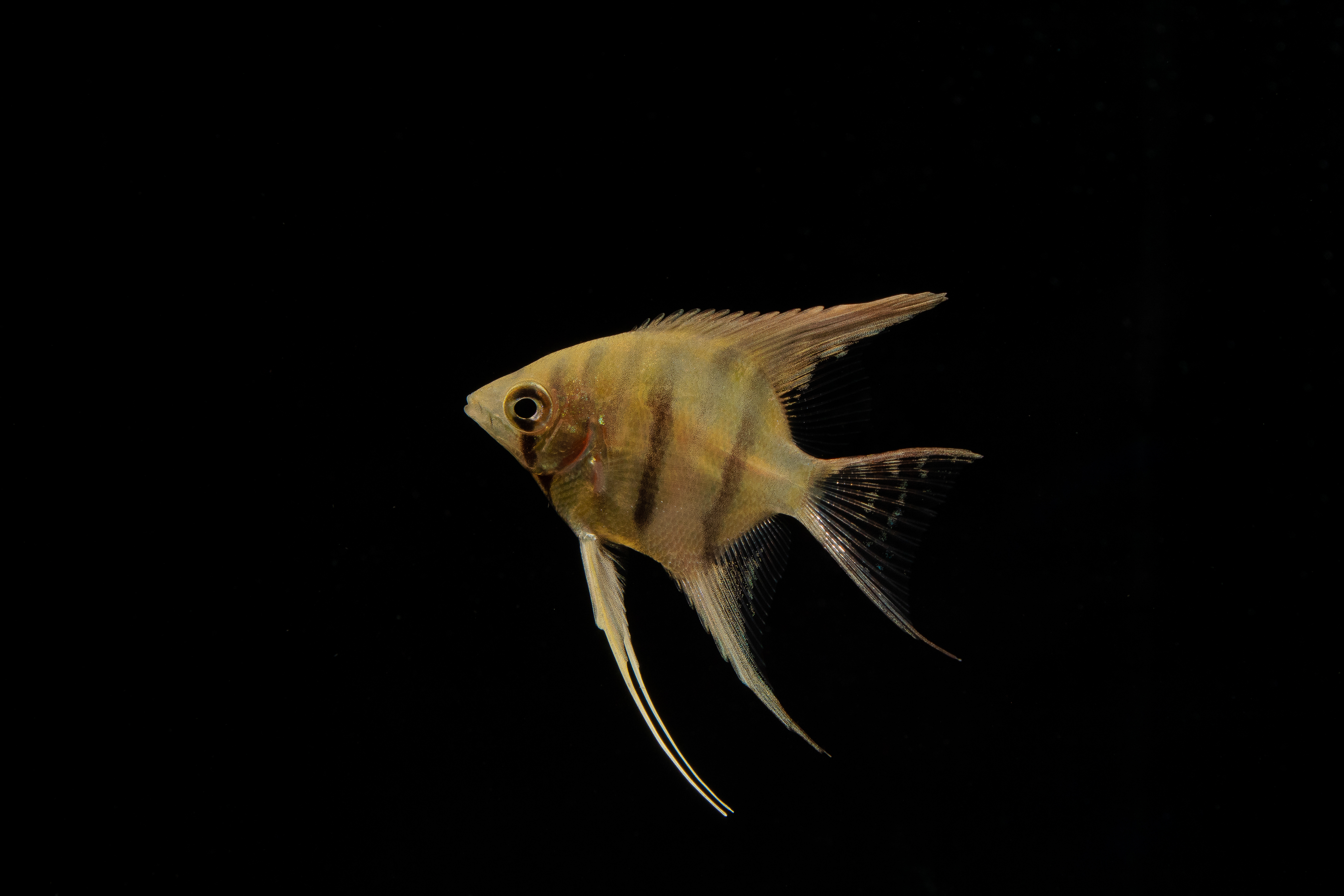
Pterophyllum leopoldiRoman Nose Angelfish
Cichlidae · Gosse, 1963
Pterophyllum leopoldi can be differentiated from other members of the genus by the presence of up to 11 vertical stripes on the body, though often only the 3 largest, boldest stripes can be seen. This species also shows a dark patch over the operculum. In adult specimens, a red/maroon hue over the back and fins is characteristic of the species, leading some to believe the most colourful natural form Angelfish. The name-sake roman nose possessed by the fish is also very distinctive and used as a meristic feature.
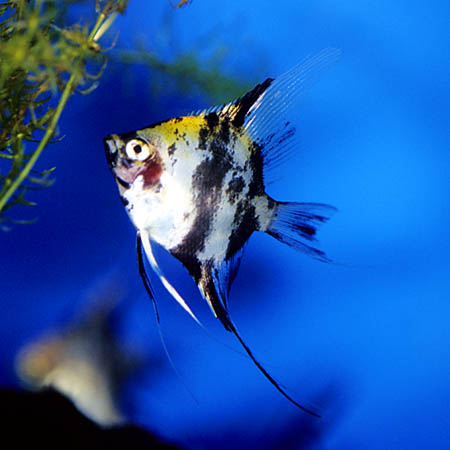
Pterophyllum "scalare"Angelfish
Cichlidae · authority not recorded
A well known and popular aquarium fish. Angels are available in a number of colour forms including black, gold and koi strains, in addition to the standard silver. It is worth remembering that although angels are generally peaceful, they are still cichilds so some aggression should be expected from time to time.
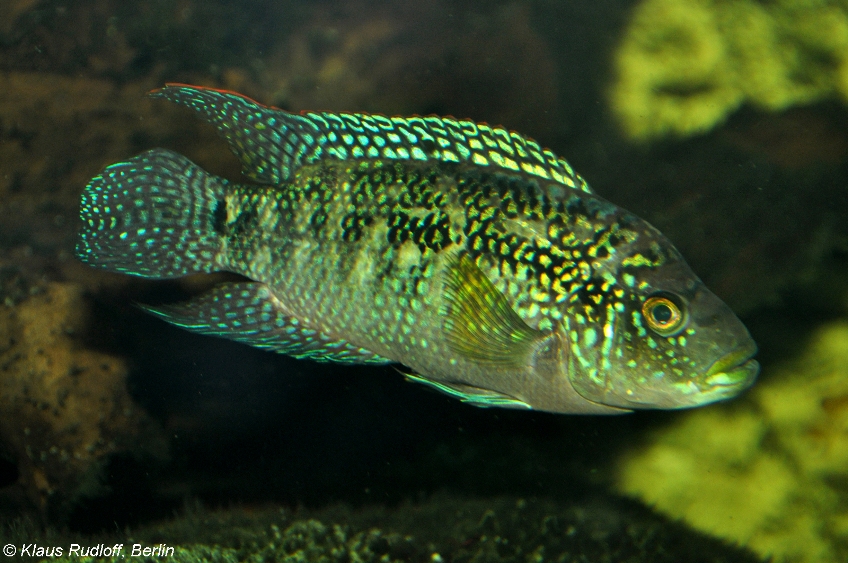
Rocio octofasciataJack Dempsey Cichlid
Cichlidae · Regan, 1903
A bright blue variant normally referred to as 'electric blue Jack Dempsey' or simply 'EBJD' is of unclear origin but it appears to be an ornamental strain fixed from a natural mutation. Care is as per the natural form although the blue fish tend to remain smaller and some reports suggest them to be less aggressive. R. octofasciata has a confusing taxono...
Steatocranus casuariusBlockhead Cichlid
Cichlidae · authority not recorded
An easily kept cichlid whose character more than compensates for its somewhat drab colouration, S. casuarius is sometimes seen for sale as "Humphead", "Lionhead" or "Buffalohead" cichlid. It is a reophilic fish meaning it inhabits fast waters. Its swimbladder is modified to reduce buoyancy and thus prevent it from being swept away by the strong currents in it's natural habitat. In the aquarium it spends most of it's time resting on the substrate or hiding ...
Tramitichromis intermedius
Cichlidae · authority not recorded
Sand dwelling Malawian cichlid species such as this can be somewhat delicate in the aquarium. A rigorous tank maintenance schedule is recommended to keep them in top shape; with small, regular partial water changes a necessity. Also take care with feeding as discussed above. It is likely this species will eventually be assigned to a different genus, as there is some confusion surrounding Tramitichromis and it's scientific validity. The fish included in the genus differ from Lethrinops sp...
Vieja maculicaudaBlackbelt Cichlid
Cichlidae · authority not recorded
The Blackbelt Cichlid gets its name from two things: firstly the vertical black stripe around its flank, and secondly its toughness. Vieja maculicauda is a tough, aggressive fish and should be respected as such. Maculicauda is a relatively easy fish to keep. They are not impossible to breed, but not the easiest fish either. If you seriously intend to breed this fish, it is a wise decision to house 6 juvenile fish in a large tank (212 litres at least), and let them pair off. When a pair has be...
Xenotilapia melanogenysBlack-Chinned Xenotilapia
Cichlidae · authority not recorded
This fish feeds in a similar way to Geophagus species in that it will sift sand through its gills to extract invertebrates and morsels hidden in the substrate. It was until recently classified in the genus Enatiopus and is still named as such in much of the available literature. There are slight geographical variations in colour but these are not major. Interestingly, the shoals in which these fish live in nature appear to be fixed. That is, that an individual will remain in the same group for ...
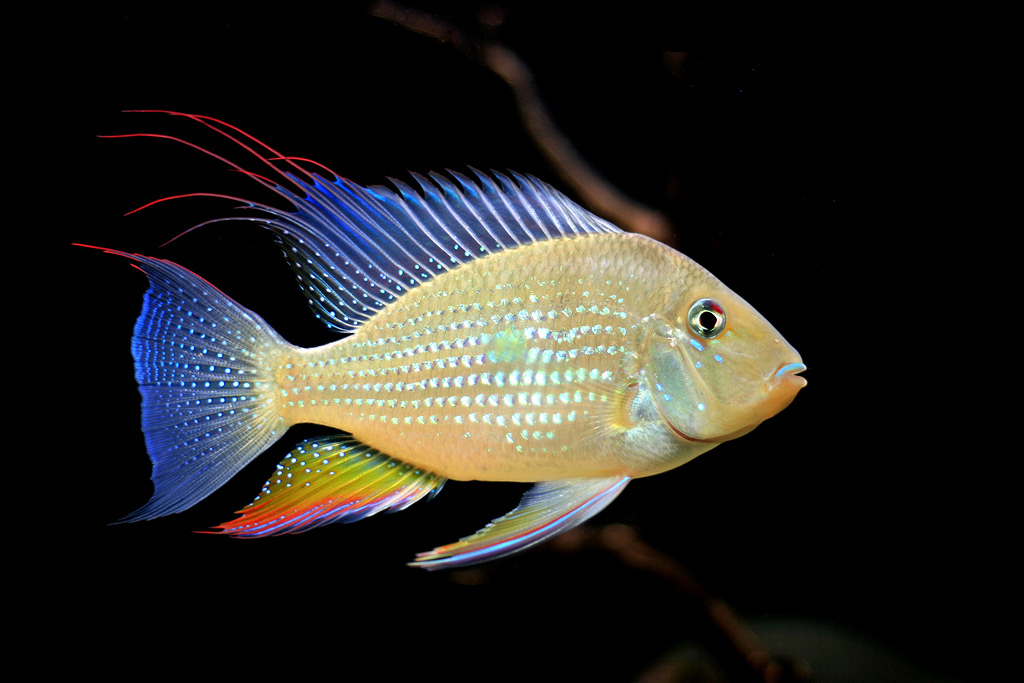
Acarichthys heckeliiThreadfin Acara
Cichlidae · Müller & Troschel, 1849
The genus Acarichthys remains monotypic and was resdescribed by Kullander (1986) who characterised it by the following: lack of epibranchial lobe; comparatively few (12-14)rays; pelvic fins with relatively broad tips (branches of the first ray are equal in length or the inner is slightly longer); possession of a single supraneural plus 14-15 vertebrae (these characters taken as a combination); no caudal extensions to swim bladder; no caudal ribs. Its current taxonomic position is based largel...
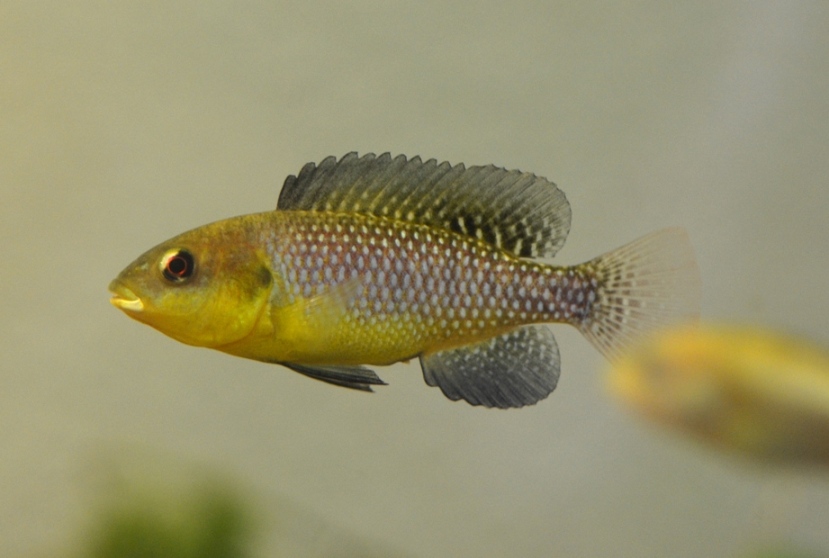
Alcolapia alcalicaSoda Cichlid
Cichlidae · Hilgendorf, 1905
This cichlid is a true wonder of nature. It lives in a soda lake which is full of hot, alkaline springs. The water contains a high concentration of sodium carbonate and other dissolved minerals and salts. The water conditions in the lake are typically pH 9.5-10.5, kH 7000+ and temperature 90-110°F! The water also has a sg reading of 1.2+ and is very shallow, having a maximum depth of only 2 metres. The fish can be acclimatised to more 'normal' conditions but the pH should not be al...
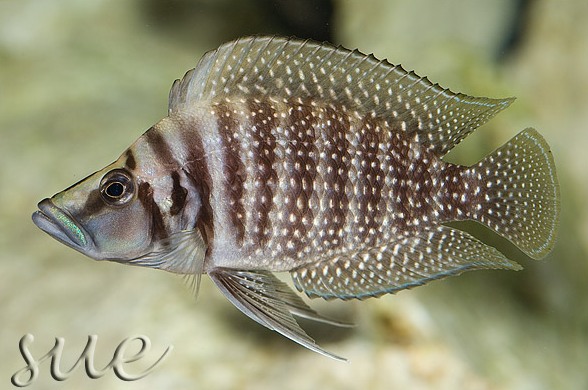
Altolamprologus calvusCalvus Cichlid
Cichlidae · Poll, 1978
A. calvus is a predator by nature and its body shape has been adapted to allow it to enter small crevices and gaps in the rockwork of Lake Tanganyika to prey on eggs, fry and small fish. Its laterally compressed shape makes the fish hard to spot head on, giving it an advantage over would be predators and prey alike. It is also quite well-armoured, possessing thick scales which can be turned towards potential attackers. These can cause real damage with their serrated edges. Several colour form...
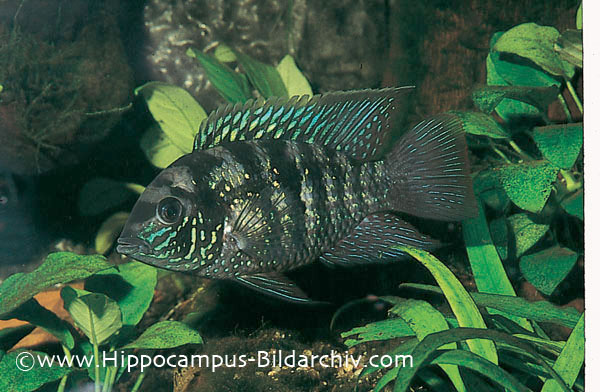
Andinoacara pulcherBlue Acara
Cichlidae · Gill, 1858
This species was previously known as 'Aequidens' pulcher but has been considered s member of the genus Andinoacara since 2009.
Julidochromis ornatusGolden Julie
Cichlidae · authority not recorded
Julidochromis are commonly known as "Julies" in the hobby. This is one of the most common Julie species encountered in aquaria and may also be sold as the Yellow or Ornate Julie. The majority of specimens available are tank bred and do not exhibit as bright colouration as wild fish. As with other Julies, large water changes should be avoided as this can cause mated pairs to turn on one another. Several geographical morphs of this species are available, as is an aquarium sport albino...
Lamprologus ocellatusOcellated Shell-dweller
Cichlidae · authority not recorded
A charming little cichlid with real character, L. ocellatus is a deservedly popular hobbyists' fish. It has an endearing habit of burying its shell and defending it against all-comers. Many an unsuspecting hobbyist has recieved a sharp nip from an ocellatus who feels its territory is being invaded. Neighbouring shells may also be buried to prevent other fish moving in. Koning has hypothesisesd that the burying of the shell and the resultant pile of sand around it not only provides additiona...
Lamprologus signatus
Cichlidae · authority not recorded
Care must be taken when purchasing this species as females look so different to males that the sexes were initially described as separate species!
Lamprologus speciosus
Cichlidae · authority not recorded
This species is very similar to L. ocellatus and often carries the trade name "black ocellatus". It is found living alongside L. stappersi in nature....
Lamprologus stappersi
Cichlidae · authority not recorded
This fish was originally thought to be a morph of L. ocellatus but has now been described as a distinct species. It is still occasionally offered for sale as "pearly ocellatus" and may also be seen under the invalid name L. meleagris....
Nanochromis nudiceps
Cichlidae · authority not recorded
This species is rarely imported. It is easily confused with N. parilus but can be distinguished by the fact that male fish lack the barring seen in the upper part of the of parilus and have dark edges to the scales on the body. Females can be distinguished by the spotting in the lower part of the caudal, which is unpatterned in parilus. We do not recommend this species to the beginner due to its very specific water and care requirements....
Nanochromis parilus
Cichlidae · authority not recorded
N. parilus is one of the commoner Nanochromis in the hobby as it is more easily collected from its natural waters than most species. It is easily confused with the less often seen N. nudiceps but can be distinguished by the fact that male fish exhibit a barred patterning inn the upper half of the which is not present in nudiceps. Females can be distinguished by the unpatterned lower part of the caudal, which is spotted in nudiceps. There are a couple of geographical variants available. We do ...
Nanochromis transvestitus
Cichlidae · authority not recorded
One of our favourite dwarf cichlids, N. transvestitus is a truly stunning fish when in good condition. However, it is not recommended to the beginner due to its very specific water requirements. The scientific name is derived from the fact that the female is the more colourful fish, making it something of an oddity....
Neolamprologus boulengeri
Cichlidae · authority not recorded
N. boulengeri can be distinguished from the similar N. hecqui and Lamprologus kungweensis primarily by the orange border on the dorsal and anal fins, although its adult patterning is somewhat different to the other species. Unlike many other shell dwellers, it will spawn in small caves if no shells are made available....
Neolamprologus brevis
Cichlidae · authority not recorded
N. brevis is one of the commoner species of shell dweller available in the hobby. Several colour morphs are available including "sunspot", "katabe" and "sambia". As mentioned above, it is often found in areas within Lake Tanganyika where relatively few snail shells collect and in these areas, pairs of fish will share the same shell. This behaviour may or may not be observed in the aquarium, depending on the number of shells provided and the individual fish. The terr...
Neolamprologus helianthusSunflower Lamprologus
Cichlidae · authority not recorded
This stunning species was only described in 1997 and is included in the so-called "Brichardi complex", which also includes N. brichardi, crassus, falcicula, gracilis, pulcher, savoryi and splendens. The species should not be mixed in aquaria as they will hybridise freely. N. helianthus can be distinguished from others in the complex by its overall yellow-orange patterning and v-shaped cheek marking....
Neolamprologus leleupiLemon Cichlid
Cichlidae · authority not recorded
One of the most popular Tanganyikan species in the hobby, N. leleupi is a stunning fish when in good condition. However, it is not as easy to maintain as its popularity suggests, due to its disagreeable attitude towards conspecifics and its sensitivity to deteriorating water conditions. It is a solitary species in nature, with male fish entering females' caves as they find them and spawning with receptive females. This explains the weak pair bond formed by spawning fish in aquaria and also ...
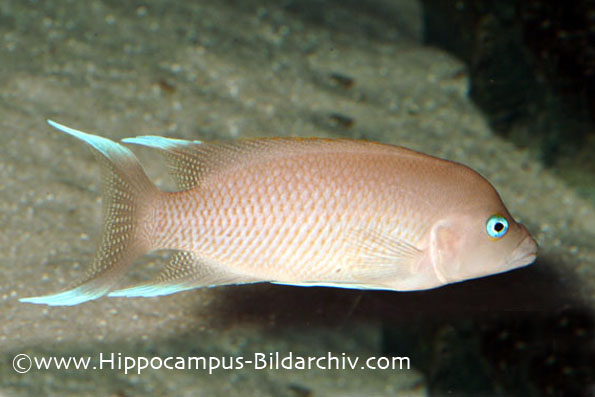
Neolamprologus marunguensis
Cichlidae · authority not recorded
A less often seen but good looking species with a deeply forked tail. It was previously sold as Neolamprologus sp. "walteri".
Neolamprologus multifasciatus
Cichlidae · authority not recorded
This is probably the smallest known cichlid species and exhibits truly fascinating behaviour. The territories it establishes are very small, usually measuring no more than 6" across, but they are defended vigorously. The tiny fish will even bite hands or fingers that invade their 'personal space'! Highly recommended to anyone wishing to observe some unique behaviour on a small scale....
Neolamprologus olivaceous
Cichlidae · authority not recorded
This species is included in the so-called "Brichardi complex", which also includes N. brichardi, crassus, falcicula, gracilis, pulcher, savoryi and splendens. These should not be mixed in aquaria, as they will hybridise freely. N. olivaceouscan be distinguished from others in the complex by the two curved markings on the gill cover. It is possible that it is synonymous with N. pulcher, as proposed by Konings (1993)....
Neolamprologus savoryiStriped Brichardi
Cichlidae · authority not recorded
This species is included in the so-called "Brichardi complex", which also includes N. brichardi, crassus, falcicula, gracilis, helianthus, olivaceous, pulcher, and splendens. These should not be mixed in aquaria as they will hybridise freely. N. savoryi can be distinguished from others in the complex by it's distinctive patterning of vertical bars....
Neolamprologus similis
Cichlidae · authority not recorded
N. similis is one of the less frequently seen shelldwellers in the hobby but has no less personality than its cousins. The territories it establishes are very small, usually measuring no more than 6" across, but they are defended vigorously. The tiny fish will even bite hands or fingers that invade their 'personal space'! It can be distinguished from the similar N. multifasciatus by the presence of additional barring on the head and neck and also in this species the stripes appear...
Pelvicachromis pulcherKribensis
Cichlidae · authority not recorded
One of the most common and popular Cichlid species in the hobby, the vast majority of Kribensis (often simply called "Krib" by many fishkeepers) seen in the hobby today are captive bred and are far more adaptable in terms of water chemistry than the wild fish. They also tend to be less aggressive when breeding. An aquarium sport albino form is available and is fairly popular. This fish is one of the best choices for newcomers to both Cichlids and fish breeding, being of a manageable...
Pelvicachromis subocellatusOcellated Kribensis
Cichlidae · authority not recorded
This is one of the less commonly seen Pelvicachromis species in the hobby. There are a few morphs available, including "Matadi" and "Moanda". Males and females of these should not be cross bred in order to keep the lines pure. It can be distinguished from others in the genus by it's higher, shorter body shape and by the fact that the spotting in the upper part of the is much lighter in this species than in others. A female condition is hard to confuse with anything else....
Pelvicachromis taeniatusStriped Kribensis
Cichlidae · authority not recorded
This stunning species is now much more readily available than it once was. There are over a dozen morphs available, including "Dehane", "Moliwe", "Kienke", "Lobe", "Wouri", "Nigeria Red" and "Calabar". Males and females of these should not be cross bred in order to keep the lines pure. It can be distinguished from others in the genus by the more pronounced upper lip, which is often bright yellow in colour. Males of this spe...
Pseudocrenilabrus multicolorDwarf Egyptian Mouth-brooder
Cichlidae · authority not recorded
This species was one of the first cichlid species to be spawned in captivity and has been in the hobby for over a century. It is less popular than it once was but remains a good choice for the beginner as it is tolerant of a wide range of water conditions and is easily bred. There currently exist 2 subspecies, Pseudocrenilabrus multicolor multicolor and P. m. victoriae. These are quite distinct in terms of colouration and patterning and exist as separate populations in nature. Both subspecie...
Variabilichromis moorii
Cichlidae · authority not recorded
V. moorii exists in several geographical morphs but interestingly the only variation in colour occurs in juvenile fish. All adults exhibit a dark patterning but depending on locality the fry may be dark (like adults), yellow or orange with the yellow and orange juveniles taking on the adult colouration as they mature. It is has been observed that the forms which undergo this colour change may 'plant' broods among fry of other species with similarly coloured young, leaving them to be gu...
Ivanacara adoketaZebra Acara
Cichlidae · authority not recorded
This species was previously included in the genus Nannacara before being moved to the newly-erected taxon Ivanacara by Römer and Hahn (2006)....
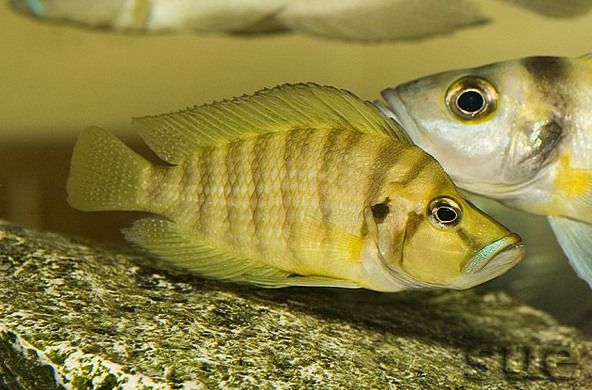
Altolamprologus compressicepsCompressed Cichlid
Cichlidae · Boulenger, 1898
This species varies in colour pattern depending on locality. Some of them are sold under several such names with the variant from Kigoma being known variously as A. compressiceps "Kigoma red", "Kigoma red fin", "Kigoma orange top" or "firefin" for example. The different populations should ideally be kept apart in aquaria and clearly labelled with collection locality in order to avoid hybridisation. Forms popular in the aquarium hobby include: - &quo...
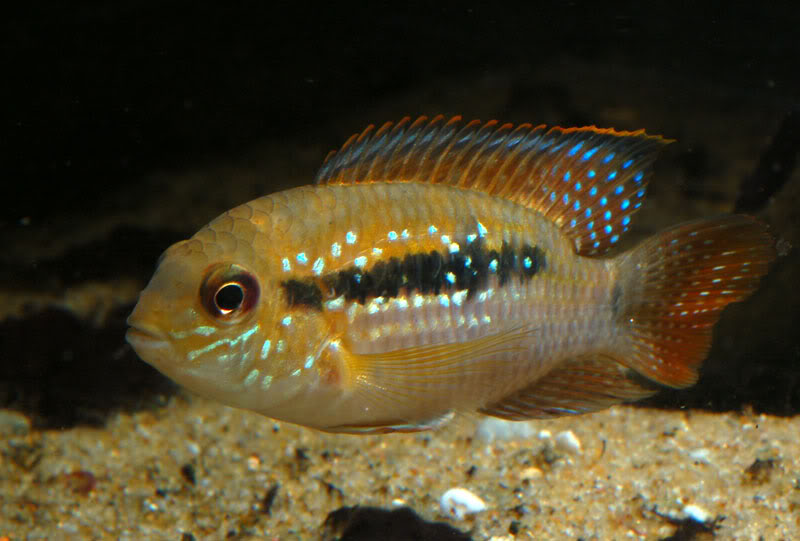
Andinoacara sp. 'Orinoco'
Cichlidae · authority not recorded
This apparently undescribed species was traded as 'Aequidens' sp. 'Orinoco' but following Musilová et al. (2009) appears to be a member of the genus Andinoacara.
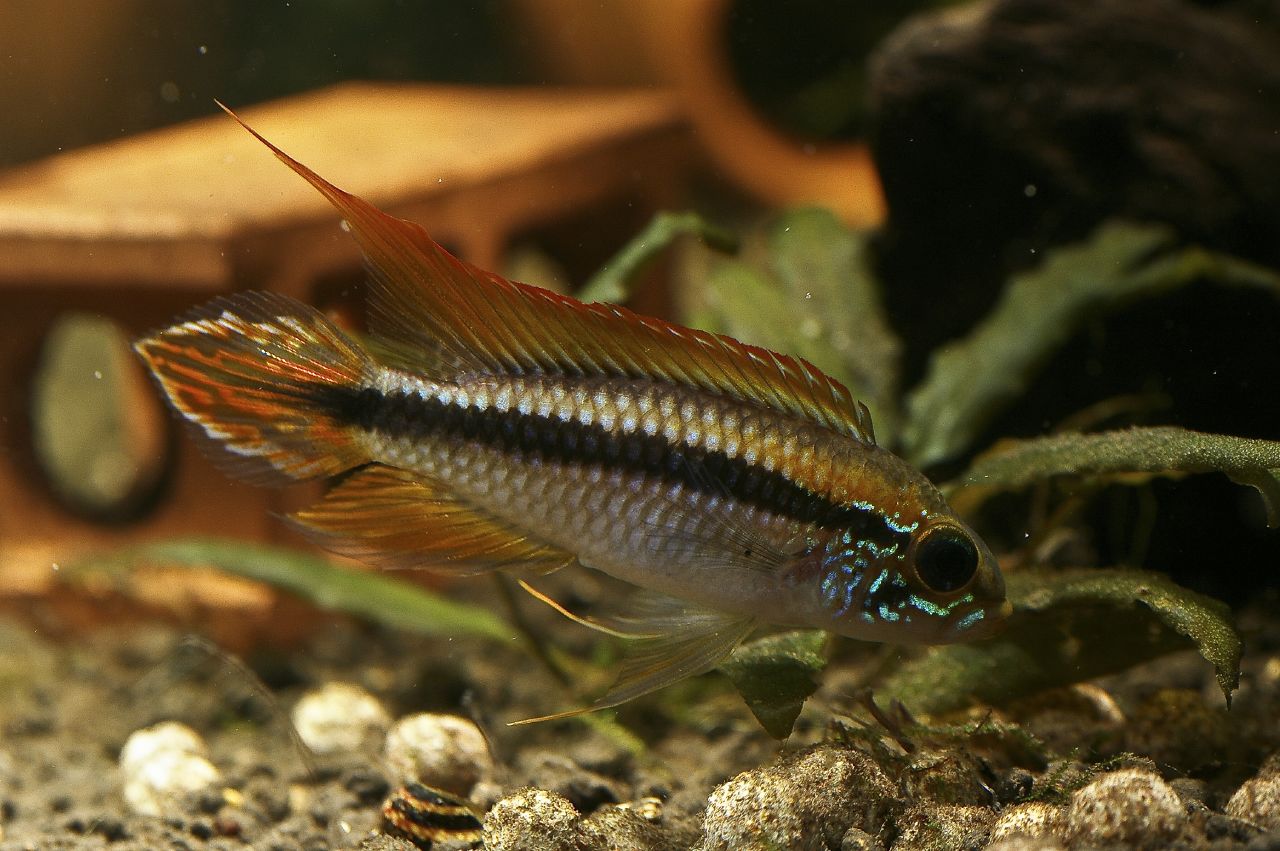
Apistogramma agassiziiAgassizi's Dwarf Cichlid
Cichlidae · Steindachner, 1875
Numerous ornamental forms of this species have been selectively-bred for the aquarium trade, some of which include. It has also been assigned the 'A' number A234 under the DATZ system with possibly conspecific, related forms similarly numbered A235, A236, A237, A238, A239, A240, A241 and A242 depending on locality. The genus Apistogramma is among the most speciose of South American cichlid genera with around 70 species valid at present but many more awaiting description. In addition ...
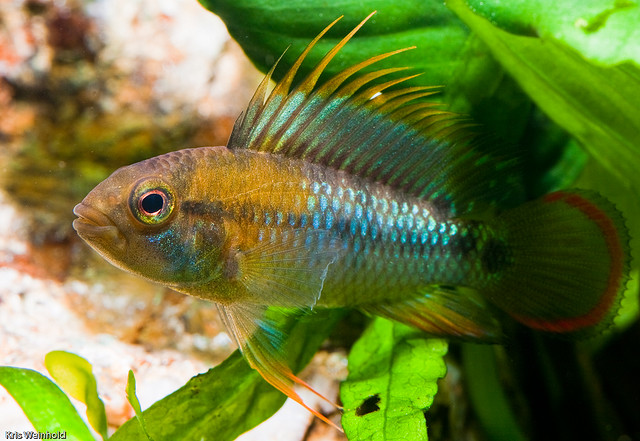
Apistogramma baenschiA188
Cichlidae · Römer, Hahn, Römer, Soares & Wöhler, 2004
This species is assigned the code A188 under the DATZ system and is also known by the trade names A. sp. 'Inca/Inka', A. sp. 'Inka 50', A. sp. 'highfin nijsseni', A. sp. 'Nijsseni 2', A. sp. 'red crescent' or A. baenschi 'Inca'. It's among those members of the genus produced on a commercial basis and is regularly available in the aquarium trade.
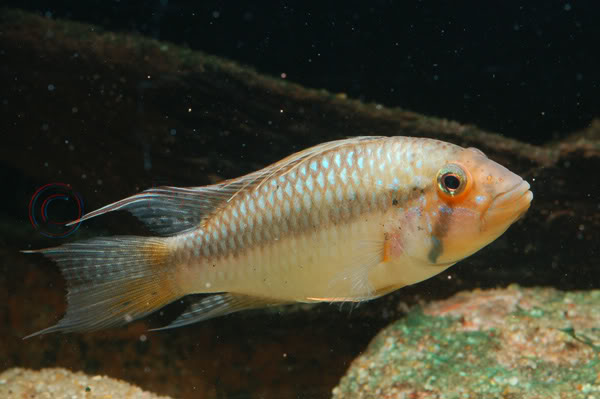
Apistogramma barlowiA174
Cichlidae · Römer & Hahn, 2008
This species has been assigned the code A174 under the DATZ system, and is also known by the trade names A. sp. 'Maulbrüter/mouthbrooder', A. sp. 'Glaser' (these referring to the 'red' colour form) and A. sp. 'Hauswell' (referring to the 'white' colour form). It can be told apart from other members of the genus most eas...
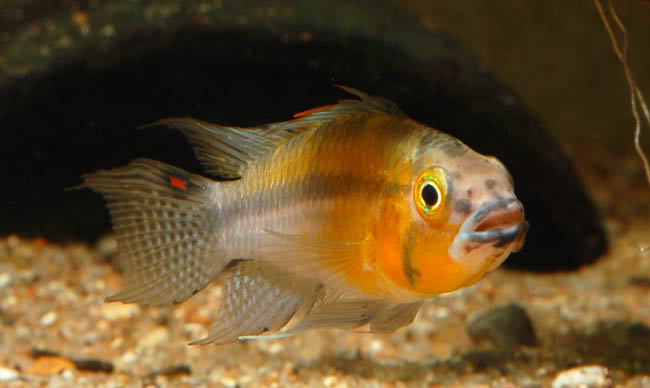
Apistogramma cacatuoidesCockatoo Cichlid
Cichlidae · Hoedeman, 1951
Numerous ornamental forms of this species have been selectively line-bred for the aquarium trade, vernacular names for which include "sunset", "sunburst", "double red", "triple red", "gold", "white gold", "orange flash" and "albino". It has also been assigned the 'A' number A200 under the DATZ system with possibly conspecific, related forms similarly numbered A201, A202 and A203 depending on locality. Th...
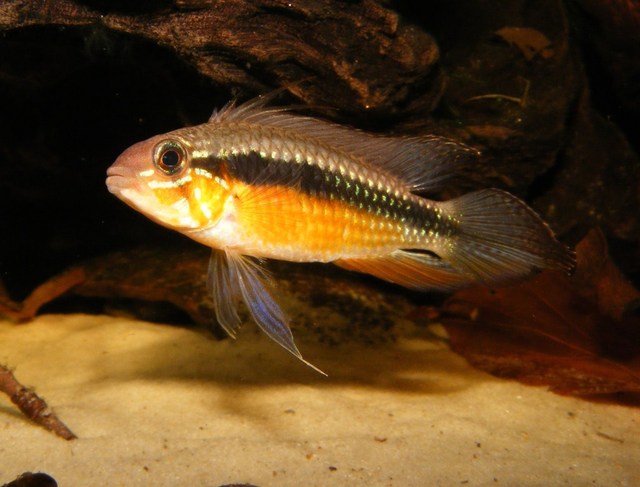
Apistogramma elizabethaeA208
Cichlidae · Kullander, 1980
The form from the rio Içana tends to have more blue markings on the head than that from the Uaupés, while a reddish population apparently collected close to the settlement of Tucana (sometimes mis-spelled 'Tucano') on the Uaupés is sometimes traded as A. elizabethae 'super red'. Apistogramma is among the most speciose of South American cichlid genera with around 70 species valid at present but many more awaiting description.
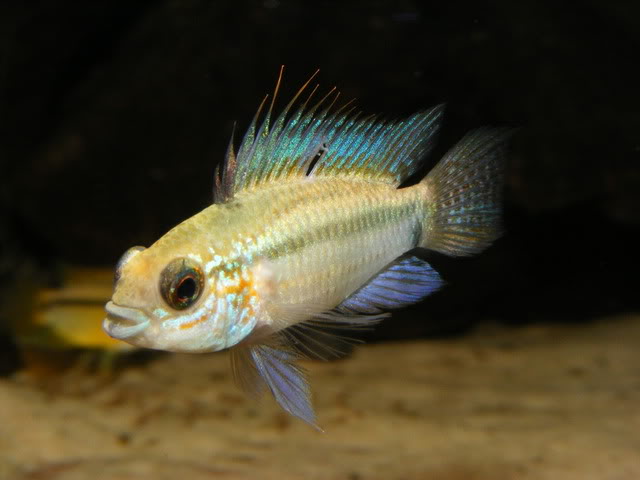
Apistogramma eremnopygeA218
Cichlidae · Ready & Kullander, 2004
Known only from Loreto region in northeastern (Amazonian) Peru. Type locality is 'Río Pintuyacu, 48 kilometers on road from Iquitos to Nauta, Río Itaya drainage, Province Loreto, Peru' and it's also been recorded from tributaries of the Nanay system in the same area. An additional population is known from the Río Tapiche, a tributary of the Río Ucayali located well over 150 km further south.
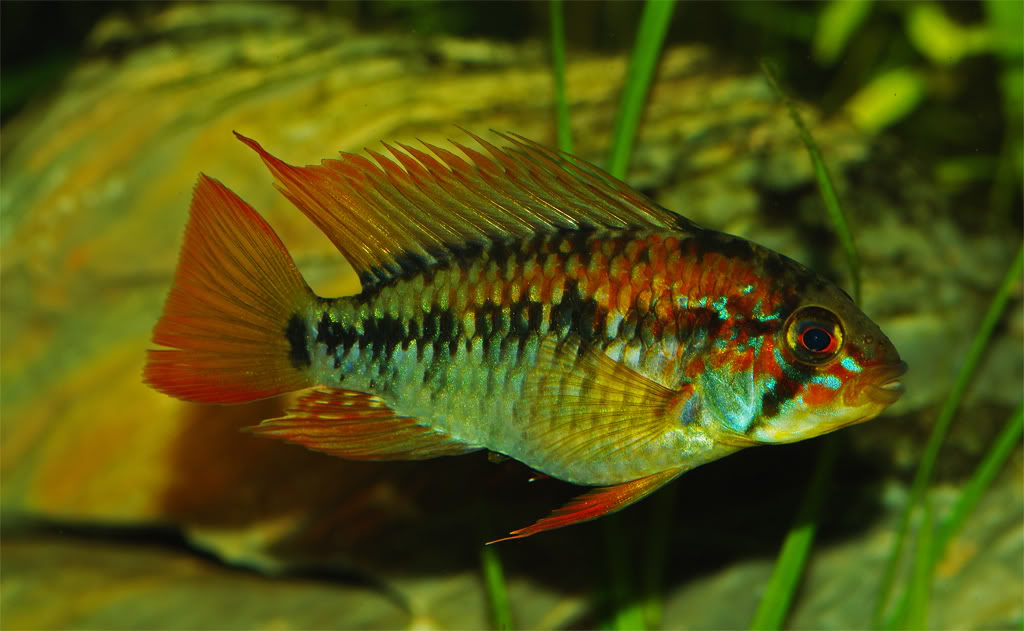
Apistogramma macmasteri
Cichlidae · Kullander, 1979
The genus Apistogramma is among the most speciose of South American cichlid genera with around 70 species valid at present but many more awaiting description. In addition many species exist in two or more geographical colour forms which may or may not turn out to be distinct in the future. Hobbyists tend to label these with collection data if available in order to avoid mixing them and the potential of hybridisation. Member species have also been organised into a series of species lineages, complexes and groups by authors in order to better separate them.
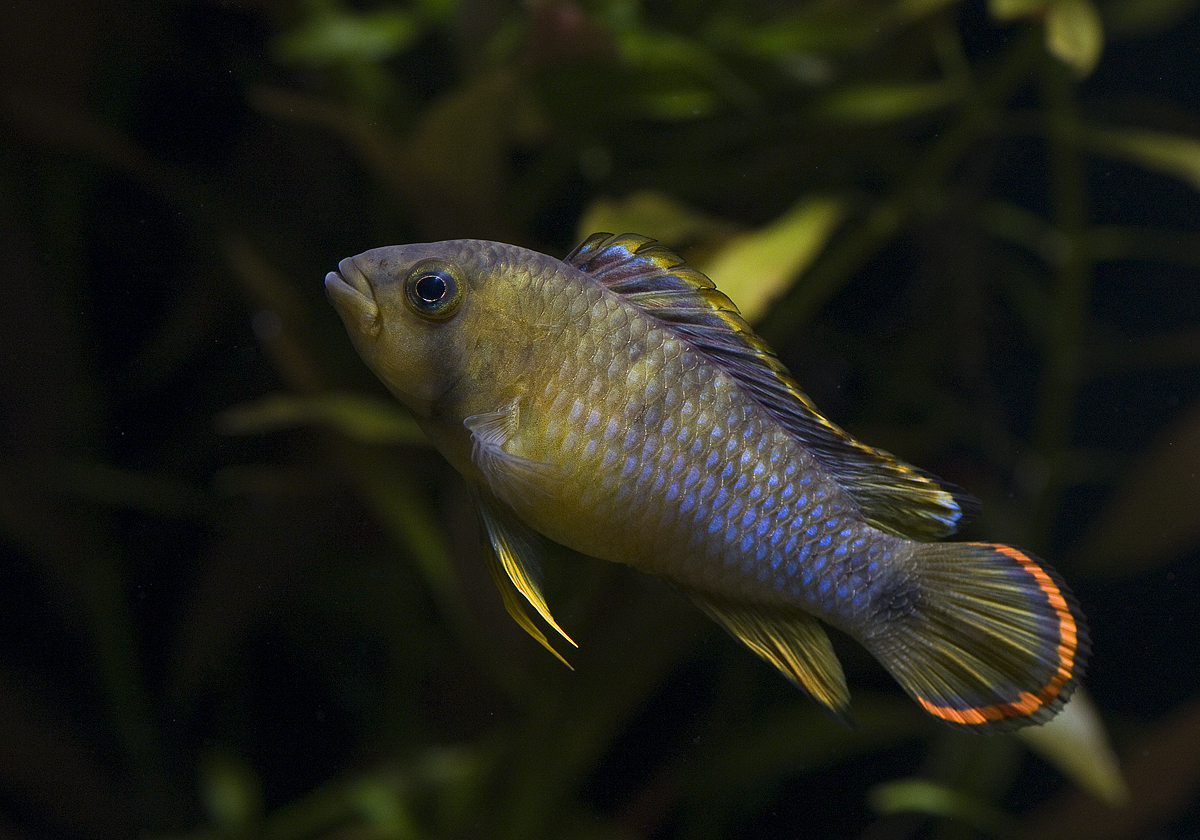
Apistogramma nijsseni
Cichlidae · Kullander, 1979
The genus Apistogramma is among the most speciose of South American cichlid genera with around 70 species valid at present but many more awaiting description. In addition many species exist in two or more geographical colour forms which may or may not turn out to be distinct in the future. Hobbyists tend to label these with collection data if available in order to avoid mixing them and the potential of hybridisation. Member species have also been organised into a series of species lineages, complexes and groups by authors in order to better separate them. Such lists have been augmented by fish that have appeared in the aquarium trade and are in a state of near-constant flux
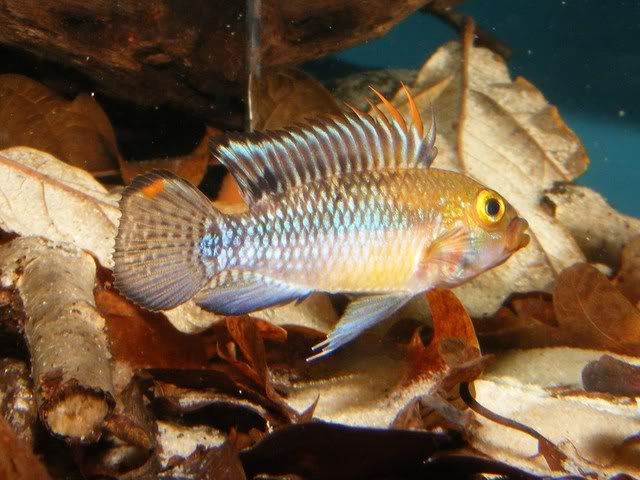
Apistogramma norberti
Cichlidae · Staeck, 1991
Prior to decription this species was known as A. sp. 'großmaul' or 'bigmouth', and it has also been assigned the code A190 under the DATZ system. The genus Apistogramma is among the most speciose of South American cichlid genera with around 70 species valid at present but many more awaiting description. In addition many species exist in two or more geographical colour forms which may or may not turn out to be distinct in the future. Hobbyists tend to label these with collection data if available in order to avoid mixing them and the potential of hybridisation.
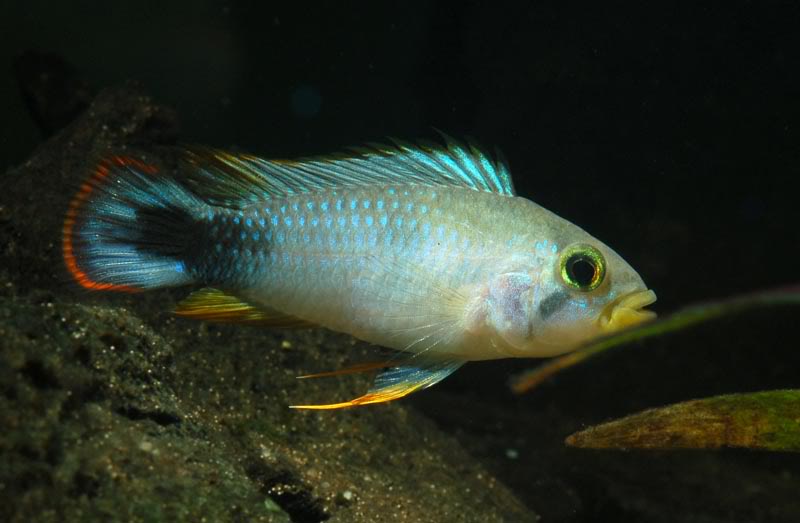
Apistogramma panduro
Cichlidae · Römer, 1987
This species is also known by the alternative vernacular names 'blue panda cichlid', 'blue sky dwarf cichlid and 'azure cichlid' as well as the confusing trade name A.sp. 'pandurini'. It has also been assigned the 'A' number A183 under the DATZ system with possibly conspecific, related forms similarly numbered A184 or A185 depending on locality. It can be distinguished from similar-looking species by the length of the lower jaw which characte...
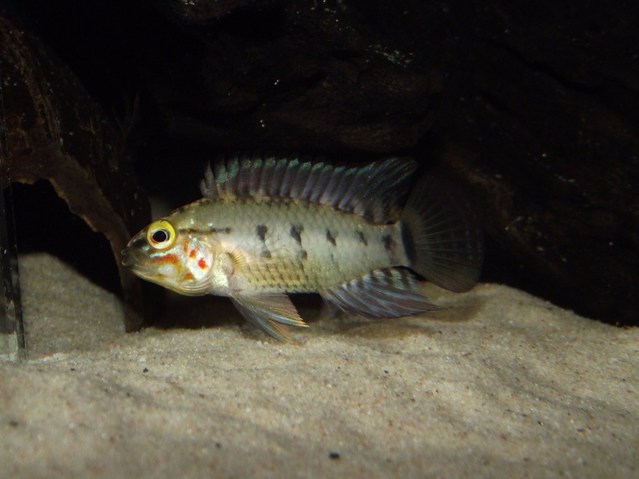
Apistogramma paulmuelleriA52
Cichlidae · Römer, Beninde, Duponchelle, García Dávila, Vela Díaz & Renno, 2013
This species is assigned the code A52 under the DATZ 'A' number system and is also known by the trade names A. sp. 'Apache', A. sp. 'Peru (II)', A. sp. 'Peru-regani', A. sp. cf. regani (Belém) and A. sp. 'carapintada'. Apistogramma is among the most speciose of South American cichlid genera with around 70 species valid at present but many more awaiting description. In addition many species exist in two or more geographical colour forms which may or ma...
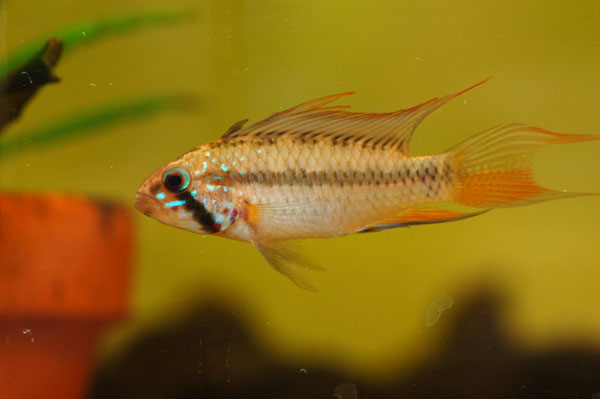
Apistogramma sp. 'breitbinden'A164
Cichlidae · authority not recorded
The German term 'breitbinden' translates literally as "broad-banded" and refers to the uniformly broad suborbital stripe seen in males of this 'species' which remains undescribed despite being known in the aquarium hobby for several decades. It's often imported as bycatch among shipments of wild-collected A. iniridae. Some of the populations have also been assigned th...
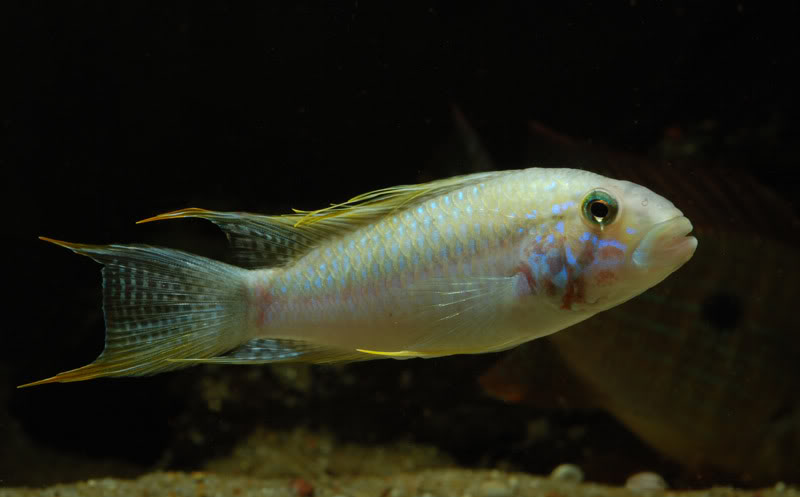
Apistogramma sp. 'Kelleri'
Cichlidae · authority not recorded
This undescribed species was first collected and subsequently appeared in the aquarium hobby during 2008. It was exported again in late 2009 and early 2010 under the names A. sp. 'Jutai' and A. sp. 'diamond face', and said to have been collected in the Río Jutai, Amazonas state, Brazil. The Jutai is a south bank tributary of the Solimões but lies several hundred kilometres downstream of Leticia so this information, from a purportedly trustworthy source, initiall...
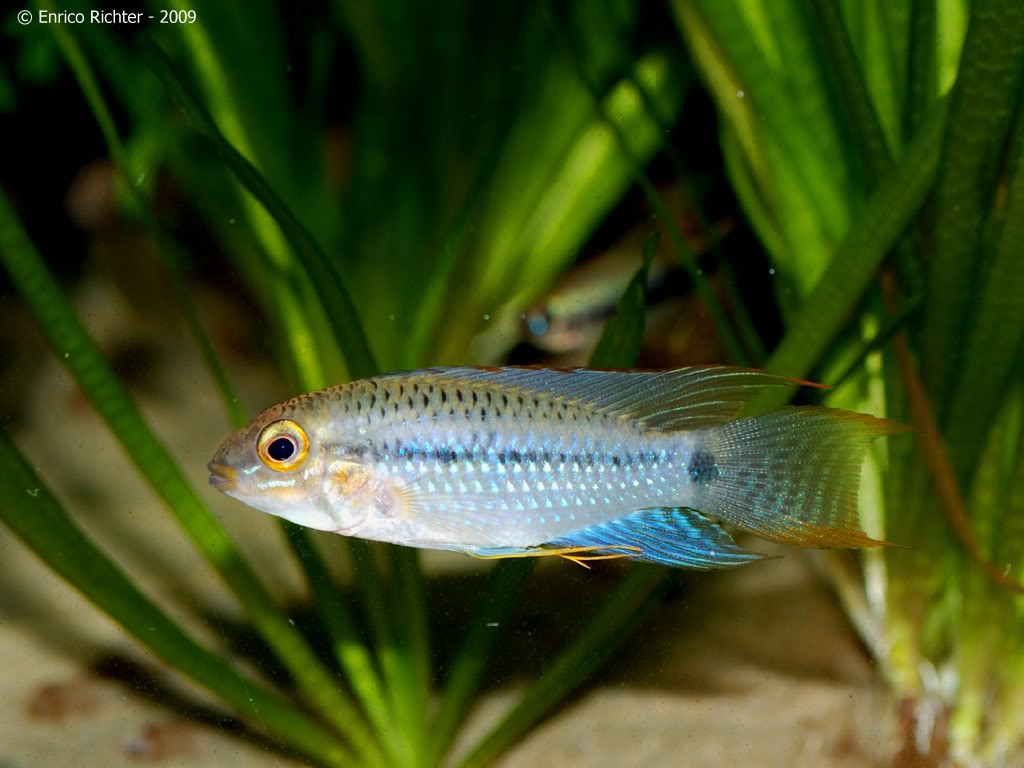
Apistogramma steindachneriSteindachner's Apisto
Cichlidae · Regan, 1908
This species is assigned the code A138 under the DATZ system, with the Venezuelan variant referred to as A139 for easy reference. The genus Apistogramma is among the most speciose of South American cichlid genera with around 70 species valid at present but many more awaiting description. In addition many species exist in two or more geographical colour forms which may or may not turn out to be distinct in the future. Hobbyists tend to label these with collection dat...
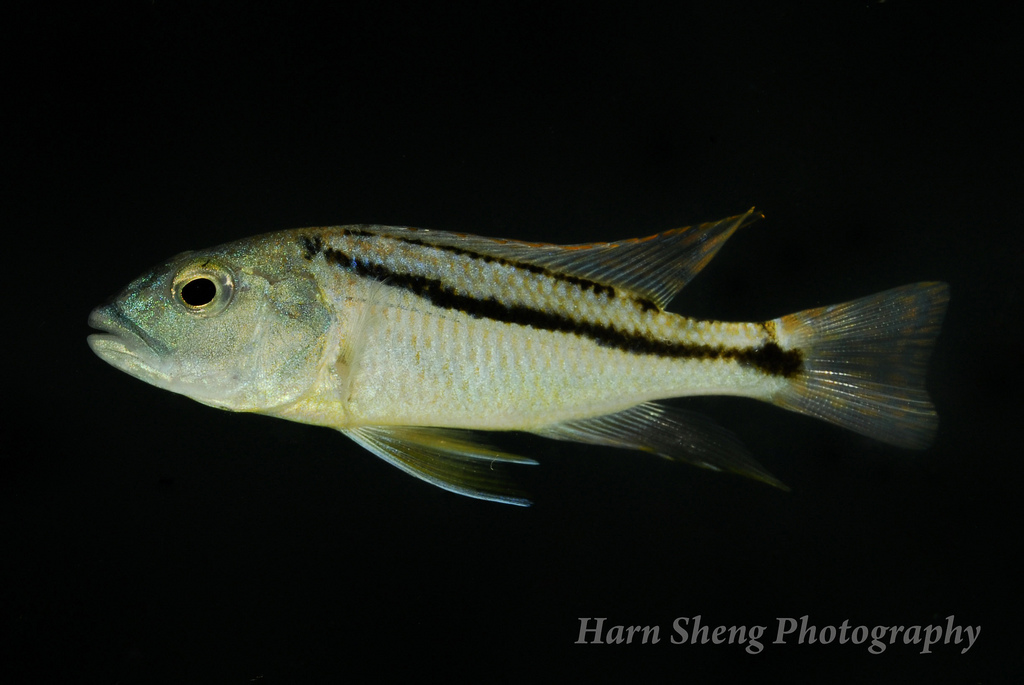
Aristochromis christyi
Cichlidae · Trewavas, 1935
This is currently the only described member ofthe genus and despite having a wide distribution, it's not particularly common in Lake Malawi. Correspondingly it's not seen all that often in the hobby either. It's beak-like mouthparts are specially adapted to allow it to hunt smaller fish among crevices between rocks. It can also extend the mouth in all four directions at once, allowing it to swallow prey up to around 4" long! As well as hunting amongst rocks, Aristoch...
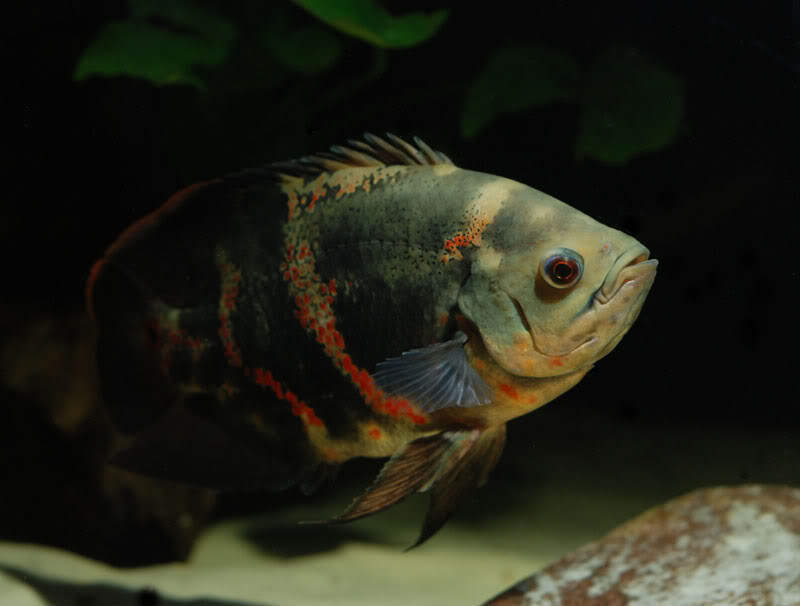
Astronotus ocellatusOscar
Cichlidae · Agassiz, 1831
This species is also referred to as 'velvet cichlid', 'red oscar', 'tiger oscar', or 'marble cichlid'. It is a popular aquarium fish although its adult size and typical life-span of 10-20 years must be taken into account before purchase. Numerous ornamental strains are now available, and while care is more-or-less identical for all of them a degree of additional care must be taken with the 'long-finned' variety which is a little less competitive than other forms.
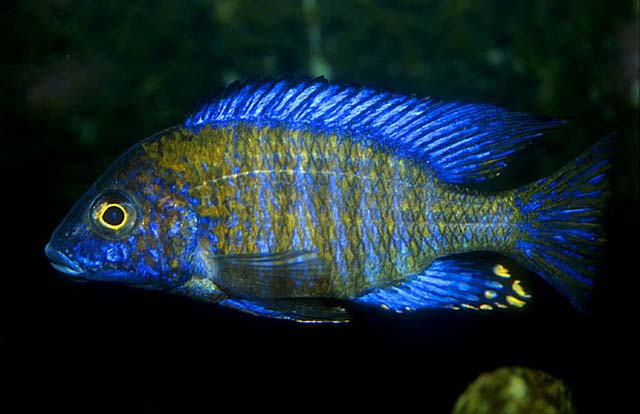
Aulonocara ethelwynnaeNorthern Aulonocara
Cichlidae · Meyer, Riehl & Zetzsche, 1987
Endemic to Lake Malawi where it was described from and only occurs around 'Chitendi Island', now normally referred to as Chitande island plus a short stretch of coastline between Ngara and Chilumba along the lake's northwestern shoreline. Aulonocara spp. are benthophagous by nature employing a method of feeding whereby mouthfuls of substrate are taken and sifted for edible items with the remaining material expelled via the gills and mouth. They're equally-skilled at hunting as grazing, tending to hover above the substrate until tiny movements are detected, and possess enlarged sensory pores on the head which assist in this technique.
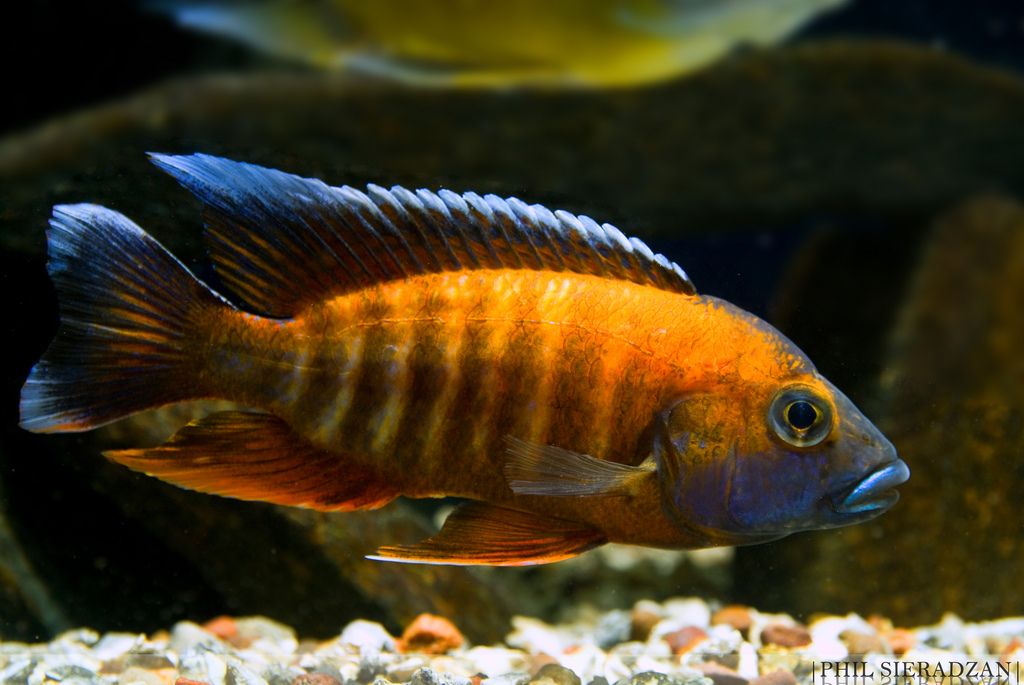
Aulonocara jacobfreibergiMalawi Butterfly
Cichlidae · Johnson, 1974
This was one of the first Aulonocara spp. to enter the hobby and its popularity has endured. It's known by several other vernacular names including 'Freiberg's peacock', 'fairy cichlid' and 'African butterfly' as well as the erroneous 'scientific' names Trematocranus trevori, T. jacobfreigbergi and T. regina. A naturally-occurring, yellowish form from Undu reef, Tanzania is often referred to as 'lemon jake'. It can be told apart from most other members of the genus by the broad, pale distal margins in the dorsal, anal and caudal fins, more deeply-forked caudal fin and larger adult size.
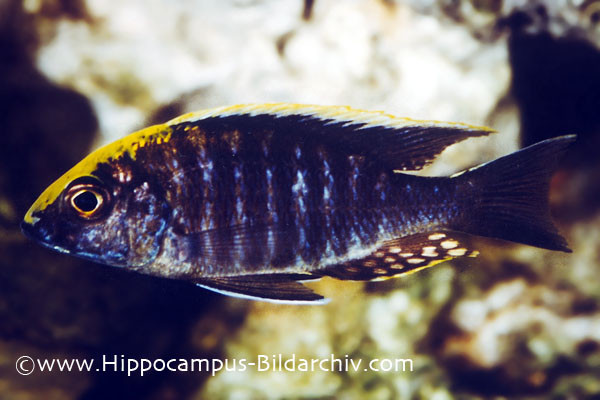
Aulonocara maylandiSulphurhead Peacock
Cichlidae · Trewavas, 1984
This species exists in two distinctive phenotypes, with male individuals from West reef and Eccles reef possessing a bright yellow stripe of colour running from the tip of the snout over the anterior portion of the dorsal surface and along the distal margin of the dorsal fin. This form is commonly referred to as 'sulphurhead' or 'sulfurhead' in the aquarium hobby. At Kande Island males exhibit a similar overall colour patterm but the dorsal stripe is whitish in colour and both males and females possess an enlarged lower pharyngeal bone. This population was described...
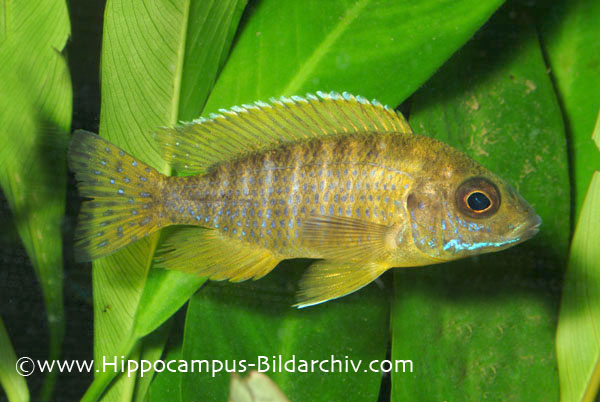
Aulonocara sp. 'stuartgranti maleri'Sunshine Peacock
Cichlidae · authority not recorded
It remains unclear whether this fish represents an as yet undescribed species or not but in either case the unofficial, vernacular name is confusing due to it being based on that of a described taxon. As a result it is often referred to as A. stuartgranti 'Maleri' or 'Maleri Islands', either through error or because some authors believe it to be conspecific with A. stuartgranti. The population from the Maleri Islands is traded as 'yellow regal peacock' (not to be confused with the 'new yellow regal peacock', i.e., A. baenschi) and the one from Chidunga Rocks as 'sunshine peacock' or 'orange peacock'.
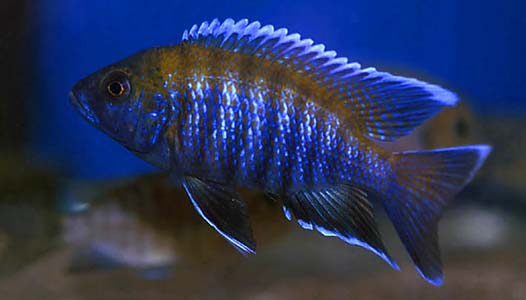
Aulonocara sp. 'walteri'Blue-faced Peacock
Cichlidae · authority not recorded
This fish has been known in the aquarium hobby for a number of years but remains undescribed to science despite the confusing trade name which has resulted in it often being referred to incorrectly as 'Aulonocara walteri'. It's known only from Chizumulu Island and Likoma Island in Lake Malawi, both located off the eastern shoreline of the central part of the lake (Mozambique). There is a similar-looking, potentially conspecific, fish which can be found between the coastal settlements of Meponda (Mozambique) and Ntekete (Malawi) further south, and has been referred to A. sp. 'trematocranus masinje'.
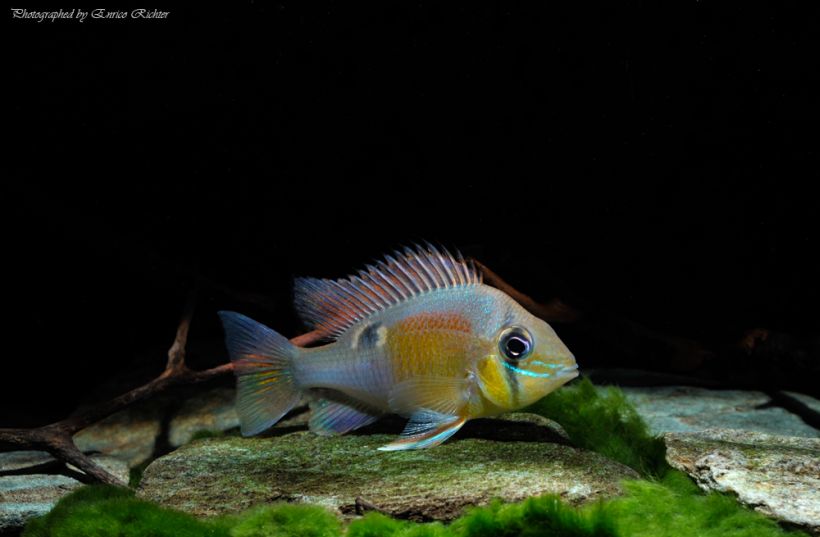
Biotodoma cupidoCupid Cichlid
Cichlidae · Heckel, 1840
Recorded throughout much of the Amazon basin, with its range extending eastwards from the Ucayali system in Peru as far as the Tocantins drainage which flows into the Atlantic alongside the Amazon at its delta. The southern extremity of its range appears to be the Río Mamoré in Bolivia, a tributary of the rio Guaporé, and the northern limit the Essequibo basin, Guyana.
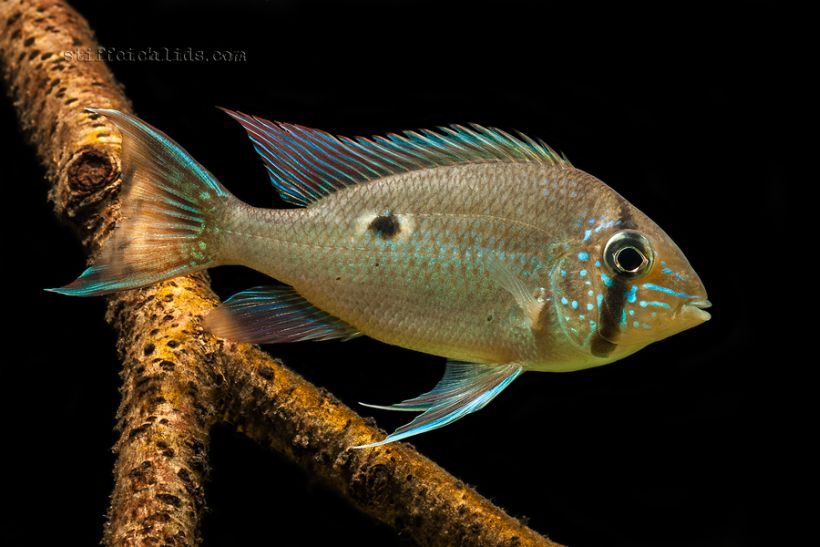
Biotodoma wavriniOrinoco Eartheater
Cichlidae · Gosse, 1963
Populations known in the aquarium trade include 'Cuao', 'Orinoco', 'San Antonio', and 'Sipapo Ventuari'. B. wavrini and its congener B. cupido can be separated by body shape and position of the dark blotch on the posterior portion of the flank. In B. cupido the body is relatively compact and the blotch located above the upper lateral line, whereas in B. wavrini the body is noticeably elongate and the blotch on or below the upper lateral line.
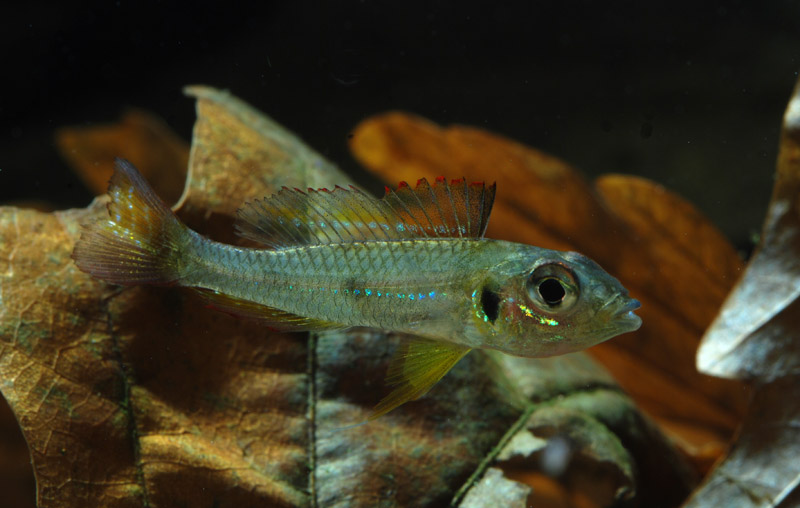
Biotoecus opercularis
Cichlidae · Steindachner, 1875
At time of writing there exists no scientific evidence that the different populations of this species seen in the aquarium trade (see 'Distribution') represent anything other than a single, widely-distributed species although some exibit minor morphological differences including relative body depth, longer fin rays in the unpaired fins and yellow or orange colouration in the paired fins. There is apparently a form from the upper rio Negro which may turn out to be distinct but it's...
Buccochromis lepturusSlender Tail Hap
Cichlidae · authority not recorded
Also known as the green lepturus, this is a stunning species when mature. Unfortunately, it is rarely seen for sale. Its pelagic nature means it is difficult to catch for export. As a result it can be quite expensive when it is available....
Buccochromis nototaeniaStripeback Hap
Cichlidae · authority not recorded
Rarely seen in the trade, as it is quite difficult to collect in nature. It retreats at great speed into deeper water at the first sign of threat. As with other members of its genus, it is a hunter, feeding mainly on smaller cichlids.
Callochromis macropsBig-eyed Mouthbrooder
Cichlidae · authority not recorded
Members of the genus Callochromis feed in a similar way to the South American "eartheaters" such as Geophagus species. They extract invertebrates and other items hidden in the substrate by taking in mouthfulls of sand and sifting it through the gills. The common term "sand sifters" is applied to these and other Tanganyikan species that inhabit a similar ecological niche, such as Enantiopus and Xenotilapia spp. Several geographical colour forms of this species exist. These ...
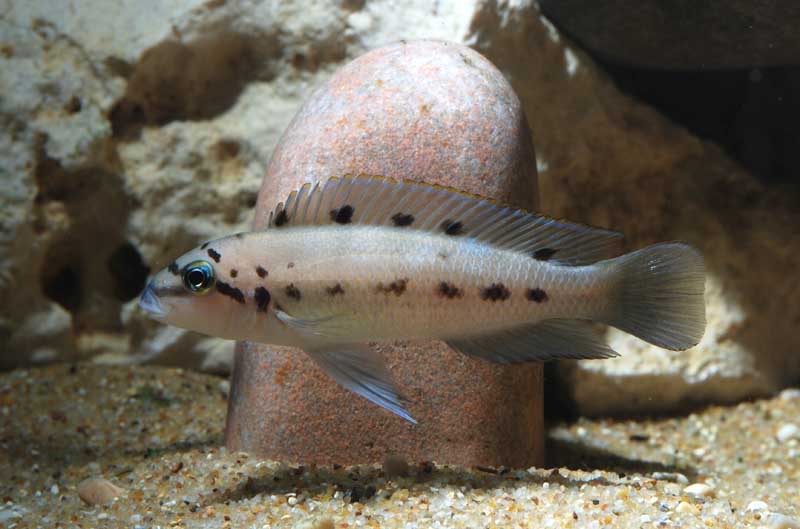
Chalinochromis sp. 'ndobhoi'
Cichlidae · authority not recorded
This undescribed species is also traded as C. sp. 'ndoboi' or 'ndobnoi', and despite its lack of official recognition it's the most commonly-encountered member of the genus in the aquarium trade at time of writing. It can be easily-distinguished from the congeners C. brichardi and C. popelini by its adult body patterning which comprises two or three series of irregular, dark, laterally-orientated blotches, the upper of which is often contained entirely within the dorsal ...
Champsochromis caeruleusMalawi Trout
Cichlidae · authority not recorded
Also known as the trout cichlid, this species makes a great centrepiece to a well-chosen community of big Rift Lake cichlids. An adult male in top condition makes for a truly jaw dropping sight. It is only occasionally offered for sale, as it is difficult to collect, living a predominantly solitary lifestyle. As a result, it is much sought after by enthusiasts. It is sometimes confused with the other species in the genus, C. spilorhynchus, but can be distinguished by its more elongate shape. ...
Champsochromis spilorhynchus
Cichlidae · authority not recorded
This species is only occasionally offered for sale, as it is difficult to collect, living a predominantly solitary lifestyle. As a result, it is much sought after by enthusiasts. It may be confused with the other species in the genus, C. caerulus, but can be distinguished by its deeper body shape and very distinctive black markings on its snout. Champsochromis have widely spaced teeth compared to some other pelagic predatory cichlids found in Lake Malawi, such as Buccochromis species....
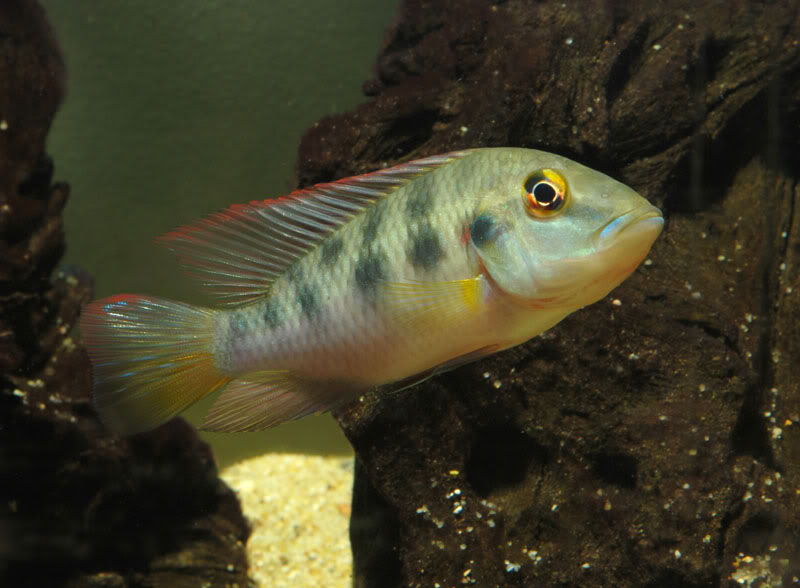
Chromidotilapia guntheri
Cichlidae · Sauvage, 1822
Described from Assinie-Mafia in south-eastern Côte d'Ivoire (Ivory Coast), western Africa but currently accepted to be extensively distributed in coastal river drainages of central western Africa from the Saint John River, central Liberia to the Cross River drainage, in southeastern Nigeria and southwestern Cameroon. It also occurs in the Niger and its major tributary the Benue (Bénoué) and has thus been recorded from Benin, Burkina Faso, Cameroon, Côte d'Ivoire, Equatorial Guinea, Ghana, Guinea, Liberia, Mali, Niger, Nigeria and Togo.
Cichlasoma festaeRed Terror
Cichlidae · authority not recorded
The Red Terror can be troublesome to breed due to pairing problems - if a pair of fish are incompatible and are housed together for any length of time, it is likely that the weaker fish will be killed. The best way of getting a true pair is to grow 6 juveniles up until a noticeably strong pair has formed. Also, its size means finding an aquarium and suitable breeding surfaces can be difficult. As previously mentioned, rocks (siliconed if necessary) and bits of slate used to create man-made caves...
Cichlasoma salviniSalvini
Cichlidae · authority not recorded
Salvin's Cichlid has a well deserved reputation for aggression, especially when breeding. They are regularly available in the trade and make an extremely colourful addition to any north/central American aggression tank. Take care when choosing tank mates, however. If only this species is kept in the tank, it will be quite shy until mature or until the natural domination order has been established. If a single fish of this species is kept alone, it will be extremely shy, usually choosing ...
Cichlasoma trimaculatumThree Spot Cichlid
Cichlidae · authority not recorded
Cichlasoma Trimaculatus is a large colourful cichlid, if a little aggressive. It is believed to be one of the fish that was used to create the hybrid Flowerhorn cichlid. We prefer it in its natural state. As with most large cichlids they can be fairly messy eaters so ensure decent filtration is provided. It is recommended to use a spraybar to disperse the water returning to the tank as trimacs will not appreciate strong flow....
Cichlasoma urophthalmusMayan Cichlid
Cichlidae · authority not recorded
A hardy and robust fish that can tolerate and breed in full marine conditions. The Mayan cichlid is also referred to as the Mexican Mojarra and is occasionally offered for sale in the UK, or can be obtained through specialist cichlid dealers. This species is regarded as a potential pest fish in the USA due to its tolerance of a wide range of conditions and the threat it could pose to native fauna....
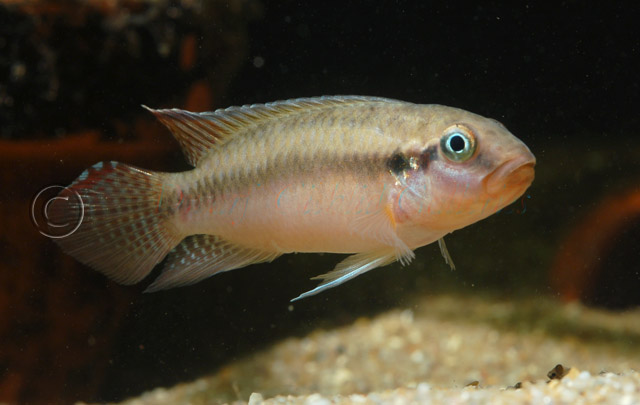
Congochromis sabinae
Cichlidae · Lamboj, 2005
This species was present in the hobby for some time prior to being officially described and the spectacular red fish first exported by Pierre Brichard in the 1960s appears to be a regional form of it. It was also known variously as Nanochromis sp. 'Bamanja', N. sp. 'Genema', N. sp. 'Makoua' and N. sp. Bloody Mary' prior to description, and continues to be mislabelled as N. squamiceps on trade lists. Diagnosis of C. sabinae is possible via a combination of c...
Copadichromis azureus
Cichlidae · authority not recorded
Together with the recently erected genus Mchenga, Copadichromis species form an exclusive group of Malawian cichlids commonly referred to as "Utaka" (prounounced "ooh-taw-kuh"). They're specialised to a pelagic lifestyle, and can be found living in huge numbers throughout much of Lake Malawi. Some tend to remain in the proximity of underwater reefs or rocky shorelines, while others occur mainly in more featureless, sandy habitats. Here they face the oncoming current, us...
Copadichromis borleyi
Cichlidae · authority not recorded
Together with the recently erected genus Mchenga, Copadichromis species form an exclusive group of Malawian cichlids commonly referred to as "Utaka" (prounounced "ooh-taw-kuh"). They're specialised to a pelagic lifestyle, and can be found living in huge numbers throughout much of Lake Malawi. Some tend to remain in the proximity of underwater reefs or rocky shorelines, while others occur mainly in more featureless, sandy habitats. Here they face the oncoming current, usi...
Copadichromis chrysonotus
Cichlidae · authority not recorded
Together with the recently erected genus Mchenga, Copadichromis species form an exclusive group of Malawian cichlids commonly referred to as "Utaka" (prounounced "ooh-taw-kuh"). They're specialised to a pelagic lifestyle, and can be found living in huge numbers throughout much of Lake Malawi. Some tend to remain in the proximity of underwater reefs or rocky shorelines, while others occur mainly in more featureless, sandy habitats. Here they face the oncoming current, usi...
Copadichromis ilesi
Cichlidae · authority not recorded
Together with the recently erected genus Mchenga, Copadichromis species form an exclusive group of Malawian cichlids commonly referred to as "Utaka" (prounounced "ooh-taw-kuh"). They're specialised to a pelagic lifestyle, and can be found living in huge numbers throughout much of Lake Malawi. Some tend to remain in the proximity of underwater reefs or rocky shorelines, while others occur mainly in more featureless, sandy habitats. Here they face the oncoming current, usi...
Copadichromis virginalis
Cichlidae · authority not recorded
Together with the recently erected genus Mchenga, Copadichromis species form an exclusive group of Malawian cichlids commonly referred to as "Utaka" (prounounced "ooh-taw-kuh"). They're specialised to a pelagic lifestyle, and can be found living in huge numbers throughout much of Lake Malawi. Some tend to remain in the proximity of underwater reefs or rocky shorelines, while others occur mainly in more featureless, sandy habitats. Here they face the oncoming current, usi...
Crenicara latruncularium
Cichlidae · authority not recorded
Rarely seen in the hobby in the UK, but makes an interesting addition to a South American setup.
Crenicichla albopunctataWhite-spotted Pike Cichlid
Cichlidae · authority not recorded
Crenicichla albopunctata
Crenicichla compressicepsCompressiceps Dwarf Pike Cichlid
Cichlidae · authority not recorded
Crenicichla compressiceps are an excellent little fish. They are small, but they swim a great deal (and can be incredibly quick) so require larger aquaria than other, similar sized fish. In the wild, Compressiceps are insect feeders. They will wait quietly then quickly sweep down and prey on any nearby insects. They have good vision in the night and will often feed in the dark. Be careful when choosing tankmates, though as previously mentioned it may be mandatory to include some fish to e...
Crenicichla johannaRed-finned Pike Cichlid
Cichlidae · authority not recorded
As stated, this fish is found across most of the Amazon basin. As a result, a number of different colour forms have developed. This pike is fairly common in the hobby due to its broad geographic range.
Crenicichla proteusProteus Pike Cichlid
Cichlidae · authority not recorded
Crenicichla proteus is occasionally offered for sale. It is one of the smaller pike cichlids, although more than makes up for that in terms of aggression!
Crenicichla strigataStriped Pike Cichlid
Cichlidae · authority not recorded
One of the more commonly available pike cichlids in the UK, c. strigata is often bought by fishkeepers unaware of the adult size of these fish. Are reported to be susceptible to hole in the head disease, more commonly seen in discus and oscars....
Crenicichla tigrinaTiger Pike Cichlid
Cichlidae · authority not recorded
A strikingly marked species that is rarely seen in the hobby in the UK.
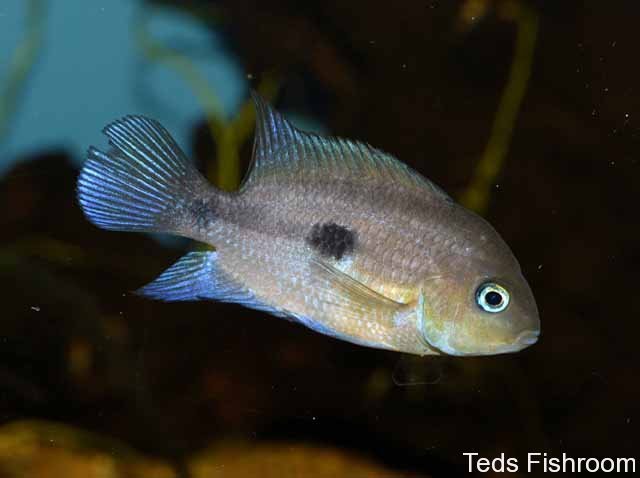
Cryptoheros myrnae
Cichlidae · Loiselle, 1997
In its natural waters, females have been observed caring for mixed broods containing both their own fry and those of another cichlid, Amphilophus bussingi. It is unknown if these are mixed by accident (as the two species have also been recorded tending broods in close proximity to one another) or if this represents an adaptive behaviour to increase numbers in a brood and therefore decrease the chance of predation.
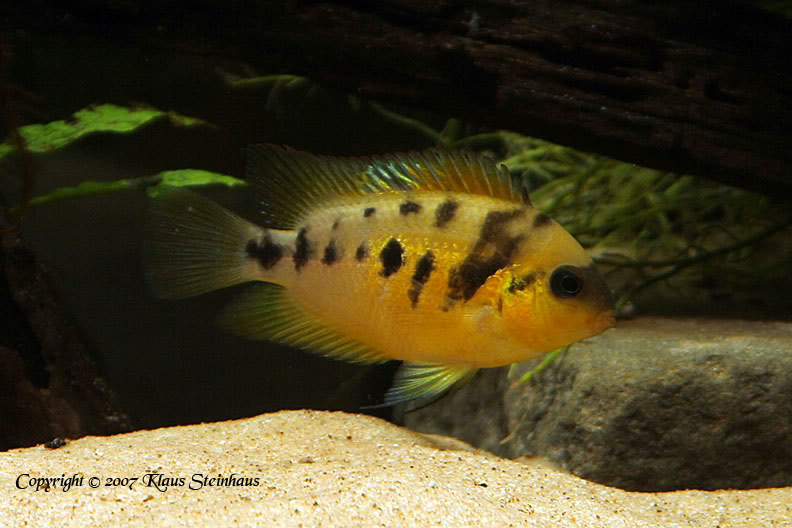
Cryptoheros nanoluteus
Cichlidae · Allgayer, 1994
Inhabits moderate to fast-flowing, well-oxygenated, lowland streams and rivers with pH measured to range between 5.4 and 8.0 and temperature 22-31°C/71.6-87.8°F, while conductivity at one habitat was 600 µS. Substrates may be composed of open mud or sand, or strewn with variably-sized boulders depending on locality, while aquatic plants have not been observed. It occurs sympatrically with the convict cichlid, Amatitlania nigrofasciata with oth...
Cynotilapia afraDogtooth Cichlid
Cichlidae · authority not recorded
C. afra is easily confused with some species of Pseudotropheus, but can be distinguished by its smaller adult size and unicuspid (as opposed to bicuspid) teeth. Also in this species the black bars on the flanks continue into the dorsal fin, unlike in Pseudotropheus zebra, for example. It exists in many different colour forms in nature. These forms should not be mixed in aquaria as they may spawn with each other, producing unwanted hybrid fry. Despite this ability to interbreed, it's probabl...
Cyprichromis leptosomaSardine Cichlid
Cichlidae · authority not recorded
One of the favourite Tanganyikan cichlids among hobbyists, this species occurs in several geographical morphs. Each of these further exists in both blue and yellow-tailed forms. They congregate in large shoals of several thousand in nature, preying on zooplankton. In the hobby you may also see C. leptosoma sp. "Jumbo" for sale. These fish grow to the size quoted above, whilst the "true" leptosoma only reaches around 4" in length. Although it's likely we are deal...
Cyprichromis microlepidotusSmallscale Cyprichromis
Cichlidae · authority not recorded
Quite a rarity in the hobby, but when available it is much sought after by enthusiasts. It can be found living in huge mixed species groups with other Cyprichromis species and the similar Paracyprichromis. There are a few geographical variants known, each of which has both a yellow and blue tailed form. Individual populations can also contain males with different colour and patterning, a phenomenon known as polychromatism. The different forms should never be mixed in the aquarium, as they will i...
Cyrtocara mooriiMalawi Blue Dolphin
Cichlidae · authority not recorded
A gentle giant ideal for the larger community of Malawi cichlids, this species was formerly named Haplochromis moorii. It is occasionally referred to by the common name, "Humphead Mouthbrooder". In nature, it exhibits an interesting feeding behaviour in which it will be attracted to clouds of sand thrown up by the activity of substrate-sifting species such as Fossorochromis rostratus or Taeniolethrinops praeorbitalis. Shoals of C. moorii will follow these species and feast on any mo...
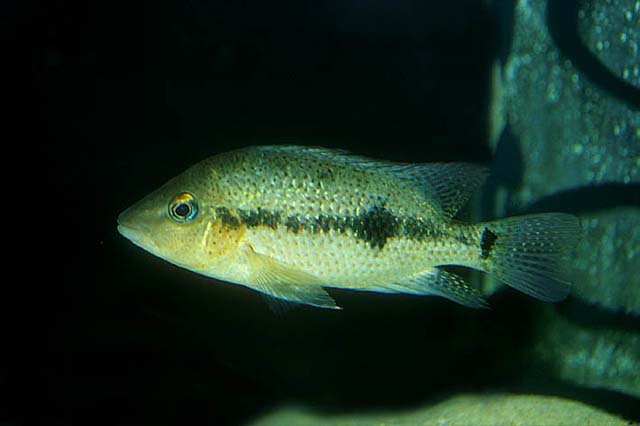
Darienheros calobrensisRedspot Cichild
Cichlidae · Meek & Hildebrand, 1913
A. calobrensis is not as common in the hobby as some other species in the genus (most notably A. citrinellus). It was considered a member of the genus Cichlasoma for some time, before being restored to its original position in Amphilophus. However it exhibits several characteristics that seem to set it apart from its congeners. As a result many experts believe it will probably be moved into a newly-erected genus at some point in the future. You may also see it listed as a member of Astatheros oc...
Dicrossus maculatusSpadetailed Checkerboard Cichlid
Cichlidae · authority not recorded
Dicrossus Maculatus are not commonly available in the trade. Sometimes they are mistaken for the more common and popular Dicrossus Filamentosa. The Spadetailed Checkerboards are an absolutely fascinating species to keep. They are a challenge to breed, requiring such acidic and soft water, but when it does happen it is a very rewarding experience. Reports maintain that the pH and temperature of the water when conceived, eggs laid, eggs hatched and in the first month of the fry's life c...
Dimidiochromis compressicepsMalawi Eye-Biter
Cichlidae · authority not recorded
D. compressiceps is an ambush predator in nature, its laterally compressed shape and head-down hunting position allowing it to remain hidden among Vallisneria beds and making it tricky to spot in open water. It has a dark stripe running from the snout along the back to the tail which serves to provide further camouflage. Despite its common name, it does not prey solely on the eyes of other species, preferring to hunt small fish (particularly juvenile Copadichromis sp.). It swallows these tai...
Ectodus descampsiiDescamp's Strange-Tooth Cichlid
Cichlidae · authority not recorded
A rare species in the hobby, there is also another, as yet undescribed fish sometimes imported as E. descampsii but this is thought to be a distinct species. This one is currently known as Ectodus sp. "north", as it's found further up the lake than E. decampsii. It can be distinguished by its smaller adult size and the fact that the black spot on the dorsal is found towards the front whereas in E. descampsii it's found in the middle of the fin. Confusingly, E. sp. "north...
Eretmodus cyanostictusStriped Goby Cichlid
Cichlidae · authority not recorded
Also known as the Tanganyikan Clown, this is one of the so-called Tanganyikan goby cichlids. They occur only in the upper few feet of water around rocky shores, also known as the surge zone, where they scrape algae from the rocks with their specialised teeth. This habitat is typified by breaking waves and strong currents. They have a few adaptations allowing them to inhabit such an environment. The swim bladder is rendered useless to reduce their buoyancy. They also have a longand a laterally co...
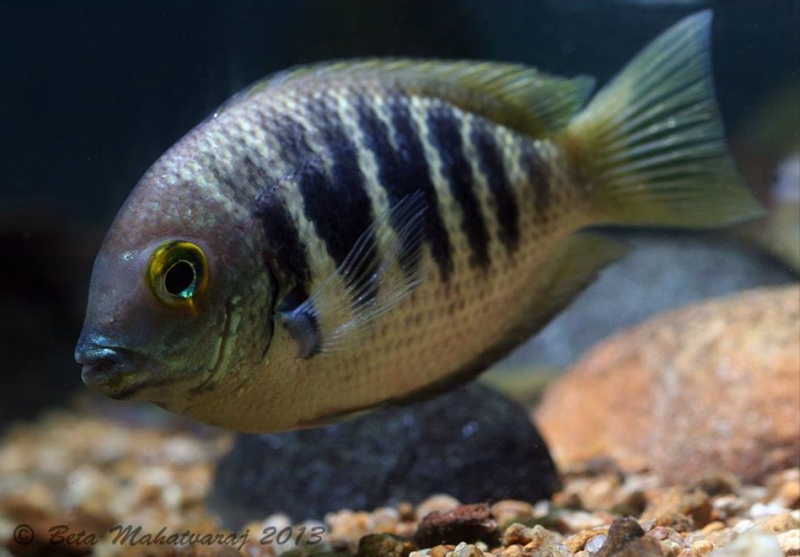
Etroplus canarensisCanara Pearlspot Cichlid
Cichlidae · Day, 1877
Etroplus is the only cichlid genus native to the Indian subcontinent and Sri Lanka and currently comprises three species among which E. canarensis is uniquely limited to freshwater and restricted in range. Its congeners E. maculatus and E. suratensis are both euryhaline inhabiting estuaries, coastal lagoons and the lower reaches of rivers around coastlines of western and southern India plus northern Sri Lanka.
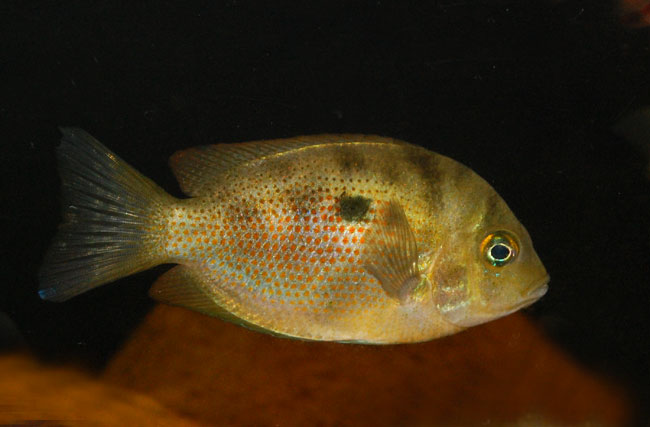
Etroplus maculatusOrange Chromide
Cichlidae · Bloch, 1795
Wild examples are rarely-seen in the aquarium hobby although selectively-bred ornamental strains are widely-available for which care is identical. These are normally traded as 'red' or 'yellow' chromide and have a solid yellow-orange colour pattern with no dark elements. It exhibits a widespread sympatry with the con...
Fossorochromis rostratus
Cichlidae · authority not recorded
F. rostratus was formerly classified as Haplochromis rostratus. When startled, it may bury itself in the substrate. It often displays its natural sand-sifting method of feeding in aquaria, and a substrate of sand is essential as gravel may injure the fish. In nature, it is only the largest dominant males that build nests, whilst the subdominant males and females shoal together. There also exists a feeding relationship between this species and Cyrtocara moorii in the wild, in which shoals of C. m...
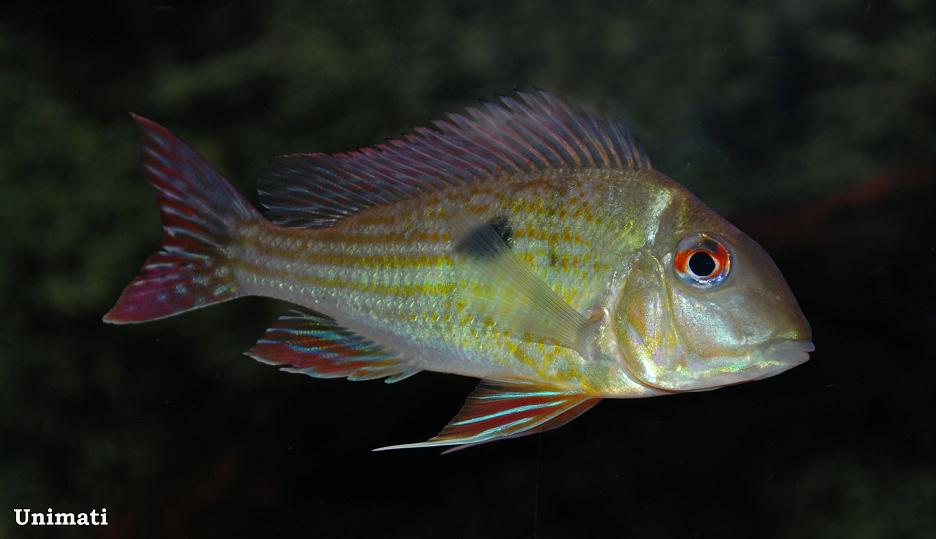
Geophagus abalios
Cichlidae · López-Fernández & Taphorn, 2004
It also occurs in the río Caura on the Guyana Shield plus the Ventauri and Mavaca drainages in the middle and upper Orinoco where it’s also known from some white water, referring to turbidity rather than turbulence, habitats. To the north its distribution appears limited by the Las Majaguas dam on the Río Cojedes, a tributary of the Apure where a probable introduced population inhabits the res...
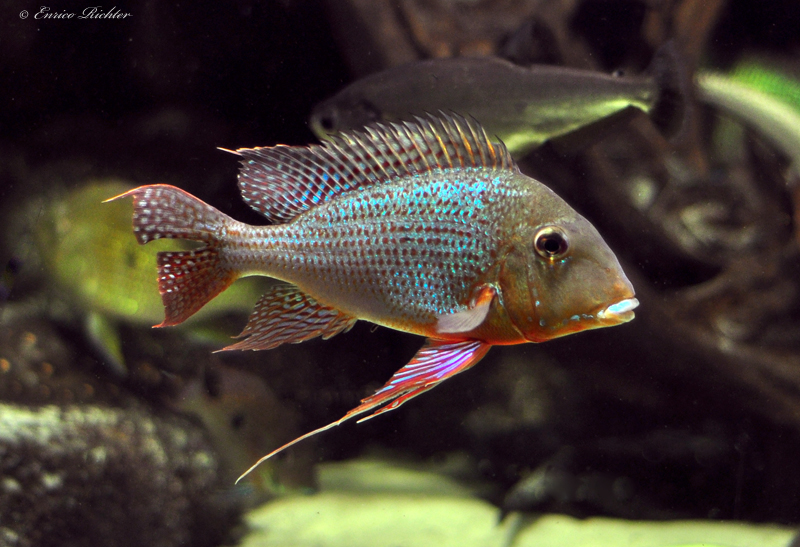
Geophagus altifrons
Cichlidae · Heckel, 1840
Despite its designation as type species this is among the most frequently-misidentified members of the genus. This is in part because its natural distribution was earlier considered even more extensive than the still-substantial range recognised today, with populations from the Río Orinoco, Guianas and rio Tocantins now recognised as species in their own right.
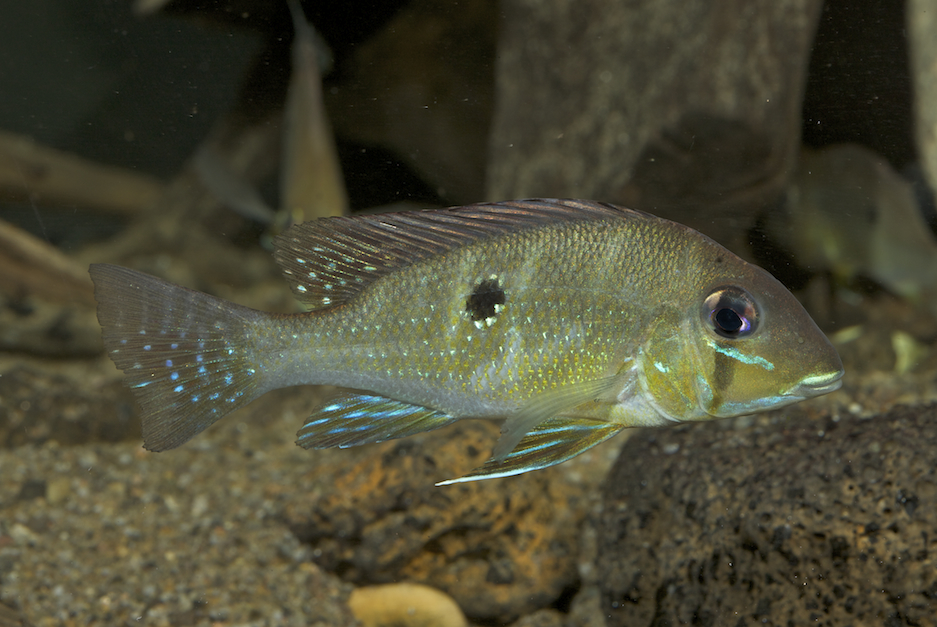
Geophagus argyrostictus
Cichlidae · Kullander, 1991
This species is relatively rare in the hobby but sometimes available from specialist retailers or private breeders. Though described in 1991 it was first collected much earlier and misidentified by Gosse (1976) as G. surinamensis. It's one of just five Geophagus species not to be included in the nominal G. surinamensis 'group' of closely-related species within the genus along with G. gottwaldi, G. grammepareius, G. harreri an...
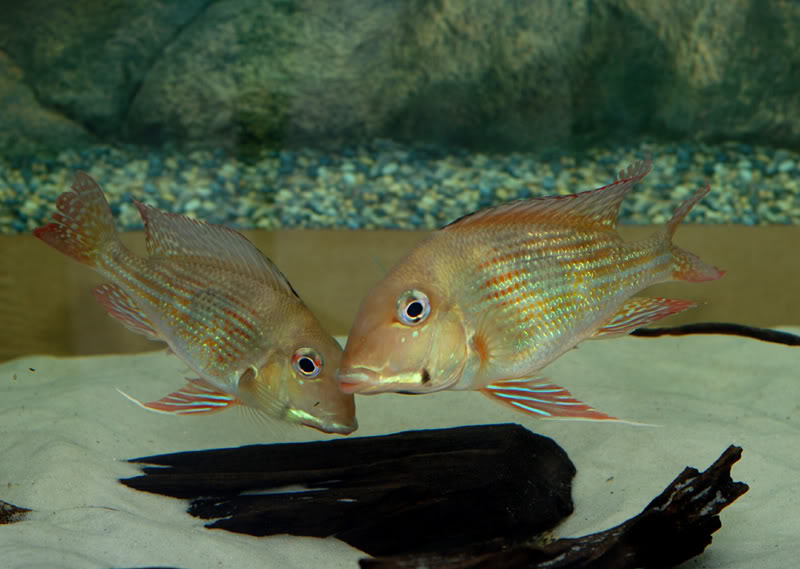
Geophagus brachybranchus
Cichlidae · Kullander & Nijssen, 1989
This species is generally rare in the aquarium hobby though oddly appears to be one of the commoner species in Australia where it's often referred to by the vernacular name 'black-throated eartheater'. It's a member of the nominal G. surinamensis 'group' of closely-related species within the genus and can be identified by a combination of characters including: presence of dark preopercular markings; no vertical bars on the flanks even when stressed/preserved; base of filaments on the first gill arch mostly covered by a flap of skin; exposed part of bra...
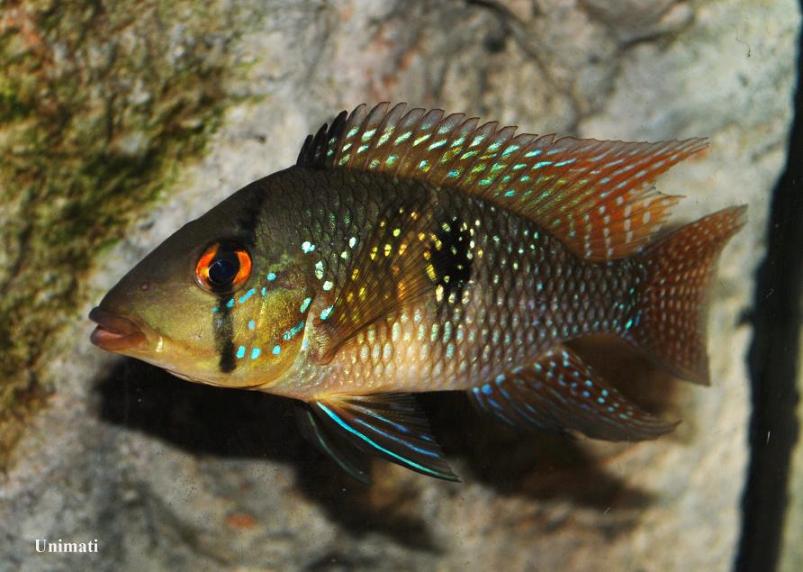
'Geophagus' brasiliensisPearl Cichlid
Cichlidae · Quoy & Gaimard, 1824
This species is also known as the 'pearlscale' or 'mother-of-pearl' cichlid in deference to the iridescent body scaling. It's also worth noting that fishes sold as Gymnogeophagus australis in Europe are 'G.' brasiliens is more often than not. Wild specimens exhibits significant dissimilarities in body colour and patterning depending on locality with basic colouration being dominated by varying shades of blue, green or yellow, for example. Some populations al...
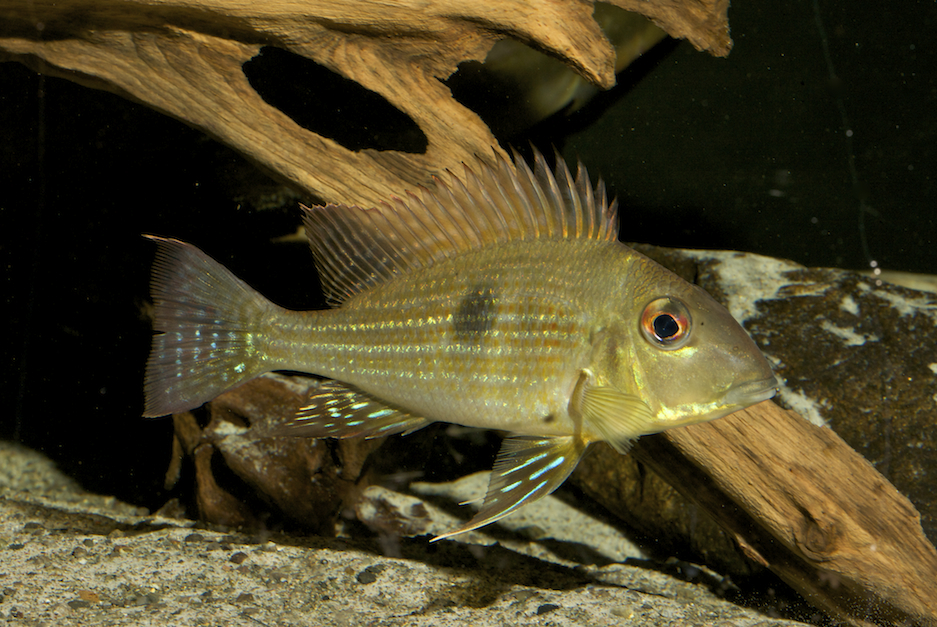
Geophagus brokopondo
Cichlidae · Kullander & Nijssen, 1989
This species is very rarely-traded since collections of fishes for commercial purposes aren't common in Suriname. It's a member of the nominal G. surinamensis 'group' of closely-related species within the genus and can be identified by a combination of characters including: no dark preopercular marking; six vertical/parallel bars on each flank (normally visible only when the fish are stressed, spawning or preserved); dark, squarish lateral spot positioned within the third vertical bar; sixth (posterior) bar elongate an...
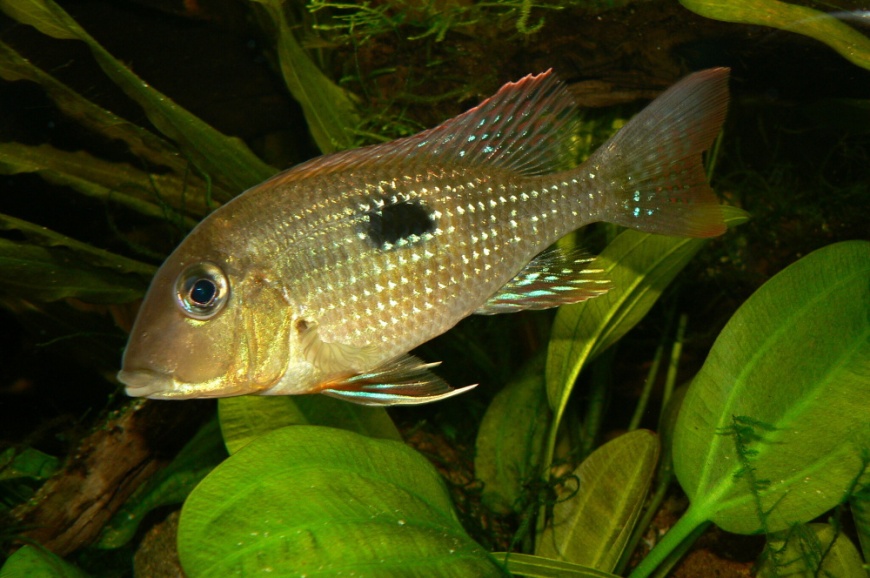
Geophagus camopiensisOiapoque Eartheater
Cichlidae · Pellegrin, 1903
In a study conducted on the Arataye River, the main tributary of the Approuage, this species was mostly collected from stretches of rapids with rocky substrate which were reduced to a series of pools during the dry season. Other fishes observed at the same site were Auchenipterus nuchalis, Hypostomus gymnorhynchus and Moenkhausia cf. intermedia while at other localities in the river Bryconops affinis, Myleus ternetzi, M. rhomboidalis, Moenkhausia aff. barbouri, Curimata sp. and Serrasalmus sp. were collected.
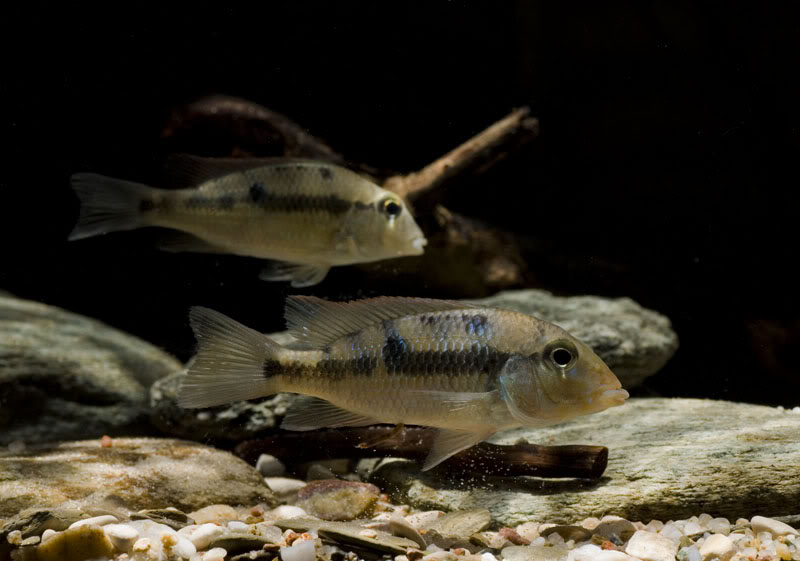
'Geophagus' crassilabrisPanamanian Eartheater
Cichlidae · Steindachner, 1876
The most essential item of décor is a soft, sandy substrate so that the fish can browse naturally (see 'Diet'). Coarser materials such as gravel or small pebbles can inhibit feeding, damage gill filaments and even be ingested with the potential of internal damage or blockages. Additional furnishings ar...
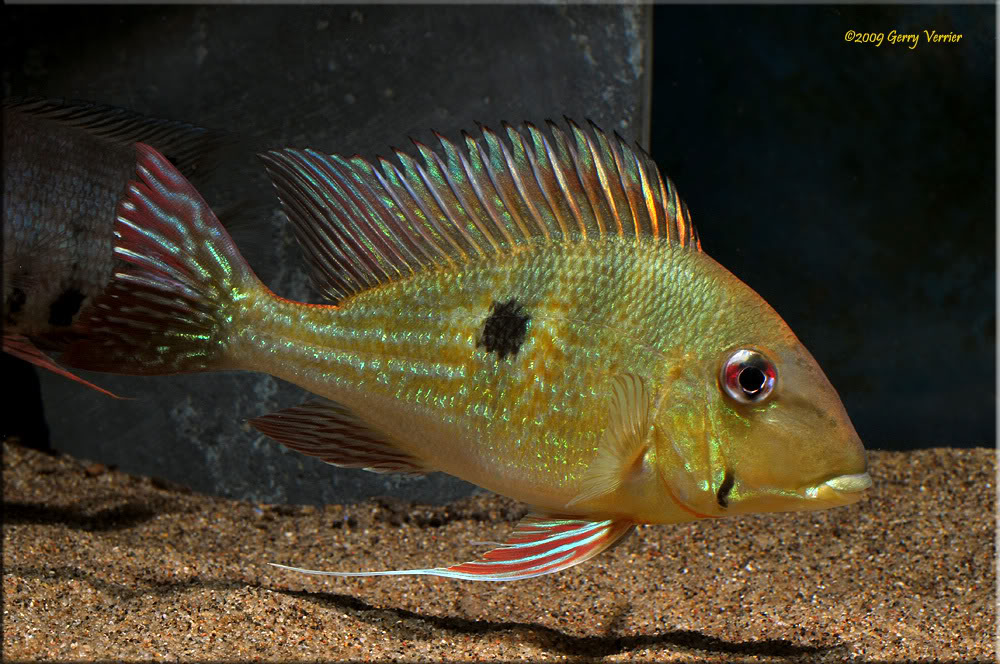
Geophagus dicrozoster
Cichlidae · López-Fernández & Taphorn, 2004
It's a member of the nominal G. surinamensis 'group' of closely-related species within the genus and can be identified by a combination of characters including: presence of dark preopercular markings; seven parallel vertical bars on each flank (normally visible only when the fish are stressed, spawning or preserved); vertical bars four and five meet in such a way that they form a 'Y' shape; dark lateral spot positioned within the third vertical bar; caudal fin reddish with variable pattern of iridescent blue spots and stripes.
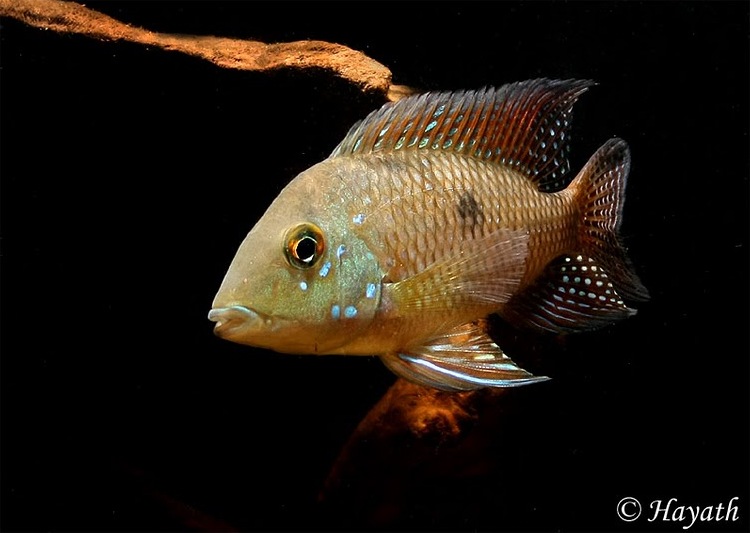
'Geophagus' iporangensis
Cichlidae · Haseman, 1911
Juvenile specimens of this species are readily confused with those of other members of the 'G.' brasiliensis species group, but adults are easily-distinguished by their relatively smaller adult size and comparative lack of reflective blue scales on the body and head. The genus Geophagus was rediagnosed by Kullander (1986) who restricted it to include only those species with paired caudal extensions to the swi...
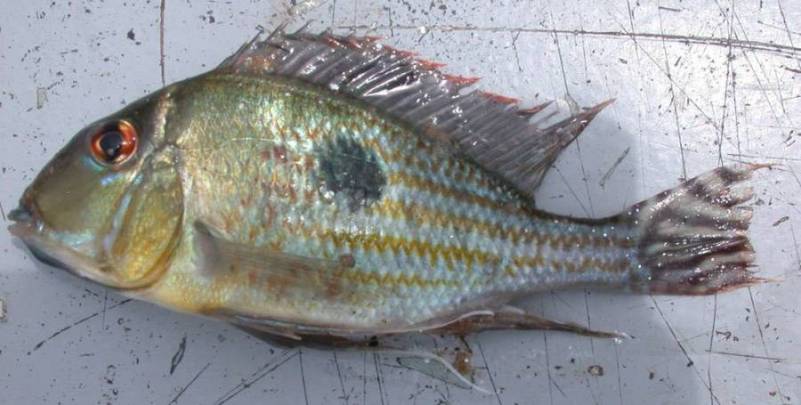
Geophagus megasema
Cichlidae · Heckel, 1840
This species is very rare in the aquarium hobby and may never have been available on a commercial basis although it has been collected, bred and distributed by some private collectors. It's a member of the putative G. surinamensis 'group' of closely-related species within the genus and ca...
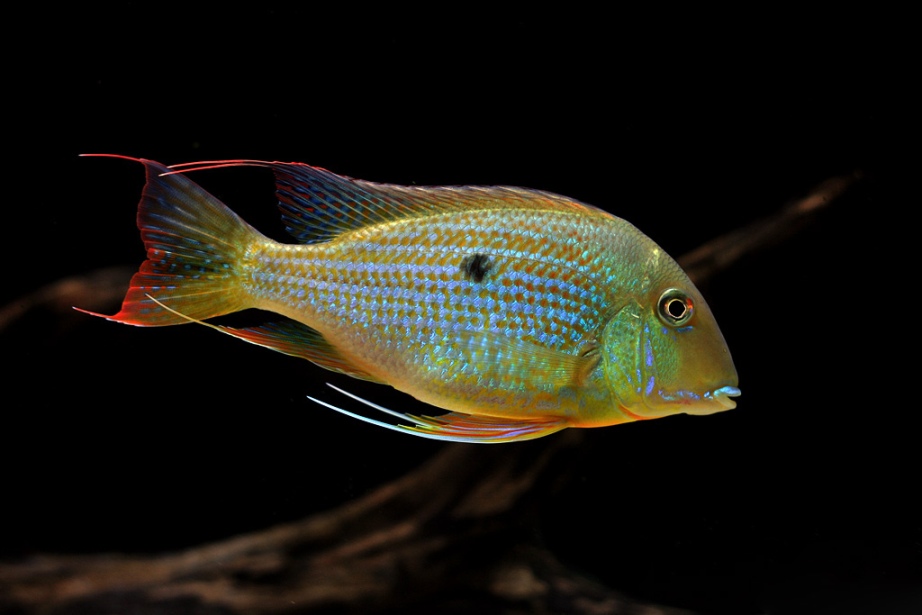
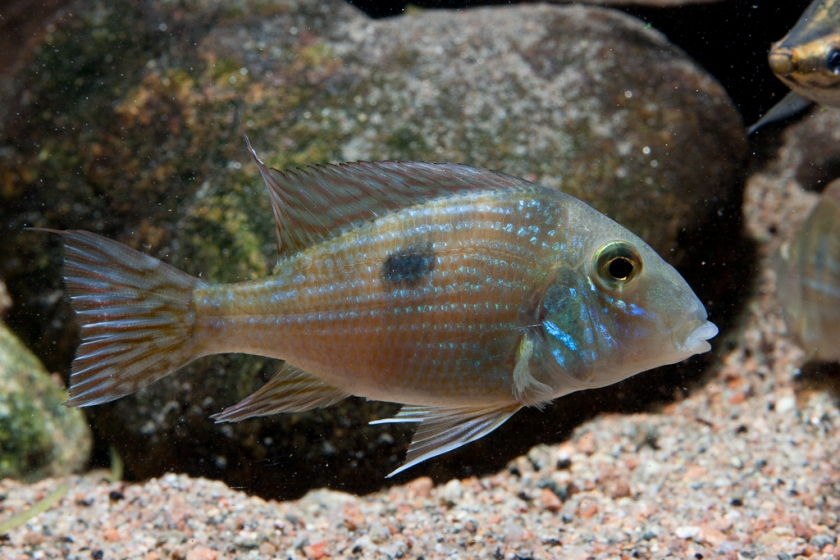
Geophagus neambi
Cichlidae · Lucinda, Lucena & Assis, 2010
This species was available in the hobby several years prior to being described, invariably traded as G. sp. aff. altifrons 'Tocantins', G. sp. 'Tocantins' or G. sp. 'rio Areoes'. The latter of these names refers to an Indian reserve named 'Areões' in the rio Das Mortes drainage, a tributary of the Araguaia which itself drains into the Tocantins, and the aquarium specimens in our images have been identified as G. neambi by Dr. Paulo Lucinda, co-describer of the species.
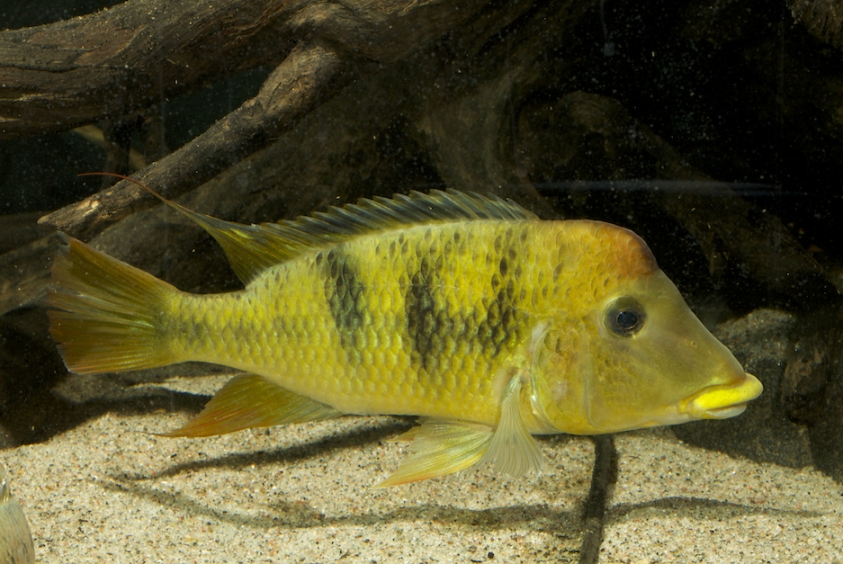
Geophagus parnaibae
Cichlidae · Staeck & Schindler, 2006
Although only described in 2006 this species has been known in the hobby since at least 1988 when it was imported to Germany and traded as G. sp. 'Parnaíba'. An undescribed species from the rio Pindaré in Maranhão state usually sold as G. sp. 'Pindaré' is sometimes labelled G. sp. 'Pindaré' (Parnaíba) which has resulted in some confusion but the two do not occur sympatrically and are totally distinct from one another.
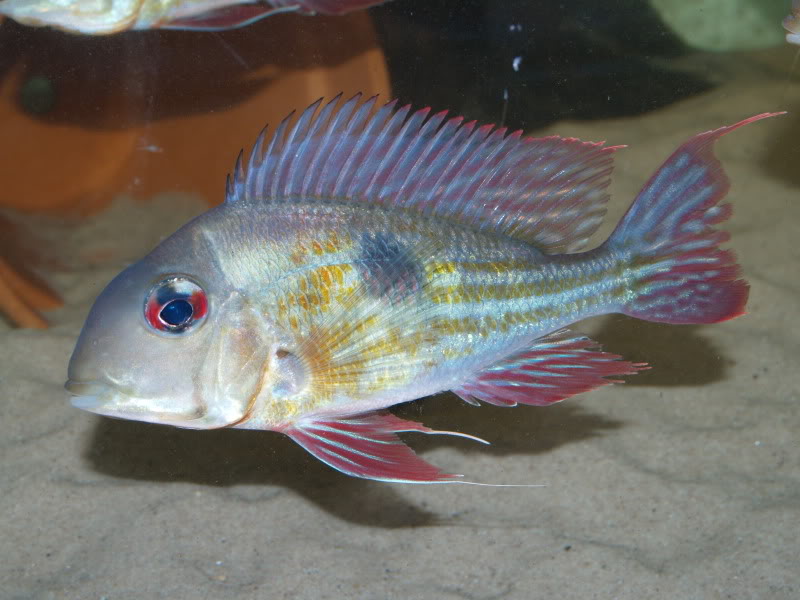
'Geophagus' pellegriniYellowhump Eartheater
Cichlidae · Regan, 1912
This species appears to be a relative ecological generalist. During a sampling trip in 1989 it was collected various habitat-types including a narrow (maximum width 3 m) stream containing shallow (maximum depth 1 m), transparent, moderate to fast-flowing water and substrate comprising gravel, mud, clay and organic debris including submerged logs. Aquatic plants consisted of water lilies and marginal vegetation was dense, comprising various trees, shrubs, grasses and ferns.
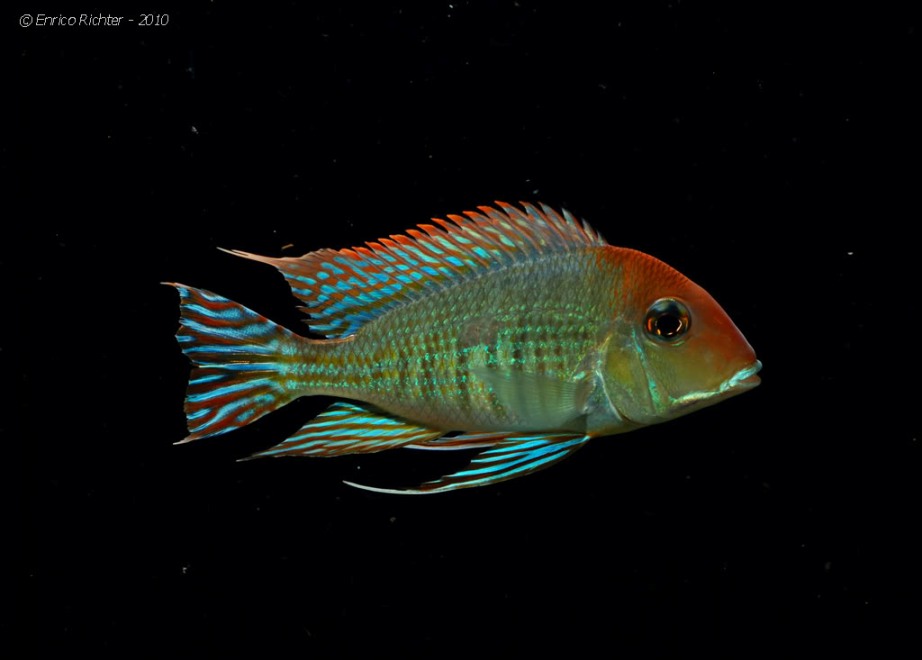
Geophagus proximus
Cichlidae · Castelnau, 1855
This species is rare in the hobby though it's name is often attached to shipments of other Geophagus species. It's a member of the nominal G. surinamensis 'group' of closely-related species within the genus and can be identified by a combination of characters including: possession of dark preopercular marking; no vertical bars on the flanks; relatively large, roughly oblong-shaped dark midlateral marking; caudal fin brownish with 3-5 light stripes on upper lobe and less well-defined stripes or mottled pattern of light spots with narrow dark interspaces on lower lobe.
Geophagus sp. 'orange head'
Cichlidae · authority not recorded
There are at least two variants available one of which is often traded as G.sp. 'Araguaia orange head'. This is misleading since both are endemic to the Tapajós drainage (see 'Distribution'), and appears to date back to an error in collection locality when the fish were first exported. The two differ in the extent of orange colouration on the head which extends onto the opercle in G. sp. 'orange head (rio Arapiuns form) but is mostly restricted to the area above the ey...
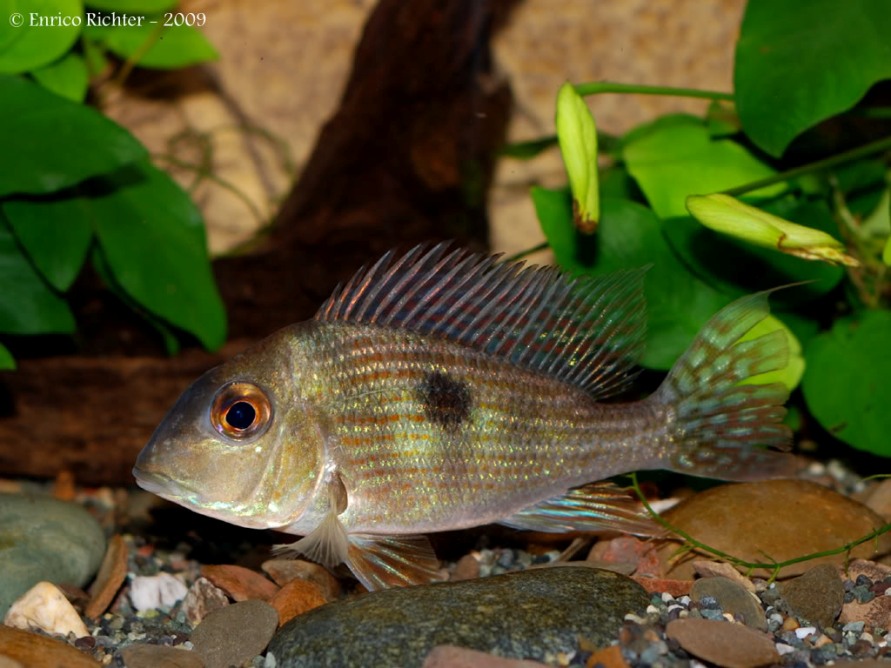
Geophagus sp. 'Pindaré'
Cichlidae · authority not recorded
Known only from the rio Pindaré in Maranhão state, north-eastern Brazil which drains into the Baía de São Marcos (St. Mark's Bay) along with the rios Mearim, of which it is sometimes considered a tributary, and Grajaú. Some sections of the Pindaré have been heavily degraded via removal of riparian vegetation for agriculture and habitats destroyed due to resultant siltation. The river is poorly-studied and the conservation status of its fishes mostly unconfirmed so su...
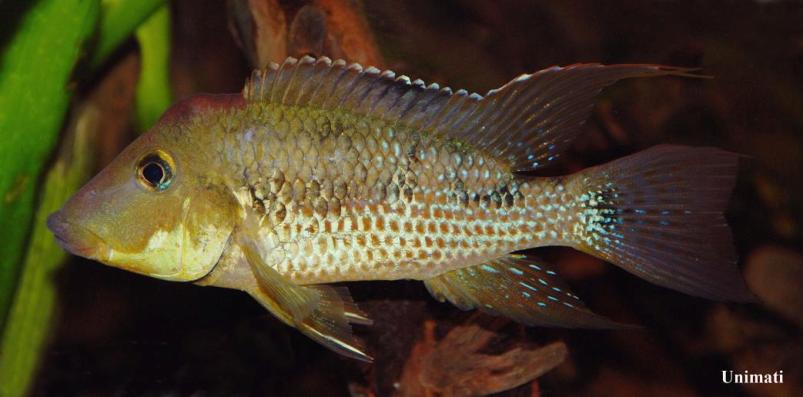
'Geophagus' steindachneriRed Hump Eartheater
Cichlidae · Eigenmann & Hildebrand, 1922
This species lends its name to the 'G.' steindachneri, an assemblage of closely-related species with unresolved generic placement which currently also includes 'G.' crassilabris and 'G.' pellegrini. It exists in a number of colour forms which vary with locality, some of which may eventually be described as separate taxa. Some of these may appear on trade lists under the synonym Geophagus hondae.
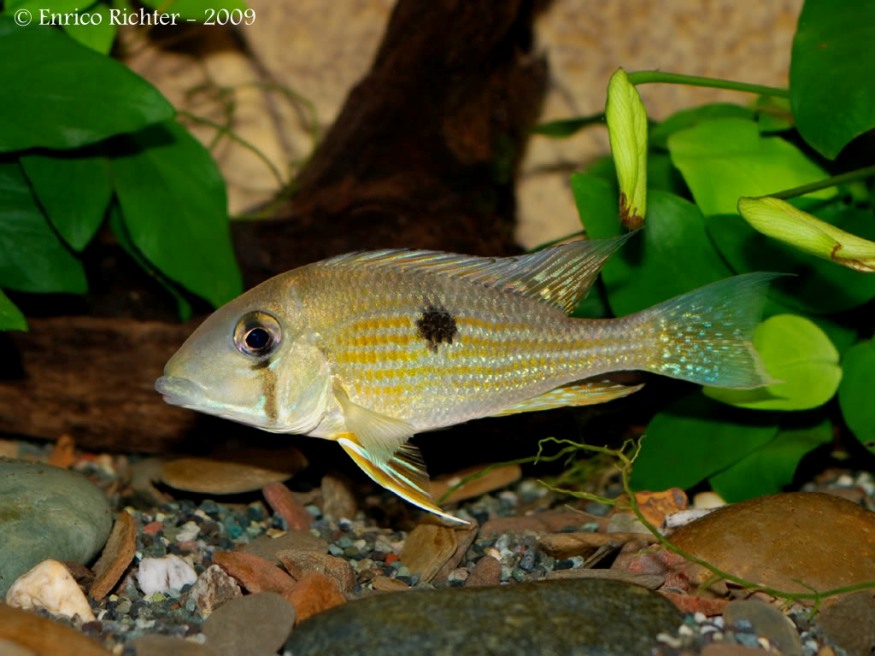
Geophagus taeniopareius
Cichlidae · Kullander & Royero, 1992
This species is relatively rare in the hobby but sometimes available from specialist retailers or private breeders. Though described in 1992 it was first collected much earlier and has been in the hobby since the late 1970s, being known as 'Wangenstrich-Erdfresser' (cheek-stripe eartheater) in Germany. It's one of just five Geophagus species not to be included in the nominal G. surinamensis 'group' of closely-related species within the genus along with G. argyrostictus, G. gottwaldi, G. grammepareius and G. harreri.
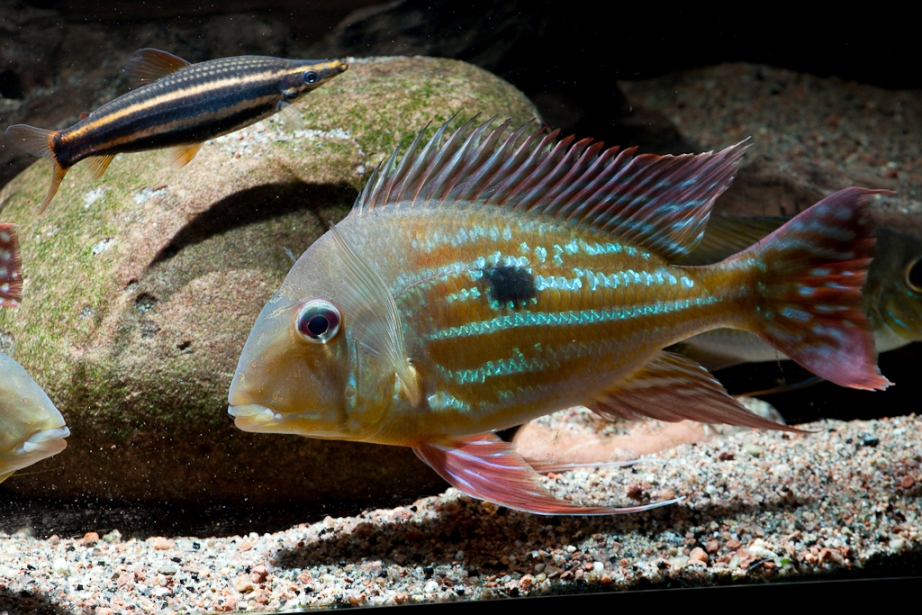
Geophagus winemilleri
Cichlidae · López-Fernández & Taphorn, 2004
This species is rare in the hobby although other species are sometimes sold under the name. It's a member of the nominal G. surinamensis 'group' of closely-related species within the genus and can be identified by a combination of characters including: possession of dark preopercular marking; four parallel, ventrally-inclined bars on each flank (normally visible only when the fish are stressed, spawning or preserved); dark lateral spot positioned within the second vertical bar; caudal fin red with variable pattern of large, iridescent blue to white spo...
Haplochromis latifasciatus
Cichlidae · authority not recorded
This beautiful species is critically endangered in nature but is not that rare in the hobby being quite easily bred. Many sources refer to it by the invalid scientific name Astatotilapia latifasciata and may also be seen for sale as Haplochromis sp. "zebra obliquidens" or H. obliquidens. Sadly it's thought that the latter fish has never even been exported and is extinct in nature. Furthermore, H. obliquidens is a Victorian species and does not even inhabit the same lake as H. l...
Herichthys carpintisPearlscale Cichlid
Cichlidae · authority not recorded
The Pearlscale Cichlid is an extremely attractive fish, showing some gorgeous bluey green hues and reflective flecks on their flanks. They aren't difficult to look after or breed, but be careful when choosing tankmates. The only problem with spawning is that the male may become aggressive towards the female - it is certainly wise to have a tank divider, just in case. Look out for Pearlscale Cichlids labelled as Texas Cichlids, as it is a misleading common name that is often given to Heri...
Heros notatusSpotted Severum
Cichlidae · authority not recorded
A rarely seen, although attractive member of the severum family. This species is occasionally offered for sale through specialist cichild or South American dealers.
Hypselecara coryphaenoidesRio Negro Chocolate Cichlid
Cichlidae · authority not recorded
This species is much rarer in the trade than the only other member of the genus, H. temporalis. If the collection locality of the fish is known, identification of the species is easy, as the distribution of the two appears not to overlap in nature. Failing this, distinguishing physical characteristics include body shape, as H. coryphaenoides is a more elongate fish than the quite squat-looking H. temporalis. There are also differences in colour and patterning, although these are less reliable me...
Hypsophrys nicaraguensisNicaragua Cichlid
Cichlidae · authority not recorded
Also known as the Spilotum or Moga, this is a popular and beautiful cichlid that exists in several different colour forms, depending on collection locality. It has also been hybridised with the convict cichlid (Archocentrus nigrofasciatus), although this is not to be encouraged. A study in 2004 found an apparent close genetic association between this species and Neetroplus nematopus, another cichlid found in the same area in nature. The 2 show remarkable similarities strategy, patterning and uni...
Iodotropheus sprengeraeRusty Cichlid
Cichlidae · authority not recorded
This lovely dwarf mbuna makes a great choice for newcomers to Mbuna due to its temperament, subdued but unique colouration and the fact it can be kept in smaller tanks. Iodotropheus is the only genus of Mbuna which has a very limited distribution within Lake Malawi, with its three (possibly two; the validity of I. declivitas is disputed by some experts) members being restricted to the south eastern arm of the lake. I. sprengerae is sometimes confused with certain populations of the similar looki...
Julidochromis dickfeldiBrown Julie
Cichlidae · authority not recorded
Julidochromis are commonly known as "Julies" in the hobby. As with other Julies, large water changes should be avoided as this can cause mated pairs to turn on one another. There is some speculation as to whether this species has been placed in the correct genus. It has a different shape to other Julidochromis, having a pointed snout. It also exhibits different patterning, with blue edging to the dorsal and anal fins, and the horizontal stripes are very dark in colour. Furthermore i...
Julidochromis reganiRegan's Julie
Cichlidae · authority not recorded
Julidochromis are commonly known as "Julies" in the hobby. Despite being the largest species of Julie this is actually the least aggressive member of the genus. As with other Julies, large water changes should be avoided as it can cause mated pairs to turn on one another. J.regani may also be seen for sale labelled as Striped Julie or Convict Julie. Several geographical morphs are available. Apparently, the yellower of these are found in shallower water with the darker forms inhabit...
Labeotropheus fuelleborniFuelleborn's Cichlid
Cichlidae · authority not recorded
This species has the characteristic overhanging snout possessed by all three members of the genus. It has chisel-shaped teeth which are designed for grazing algae off rocks. These physical adaptations allow it to graze algae from rocks situated in very shallow water which other species cannot reach. The position of the mouth allows the fish to remain parallel to the rock surfaces, thus enabling it to cope with the turbulence in these areas. L. fuelleborni exists in many different colour forms in...
Labeotropheus trewavasaeTrewavas' Cichlid
Cichlidae · authority not recorded
This species has the characteristic overhanging snout possessed by all three members of the genus. It also has chisel-shaped teeth which are designed for scraping algae off rocks. These physical adaptations give it a competitive advantage, as they allow it to graze from rocks situated in very shallow water which other species cannot reach. The position of the mouth allows the fish to remain parallel to the rock surfaces, thus enabling it to cope with the turbulence in these areas. L. trewava...
Labidochromis caeruleusCaeruleus
Cichlidae · authority not recorded
This species is one of the most popular Rift Lake cichlids in the hobby, due to its striking colouration and somewhat peaceful (for a mbuna) nature. It exists in many different colour forms in nature, and the ubiquitous "electric yellow" morph, so popular in the hobby, is actually one of the rarer forms in nature, with the blue and white variety being more widespread. Wild fish are correspondingly rare in the hobby, with the vast majority of specimens offered for sale being tank-bred. ...
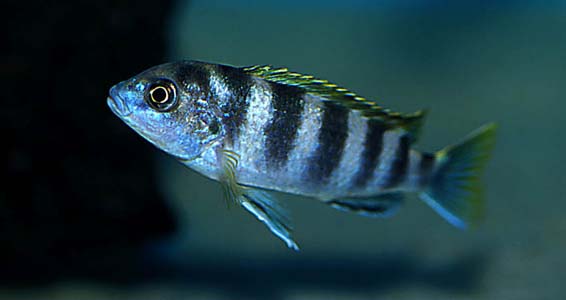
Labidochromis sp. "perlmutt"Pearly Labidochromis
Cichlidae · authority not recorded
This 'species' was only discovered in 1995, and remains undescribed to science. The common name 'perlmutt' is the German word for 'mother of pearl', and refers to the beautiful pearly white colouration of adult fish. It's sometimes sold with the alternative trade name of Labidochromis sp. 'yellow bar'. Konings has hypothesised that the Mbamba Bay Island population so closely resembles L. caeruleus that it may turn out to be a geographical variant o...
Lamprologus callipterus
Cichlidae · authority not recorded
In nature, the spawning nests of large male fish may measure several meters across and contain hundreds of snail shells. Interestingly, when they are protecting brooding females males do not eat and eventually become so weak that their territories are taken over by stronger fish. Immature and sub-dominant males can be seen over areas of open substrate where they feed voraciously in large shoals. Females are only ever found in areas containing the nests of dominant males. It appears that the ...
Lamprologus congoensisCongo Lamprologus
Cichlidae · authority not recorded
An interesting species which resembles the popular Steatocranus species, both physically and in lifestyle. It has several physiological adaptations to allow it to live in rapids and fast-moving waters. The body is very streamlined, with strong pectoral fins. The swimbladder is also modified, being much reduced in size. This makes the fish less buoyant and thus less likely to be swept away by strong currents. In the aquarium it spends most of its time on the substrate, where it swims in a comical...
Lamprologus lemairiiLemaire's Lamprologus
Cichlidae · authority not recorded
A highly piscivorous, predatory species unsuited to the general aquarium. It is an ambush predator in nature, often being seen hanging motionless around rocky structures or on the floor of the lake. It is a sedentary species and does not move around a lot. This is a behavioural adaptation known as thanatosis, or 'playing dead'. This strategy is usually used as a defensive means in other animals, but in L. lemairii it is adapted for offensive means. The fish has a mottled colour pattern...
Lestradea perspicax
Cichlidae · authority not recorded
There is some confusion regarding the taxonomy of this species and its congener L. stappersi. L. stappersi was originally regarded as a subspecies of perspicax but is now considered a distinct species. It is not often seen in the hobby....
Maylandia callainosCobalt Blue Zebra
Cichlidae · authority not recorded
This species was formerly classified as Pseudotropheus callainos and Metriaclima callainos and is still named as one of these by many sources. It has also been seen for sale as Pseudotropheus zebra "pearly". The genus name Maylandia is now used to describe all former members of the 'zebra' group of Pseudotropheus. It exists in three main colour forms, namely "cobalt blue", "orange blotch" and "pearl zebra". It is very easily confused with similar...
Maylandia greshakeiRed Top Ice Blue Zebra
Cichlidae · authority not recorded
This species was formerly classified as Pseudotropheus greshakei and Metriaclima greshakei and is still named as either of these by many sources. The genus name Maylandia is now used to describe all former members of the 'zebra' group of Pseudotropheus. An albino form of this species exists in aquaria and is occasionally available....
Maylandia zebraZebra Mbuna
Cichlidae · authority not recorded
...
Mchenga flavimanus
Cichlidae · authority not recorded
The genus Mchenga was erected in 2006 by Stauffer and Konings and currently numbers half a dozen species, all of which are previous members of Copadichromis. The reclassification was based on various morphological and behavioural traits, including habitat preference and breeding strategy. Together with Copadichromis, Mchenga spp. form an exclusive group of Malawian cichlids commonly referred to as "Utaka" (prounounced "ooh-taw-kuh"). They're specialised to a pelagic l...
Melanochromis auratusGolden Mbuna
Cichlidae · authority not recorded
Despite its ready availability, M. auratus is not recommended for the beginner due to its intolerant nature. Do not keep it with other Melanochromis species as they may hybridise. Male fish can revert to the golden colouration when stressed, and older females often darken with age until they superficially resemble males....
Melanochromis chipokae
Cichlidae · authority not recorded
This species belongs to the group of Melanochromis often called "Pike Auratus". These species predate on the fry of other species, although M. chipokae will also eat crustaceans and algae. Female and juvenile male M. chipokae are easily confused with M. auratus. However, it can be distinguished by its noticeably more pointed mouth, denoting the predatory nature of this species (auratus has a rounded mouth which is designed for feeding on algae). The striped patterning in the also exten...
Melanochromis cyaneorhabdos
Cichlidae · authority not recorded
M. cyaneorhabdos was formerly known as M. "maingano", after a village located on the shore off which it is found. It can be distinguished from the similar M. johanni by the overall blueish colouration of dominant males, as opposed to the more black patterning of johanni. It is sometimes incorrectly sold as "electric blue" johanni. Do not keep it with other Melanochromis species as they may hybridise....
Melanochromis johanni
Cichlidae · authority not recorded
This species can be distinguished from the similar M. cyaneorhabdos by the overall black colouration of dominant males, as opposed to the more blueish patterning of cyaneorhabdos. It is sometimes sold as "electric blue johanni". Do not keep it with other Melanochromis species as they may hybridise....
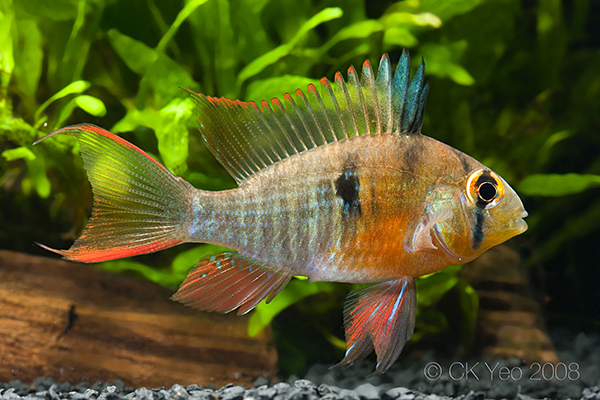
Mikrogeophagus altispinosusBolivian Ram
Cichlidae · Haseman, 1911
This species appears endemic to the upper rio Madeira basin in Bolivia and Brazil. Records exist from the Río Mamoré and Río Guaporé drainages in Bolivia (where the Guaporé is known as the Iténez) and Brazil plus the upper Río Orthon (ríos Tahuamanu and Manuripi). Type locality is 'sand-bank in the Rio Marm...
Mylochromis melanonotusHaplochromis Yellow-black Line
Cichlidae · authority not recorded
M. melanonotus is rarely imported and little information is available regarding its captive care. The shovel-like lower jaw possessed by some individuals of this species has been the cause of some confusion regarding the fishes' true identity. It was originally placed in the genus Platygnathochromis, in which it was the only species. However, Ad Konings observed that amongst wild breeding populations there existed individuals both with and without the modified lower jaw. The specimens witho...
Neolamprologus buescheriStriped Lamprologus
Cichlidae · authority not recorded
Not recommended for the beginner N. buescheri is one of the most aggressive small cichlids in the hobby. Several geographical morphs are available, including "gombi", "kachese", "kamakonde", and "zaire".
Neolamprologus fasciatusBarred Lamprologus
Cichlidae · authority not recorded
N. fasciatus is a predator by nature and its body shape has been adapted to allow it to enter small crevices and gaps in the rockwork of Lake Tanganyika to prey on invertebrates, eggs, fry and small fish. The lateral compression exhibited by this fish also makes the fish hard to spot head on, giving it an advantage over both its predators and prey. It hunts in a head down position a few feet above the substrate, moving its body in sinuous motions to counteract the water currents. It is sometimes...
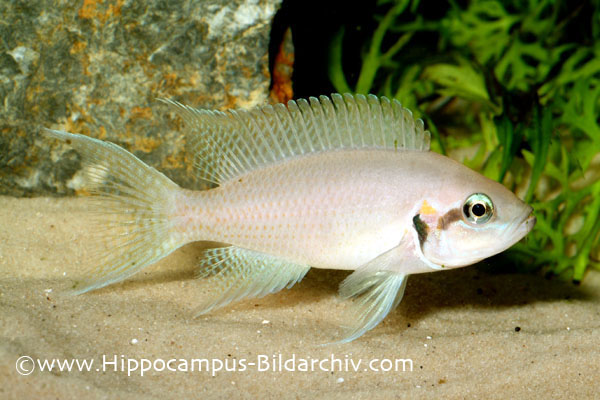
Neolamprologus pulcherBrichardi
Cichlidae · Trewavas & Poll, 1952
Deservedly one of the most popular Tanganyikan species available in the hobby, N. brichardi is ideal for newcomers to both Rift Lake cichlids and cichlids in general, being beautiful and easy to keep and breed. It is seen for sale under several common names including "Fairy Cichlid", "Lyretail Cichlid" and "Princess of Burundi". There are several colour morphs available, although these do not vary much in patterning, and an albino form is also occasionally available...
Neolamprologus tretocephalusFive-barred Lamprologus
Cichlidae · authority not recorded
It can be distinguished from the similar N. sexfasciatus by the presence of only five, rather than six, vertical bars on it's flanks. It is not recommended for the general Tanganyikan community due to it's aggressive nature, particularly when breeding....
Nimbochromis livingstonii
Cichlidae · authority not recorded
Not a fish for the general Malawi cichlid community, N. livingstonii is an ambush predator in nature, often being seen hanging motionless around rocky structures, in Vallisneria thickets or on the floor of the lake. It is a sedentary species and does not move around a lot. This is a behavioural adaptation known as thanatosis, or 'playing dead'. This strategy is usually used as for defensive means in other animals but in N. livingstonii is adapted for offensive means. The fish has a mot...
Nimbochromis venustusVenustus
Cichlidae · authority not recorded
Not a fish for the general Malawi cichlid community, N. venustus is an ambush predator in nature. It is often found hanging motionless around rocky structures, in Vallisneria thickets or on the floor of the lake. It is a sedentary species and does not move around a lot. This is a behavioural adaptation known as thanatosis, or 'playing dead'. This strategy is usually used as for defensive means in other animals but in N. venstus is adapted for offensive means. The fish has a mottled col...
Ophthalmotilapia boops
Cichlidae · authority not recorded
This was the first species to be placed into the genus Ophthalmotilapia.
Ophthalmotilapia nasuta
Cichlidae · authority not recorded
O. nasuta can be distinguished from other members of the genus primarily by the fleshy proboscis-like growth that extends beyond the upper lip. It exists in several different geographical morphs including "Kachese", "Mpimbwe", "Cape Tembwe" and "Chamba", among others. These should not be mixed in aquaria as they will hybridise freely....
Ophthalmotilapia ventralis
Cichlidae · authority not recorded
This is a truly stunning species that does well in a Tanganyikan community with well-chosen tankmates. It exists in well over 20 colour morphs, too many to list here. Obviously these should not be mixed in aquaria as they will hybridise freely. In nature, it is only the largest dominant males that build nests whilst the subdominant males and females shoal together. The territories of these dominant fish may measure several metres across....
Oreochromis mossambicusMozambique Mouthbrooder
Cichlidae · authority not recorded
One of the most invasive fish species in the world, O. mossambicus is one of the species farmed for supermarkets and restaurants across the globe. Several colour varieties have been selectively bred from the natural green fish to make the fish more appealing to consumers and unsurprisingly, it is these more brightly coloured forms which are usually seen in aquaria. Some of these variants are cross breeds with other species of Oreochromis. The destructive effect of O. mossambicus on non-nativ...
Oreochromis niloticus niloticusNile Tilapia
Cichlidae · authority not recorded
One of the most invasive fish species in the world but also one of the most economically important, O. niloticus is bred in huge numbers in many countries as a food fish. It is often cross-bred with other Oreochromis species for colour in order to make the fish more appealing to consumers. The destructive effect of O. niloticus on non-native ecosystems into which it escapes or is released is mainly due to it's adaptibility. It has been recorded over a temperature range of 60-110°F an...
Oreochromis tanganicaeTanganyikan Tilapia
Cichlidae · authority not recorded
This large Tanganyikan species is not seen very often in the hobby. It is often seen in shoals in nature, where it appears to feed primarily on phytoplankton. An adult male would make a truly stunning specimen fish....
Orthochromis stormsi
Cichlidae · authority not recorded
O. stormsi was previously classified as Schwetzochromis stormsi and is still named as such by many sources. Its swimbladder is modified, being much reduced in size. This makes the fish less buoyant and therefore less likely to be swept away by the strong currents in its natural habitat. In the aquarium it spends most of its time on the substrate, where it swims in a characteristic 'hopping' fashion. Unfortunately, it is rather rare in the hobby....
Parachromis managuensisJaguar Cichlid
Cichlidae · authority not recorded
Parachromis Managuense are your typical north/central American large predatory cichlid. They are extremely attractive, but a large aquarium is required. They are not difficult to look after, as long as filtration is up to standard. Choose tankmates carefully - if you are hoping to breed Managuense, house a breeding pair or grow 6 juveniles up until a pair is formed. One of the biggest problems with breeding Managuense is the fact that a single spawn from 12" parents can produce 3000 f...
Paracyprichromis brieni
Cichlidae · authority not recorded
Although P. brieni is better kept in a group, it tends to form much looser shoals than the similar Cyprichromis species. Male fish form territories under overhangs if they are available and can often be seen hanging upside down under these or vertically against rock walls. In the aquarium if it is not provided with such retreats, or if it is housed under bright lighting or with boisterous fish it will rapidly lose its best colouration. It is quite easily confused with P. nigripinnis, it'...
Paracyprichromis nigripinnis
Cichlidae · authority not recorded
Although P. nigripinnis is better kept in a group, it tends to form much looser shoals than the similar Cyprichromis species. Male fish form territories under overhangs if they are available and can often be seen hanging upside down under these or vertically against rock walls. In the aquarium, if it is not provided with such retreats, or if it is housed under bright lighting or with boisterous fish, it will rapidly lose it's best colouration. It is quite easily confused with P. brieni,...
Paretrolplus damii
Cichlidae · authority not recorded
An attractive, if aggressive Madagascan cichlid. Not commonly available in the UK, it can occasionally be obtained through cichlid enthusiasts aor specialist dealers.
Petrochromis famula
Cichlidae · authority not recorded
The mouthparts of this species are highly specialised, reflecting its natural feeding habits of rasping algae and other organisms from rock surfaces. It feeds almost exclusively on unicellular algae and has very thick, extended lips and brush-like, mobile pads of teeth. The mouthparts thus form a rasping 'plate', used when the fish is feeding. It is somewhat rare in the hobby, perhaps due to its violent reputation or the fact that this is not a particularly gregarious species in nature...
Placidochromis electraDeepwater Hap
Cichlidae · authority not recorded
The common name is derived from the fact that it was previously thought to be found only in much deeper water than we now know it inhabits. In nature, P. electra feeds from the surface of the substrate on invertebrates and other morsels stirred up by the action of digging substrate feeders such as Taeniolethrinops praeorbitalis. It is attracted to the clouds of sediment thrown up by these species. Several colour forms exist and these should not be kept together in aquaria as they may hybridis...
Protomelas fenestratusFenestratus
Cichlidae · authority not recorded
This species has an interesting method of feeding in nature. It will 'blow' sediment from the surface of rocks and feed on morsels that are uncovered. Protomelas sp. "steveni taiwan reef" is often sold as a subspecies of P. fenestratus but is actually thought not to be synonymous. P. taeniolatus is also very similar to fenestratus, and several colour forms of both these species exist. It is likely that some of these may be reclassified as distinct species in the future. None ...
Protomelas pleurotaenia
Cichlidae · authority not recorded
This species has an interesting method of feeding in nature. It 'blows' at the top layer of the substrate (usually sand) and feeds on any invertebrates or other morsels that are uncovered. It is rare in the hobby and little information regarding it's care is available....
Protomelas sp. steveni "Taiwan reef"
Cichlidae · authority not recorded
Protomelas sp. "steveni taiwan reef" is often sold as a subspecies of P. fenestratus, but is actually thought not to be synonymous and is currently undescribed. It can be distinguished from similar species such as P. fenestratus and P. taeniolatus by the bright redof adult males. None of these related species or morphs should be kept together in aquaria as they may hybridise. Some captive spawns of this species have resulted in albino fry. It is one of the more popular and readily a...
Pseudocrenilabrus nicholsi
Cichlidae · authority not recorded
Rarely seen in the hobby, P. nicholsi is a stunning but pugnacious little fish that is nevertheless well worth seeking out. Some males develop long extensions to the ventral fins.
Pseudocrenilabrus philanderSouthern Mouth-Brooder
Cichlidae · authority not recorded
This species is not often seen in the hobby, which is a pity as it is a stunning fish with interesting behaviour. If you do manage to get some, be sure to provide the best possible conditions from the start, as they appear to travel quite badly and losses are common. There are currently 3 subspecies, Pseudocrenilabrus philander philander, P. p. dispersus and P. p. luebberti. However, recent studies suggest as many as 11 distinct populations exist, differing in location, colour, patterning, be...
Pseudotropheus demasoni
Cichlidae · authority not recorded
This dwarf mbuna is one of the more recent introductions into the hobby, being described only in 1994. It is not recommended for the beginner due to its pugnacious nature, but does make a good aquarium subject for the advanced aquarist. It exhibits some very entertaining behavioural traits, preferring to hug the rock surfaces much more than most mbuna. It will often be seen swimming on its side or upside down as it explores caves and crevices. As with other members of the genus, it possesses fla...
Pseudotropheus elongatusElongate Mbuna
Cichlidae · authority not recorded
Over 30 different forms of this species occur in Lake Malawi. These should not be mixed in the aquarium as they will hybridise freely. P. elongatus differs morphologically from other mbuna, being relatively slender and elongate. In nature females protect territories which contain 'gardens' of algae which they leave to breed before returning once they are holding eggs. Juvenile fish from previous spawns also inhabit the territory, protecting it when the female is away. This species i...
Pseudotropheus estheraeRed Zebra
Cichlidae · authority not recorded
A deservedly popular mbuna, there is ongoing debate as to the true genus of this species, it having been variously grouped in both Maylandia and Metriaclima, as well as the currently valid Pseudotropheus. It is unlikely it will remain in Pseudotropheus. To add to the confusion, it was only described as a distinct species in 1995, having previously been regarded as a morph of Maylandia zebra. Several colour forms are available and these should not be kept together under any circumstances as they ...
Pseudotropheus fainzilberiGoldbreast Zebra
Cichlidae · authority not recorded
There is ongoing debate as to the true genus of this species, it having been variously grouped in both Maylandia and Metriaclima as well as the currently valid Pseudotropheus. It is unlikely it will remain in Pseudotropheus, however. One interesting feature is the presence of additional rows of teeth when compared to others in the genus. Also, the rows of bicuspid teeth, used for rasping algae from rock surfaces, extend further back into the mouth than in other Pseudotropheus. P. fainzilberi...
Pseudotropheus flavus
Cichlidae · authority not recorded
Although it is a good choice for the general mbuna community, as mentioned above P. flavus should not be kept together with any member of the P. elongatus complex. Not only will these species interbreed, producing undesirable hybrid offspring, but males of these species will clash very heavily. As with other members of the genus it possesses flat, bicuspid teeth which are designed for scraping algae and other organisms from the surface of rocks....
Pseudotropheus lombardoiKennyi
Cichlidae · authority not recorded
A popular mbuna that has been in the hobby for many years. There is ongoing debate as to the true genus of this species, it having been variously grouped in both Maylandia and Metriaclima, as well as the currently valid Pseudotropheus. It is unlikely it will remain in Pseudotropheus, however, and many sources already consider it a member of Metriaclima. As with other members of the genus, it possesses flat, bicuspid teeth which are designed for scraping algae and other organisms from the surface...
Pseudotropheus socolofiPowder Blue Cichlid
Cichlidae · authority not recorded
This common mbuna also goes by the names "Eduard's mbuna" and "Pindani". It is one of the most popular Rift Lake cichlids in the hobby due to its striking colouration and somewhat peaceful nature (for a mbuna). Wild fish can now be quite difficult to find, as the vast majority of specimens offered for sale are tank-bred. An albino form exists in aquaria and has achieved a fair degree of popularity. A highly recommended beginner's mbuna....
Pseudotropheus tropheops tropheops
Cichlidae · authority not recorded
This species has a confusing taxonomic past. There are currently 3 subspecies, Pseudotropheus tropheops tropheops, P. t. romandi and P. t. gracilior. P. macrophthalmus and P. microstoma were also once considered as subspecies of tropheops, but are now classed as distinct species. Furthermore, it is likely that the current subspecies and their various colour forms (of which there are many) will be themselves reclassifed into the currently invalid genus Tropheops! Incidentally, none of the subspec...
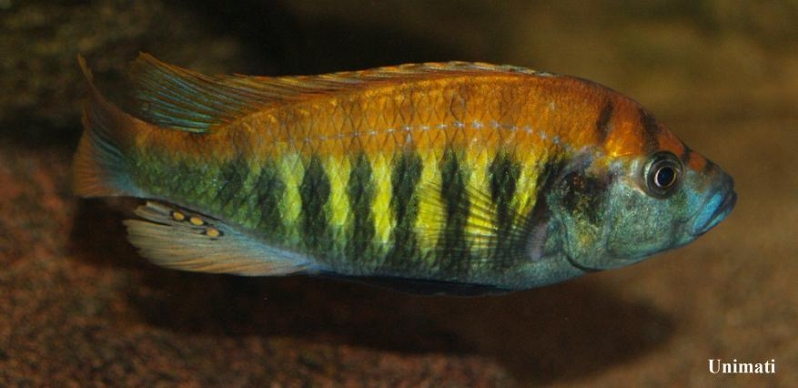
Pundamilia nyererei
Cichlidae · Witte-Maas & Witte, 1985
Endemic to Lake Victoria which has a shoreline divided between Kenya, Uganda and Tanzania, although P. nyererei has been recorded only in the southern part of the lake belonging entirely to Tanzania. Type locality is 'Mwanza Gulf, Tanzania, Lake Vic...
Pungu maclareni
Cichlidae · authority not recorded
This is currently the only described species in the genus Pungu. Because of it's its tiny natural range, habitat destruction due to excess water removal (the nearby town of Kumba relies on the lake for it's water supply), deforestation, the introduction of non-native species and overfishing, it is considered to be critically endangered and all efforts at captive breeding are to be encouraged. It is correspondingly rare in the hobby, and we suggest purchasing some only if you intend to ...
Reganochromis calliurus
Cichlidae · authority not recorded
A rarely seen species in the hobby due to its deep water lifestyle and the associated difficulties with collecting it.
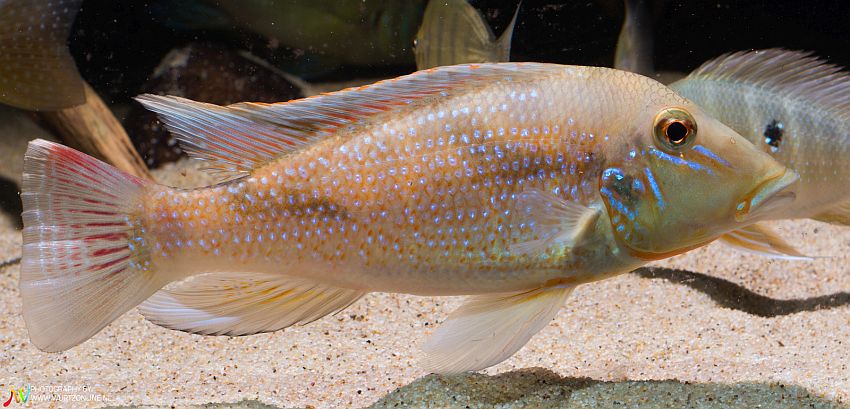
Retroculus lapidifer
Cichlidae · Castelnau, 1855
Retroculus spp. are unsuitable for the standard community aquarium, and should be maintained in a set-up designed to resemble a flowing river. The substrate should be composed of soft sand mixed with small pebbles if the aim is to breed the fish (see 'Reproduction'). Rocks, boulders, roots, branches, and aquatic plants can also be added, although the la...
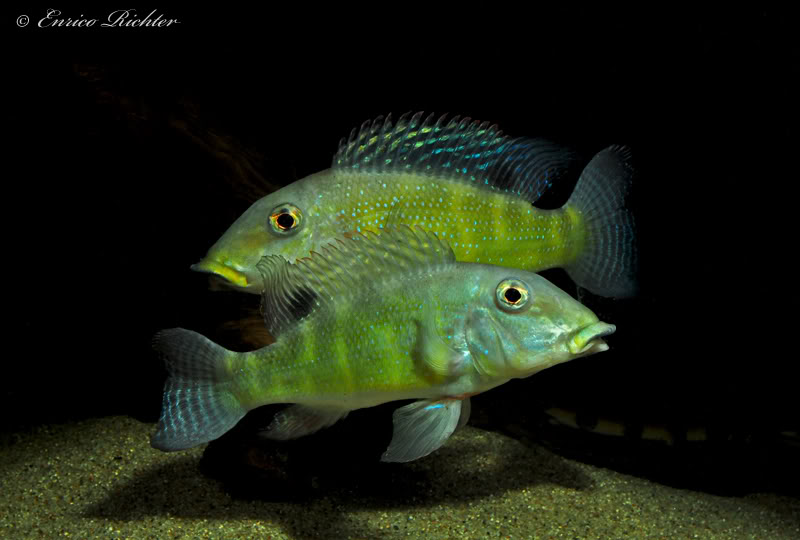
Retroculus xinguensis
Cichlidae · Gosse, 1971
The precise extent of this species' range is unclear. The majority of records pertain to the lower rio Xingu basin in the state of Pará, northern Brazil, including middle and lower reaches of its major tributary the rio Iriri, although the type locality is in Mato Grosso state several hundred kilometres upstream. There also exist a handful of records from the rio Jamanxim (a major affluent of the rio Tapajós which drain...
Sarotherodon melanotheron melanotheronBlack Chin Tilapia
Cichlidae · authority not recorded
At present there are 5 sub-species, Sarotherodon melanotheron melanotheron, S. m. heudelotii, S. m. leonensis, S. m. nigripinnis and S. m. paludinosus. Confusingly, some of these are maternal mouthbrooders. It has been introduced into several countries for aquaculture purposes and thriving populations now exist in areas of Asia, Europe and the USA....
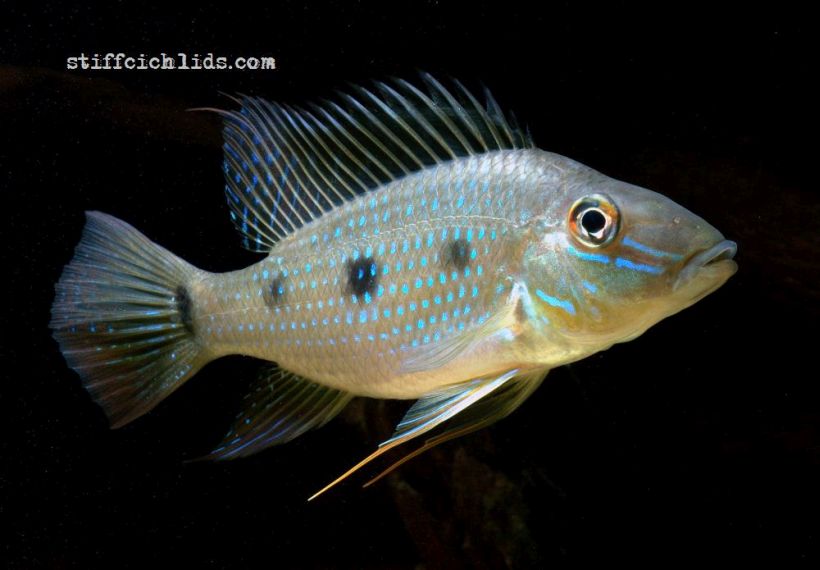
Satanoperca acuticepsSharphead Eartheater
Cichlidae · Heckel, 1840
This species is relatively rare in the ornamental trade, where it is sometimes confused with its similarly-patterned congeners S. daemon and S. lilith. These three species all possess 1-3 dark blotches on the side of the body and a relatively large ocellus on the upper caudal-fin base, characters that immediately separate them from the remainder of the genus which lack blotches on the body and have a relatively small ocellus on the upper caudal-fin base.
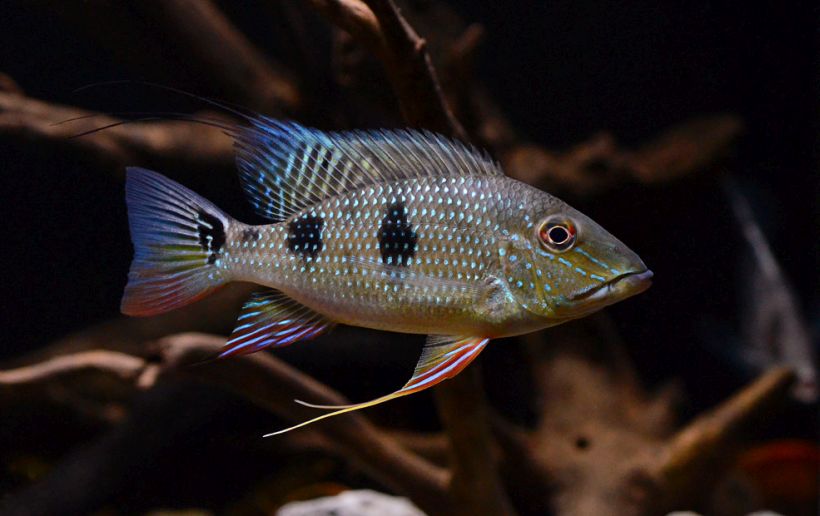
Satanoperca daemonThreespot Eartheater
Cichlidae · Heckel, 1840
S. daemon is relatively common in the aquarium trade but is by no means easy to maintain, with particular attention to space, diet, water quality, and chemistry required in order for it to thrive. It can be distinguished from other members of the genus by possessing two dark blotches on the flank and a prominent ocellus at the caudal-fin base. Among the named species it is most similar to...
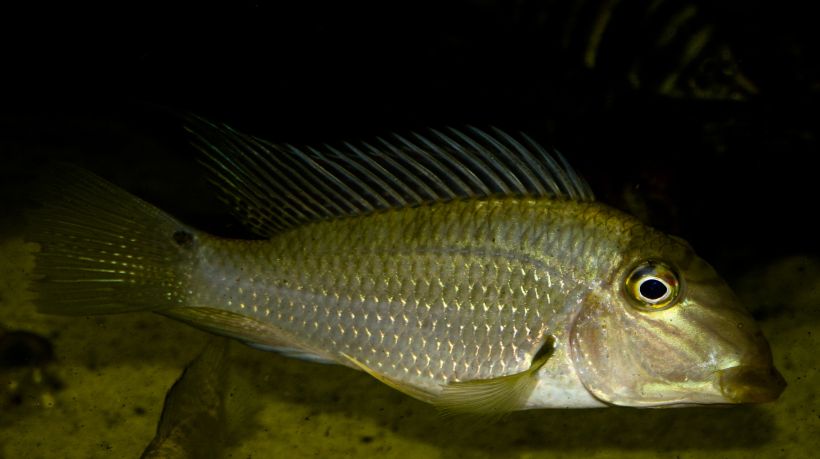
Satanoperca jurupariDemon Eartheater
Cichlidae · Heckel, 1840
S. jurupari is also known as 'demon fish', 'jurupari earth eater', 'green horse face', or simply 'jurupari' in the aquarium hobby. It can be distinguished from other members of the genus by the following combination of characters: presence of a relatively small dark ocellus on the upper caudal-fin base; absence of well-defined dark blot...
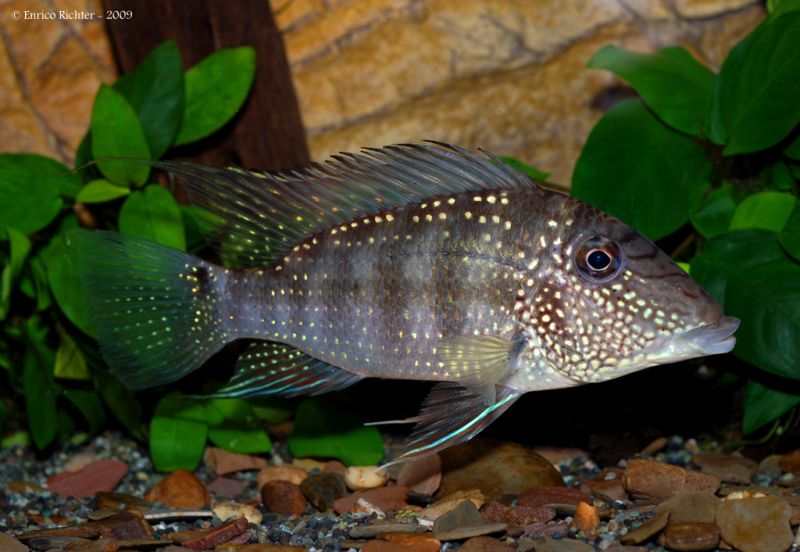
Satanoperca leucostictaWhitespot Eartheater
Cichlidae · Müller & Troschel, 1849
S. leucosticta is frequently available in the ornamental trade and farmed for the purpose in several countries. It is often confused with its congener S. jurupari in aquarium literature and on websites, but is easily recognised by presence (vs. absence) of prominent white spots or vermiform markings on the sides of the head. Although the presence of white spots on the head does not distinguish it from all known Satanoperca populations (see below), it can...
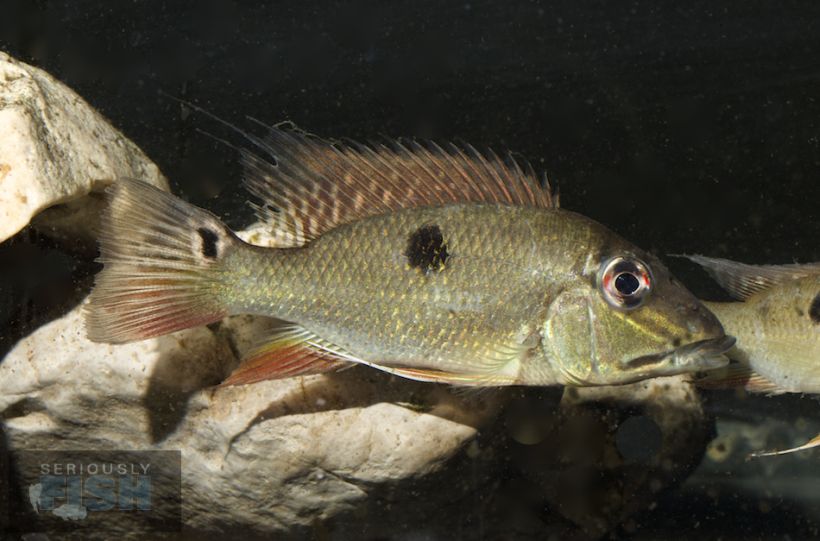
Satanoperca lilith
Cichlidae · Kullander & Ferreira, 1988
Despite its extensive natural distribution S. lilith is uncommon in the ornamental trade, where it is sometimes referred to as 'one-spotted demon fish' or 'one spot eartheater'. It can be distinguished from other members of the genus by possessing a single dark blotch on the flank and a prominent ocellus at the caudal-fin base. Among the named species it is most similar to S. daemon, but that species possesses two blotches on the flank.
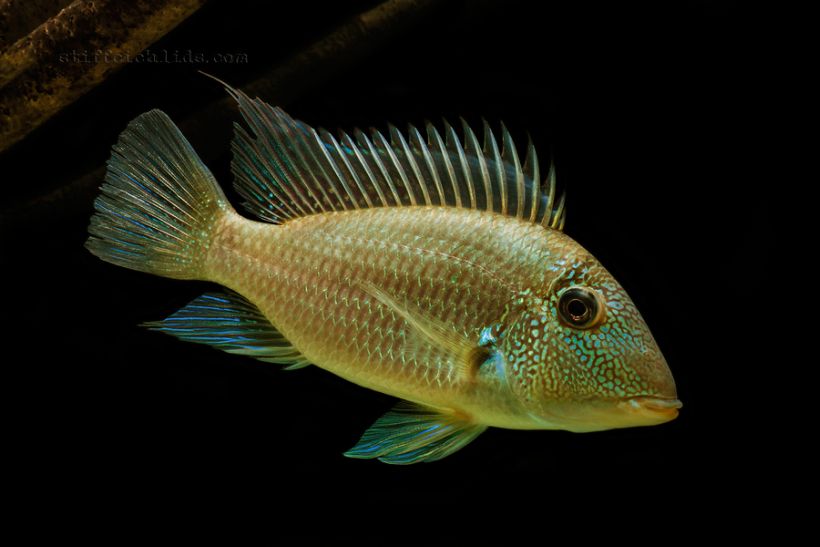
Satanoperca mapiritensis
Cichlidae · Fernández-Yépez, 1950
Recent genetic research has revealed there to be a possibility that although S. mapiritensis is genetically distinct from S. leucosticta, it may turn out to be conspecific with S. jurupari and S. rhynchitis. There appears to be no clear genetic separation between these three putative species nor a form known to aquarists as S. sp. 'Negro-Alto Orinoco' which replaces S. mapiritensis in the middle and upper Orinoco, Casiquiare Canal, and upper rio Negro.
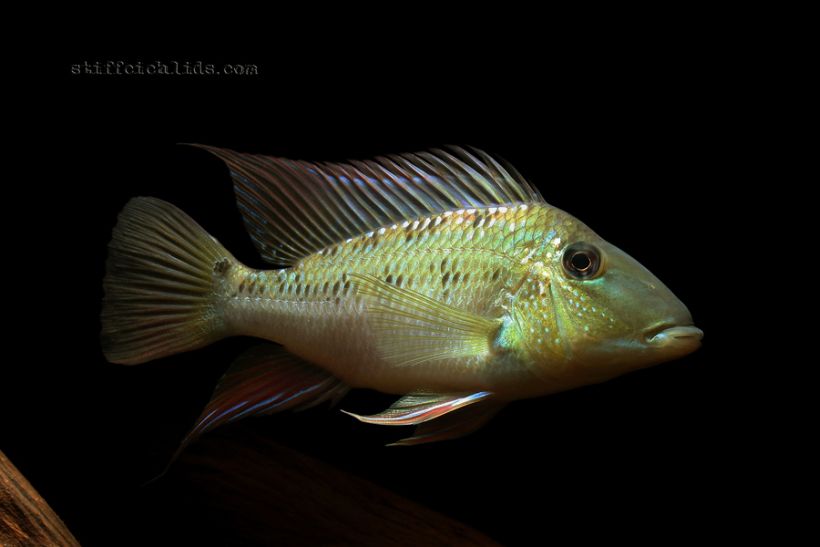
Satanoperca pappaterraPantanal Eartheater
Cichlidae · Heckel, 1840
S. pappaterra is relatively rare in the ornamental trade and much sought after by enthusiasts. It is easily distinguished from all known congeners by presence of a series of prominent black blotches beneath the dorsal-fin, plus a well-defined dark band extending along the side of the body. In recent genetic analyses its genetic distinctness was strongly supported, with S. jurupari and S. leucosticta its closest relatives.
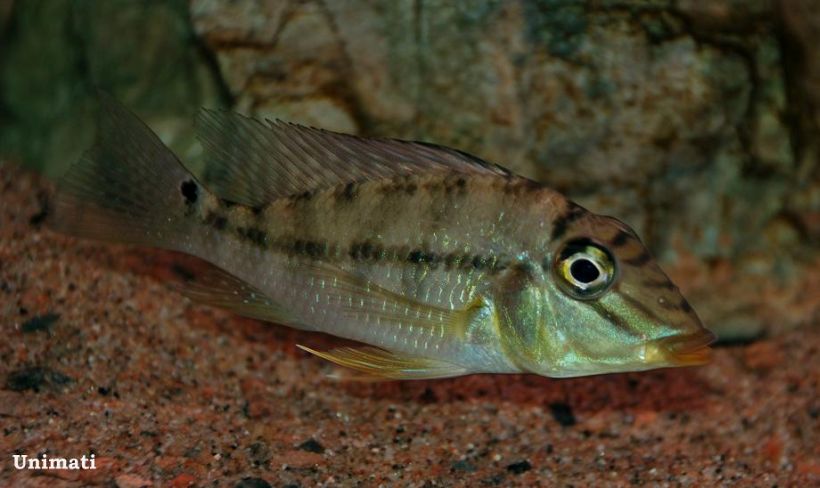
Satanoperca rhynchitis
Cichlidae · Kullander, 2012
Based on current knowledge, it thus remains impossible to deduce whether the group of putative species currently comprising S. jurupari, S. mapiritensis, and S. rhynchitis, plus populations from Amapá and the upper Negro/upper Orinoco region, represent distinct taxa or a single meta-population which can be referred to as S. jurupari sensu lato. Here on SF we include the named species separately, since they continue to be considered valid.
Sciaenochromis fryeriElectric Blue Hap
Cichlidae · authority not recorded
This popular species was previously imported and classified as Sciaenochromis ahli, and is still named as such in much of the available literature. Many morphs exist, although males of all these exhibit the characteristic blue colouration, differing only in fin colouration and patterning. These should not be mixed in aquaria as they will hybridise. Extra care must be taken regarding tankmates, too, as male S. fryeri have been known to spawn with females of other genera, particularly Aulonoca...
Stomatepia pindu
Cichlidae · authority not recorded
Because of it's its tiny natural range, habitat destruction due to excess water removal (the nearby town of Kumba relies on the lake for it's water supply), deforestation, the introduction of non-native species and overfishing, it is considered to be critically endangered. All efforts at captive breeding are to be encouraged. However, it is correspondingly rare in the hobby. The area around Lake Barombi Mbo has been suggested to be designated a protected area, but as yet this has not o...
Taeniacara candidi
Cichlidae · authority not recorded
Taeniacara Candidi are the source of much discussion amongst dwarf cichlid keepers. They are a highly attractive species, but require very specific water parameters and as such are seen as a challenge amongst even experienced south american cichlid keepers. Candidi are renowned for not liking water changes - they will commonly get "moody" after a water change, and will sulk at the bottom of the tank for over a day in some cases. Try to keep new water at the same temperature as the C...
Tanganicodus irsacae
Cichlidae · authority not recorded
This is one of the so-called Tanganyikan Goby Cichlids. They occur only in the upper few feet of water around rocky shores, also known as the surge zone, where they scrape algae from the rocks with their specialised teeth. This habitat is typified by breaking waves and strong currents. They have a few adaptations allowing them to inhabit such an environment. The swim bladder is rendered useless to reduce their buoyancy. They also have a longand a laterally compressed body shape to allow them to ...
Telmatochromis vittatus
Cichlidae · authority not recorded
Similar in lifestyle to Julidochromis species, Telmatochromis vittatus is ideal for the smaller Tanganyikan community and is also a good choice for the beginner. It can be distinguished from the similar T. brichardi and T. bifrenatus primarily by its larger size, smaller eyes and more rounded nose. Like other Lamprologines, Telmatochromis have fang-like, caniform teeth, which they use for scraping microrganisms from rock surfaces. On adult specimens these are clearly visible....
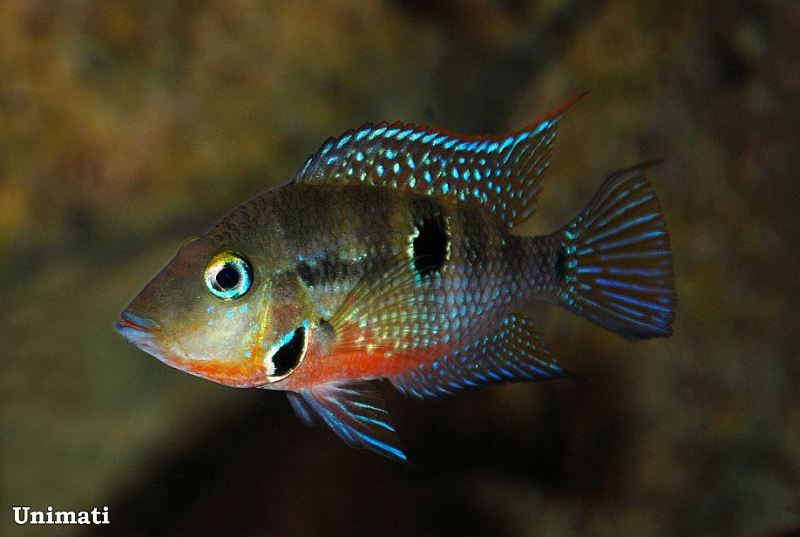
Thorichthys meekiFiremouth Cichlid
Cichlidae · Brind, 1918
This species has been a popular aquarium fish for a considerable period and virtually all fish traded are now raised commercially for the purpose. It is easily identified by the characteristic bright red or orange underside of the head, which is more pronounced in adults. Following Miller and Taylor (1984), the genus Thorichthys is identified...
Tilapia guinasana
Cichlidae · authority not recorded
Rare in the hobby, this species is unfortunately considered critically endangered in the wild. The lake in which it is found is receiving less groundwater than it once was, due to extraction of water for agriculture. Even if this were not the case, the species is found over such an enclosed range that it would still be at extreme risk. All attempts at captive breeding are therefore to be encouraged, with care being taken to keep the different lines pure. Interestingly, as there are no natural...
Trematocranus placodonSnail-Crusher Hap
Cichlidae · authority not recorded
An ideal species for the larger Malawian community but one not often seen for sale. In nature, it is a molluscivore, feeding primarily on snails. It has specially developed pharyngeal teeth, which can crush and grind the shells of these animals with ease. Several other species were originally assigned to the genus but currently, only 3 species of Trematocranus exist, most having been reclassified as Aulonocara or Alticorpus....
Tyrannochromis macrostomaBig-Mouth Hap
Cichlidae · authority not recorded
T. macrostoma is an ambush predator in nature, lurking behind rocks and in crevices as it stalks its prey. It is rarely seen in the hobby and is usually quite expensive. Juveniles are easily confused with the similar T. nigriventer, but are easily distinguished when adult, as nigriventer does not develop the dark belly of macrostoma. Interestingly, this species exhibits reverse countershading, as also seen in the common Upside-down catfish, Synodontis nigriventris. This means that unlike the...
Vieja argenteaSilver Cichlid
Cichlidae · authority not recorded
A strikingly coloured, if somewhat aggressive fish. Also referred to as the White Cichlid, it is occasionally available in the UK through specialist cichlid dealers.
Vieja fenestrata
Cichlidae · authority not recorded
A very attractive fish when in adult colouration, vieja fenestrata is not all that common in the UK hobby. It can is often confused with the more commonly available v. synspila.
Xenotilapia flavipinnisYellow Sand Cichlid
Cichlidae · authority not recorded
In nature, the pair bond formed by this species lasts only for the duration of the breeding season. However, in aquaria this bond can last much longer, with the pair remaining in their territory and defending it even when not spawning. It is thought that this is directly due to the fish being kept in the confines of the aquarium, where the territory is a permanent fixture. X. flavipinnis is very sensitive to deteriorating water conditions and regular water changes are essential to its good heal...
Xenotilapia simaBig-Eyed Xenotilapia
Cichlidae · authority not recorded
A rarely seen species in the hobby, X. sima is nevertheless a charming species for the peaceful Tanganyikan community. It feeds in a similar way to the well-known South American Geophagus species in that it will sift sand through its gills to extract invertebrates and morsels hidden in the substrate. It is quite a skittish fish and may react very nervously to rapid movements outside the tank or when lights are switched on and off....
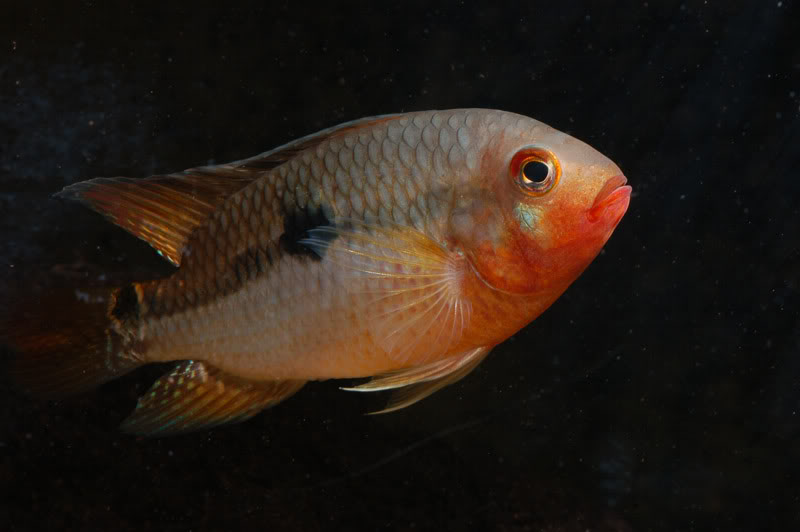
Aequidens tetramerusSaddle Cichlid
Cichlidae · Heckel, 1840
This is the type species of the genus Aequidens and has the widest distribution of any member species. It exists in various colour forms depending on locality with variants from Ecuador and Peru being particularly sought after since they develop striking red (Ecuador) or orange (Peru) colouration on the lower part of the jaw, head and anterior portion of the belly whereas those from Brazil tend to have an overall grey/blue/green colouration, for example. Despite its type status it's long...
Alcolapia grahamiGraham's Soda Cichlid
Cichlidae · Boulenger, 1912
This species is a true wonder of nature. It lives in a soda lake which is full of hot, alkaline springs. The water contains a high concentration of sodium carbonate and other dissolved minerals and salts. The water conditions in the lake are typically pH 9.5-10.5, kH 7000+ and temperature 90-110°F! The water also has a sg reading of 1.2+ and is very shallow, having a maximum depth of only 3 metres. It can be acclimatised to more 'normal' conditions but the pH should not be allowed ...
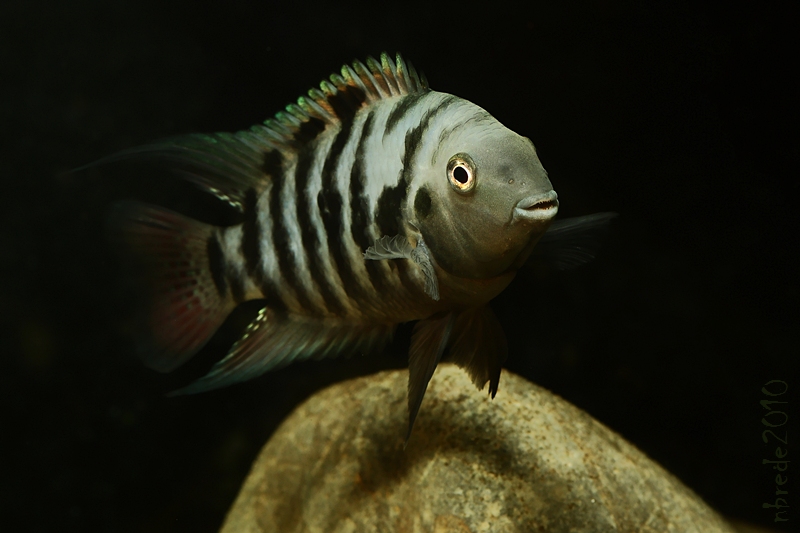
Amatitlania nigrofasciataConvict Cichlid
Cichlidae · Günther, 1867
A hugely popular and very adaptable species, the convict is one of the most ubiquitous fish in the hobby. It is often referred to by synonyms such as Cryptoheros nigrofasciatus and Cichlasoma nigrofasciatus. It's difficult to know how much to recommend it to the beginner, as despite its hardiness and ease of breeding, it's not really a community fish. However, if you want to breed a species and witness some amazing parental behaviour, it's an unreserved recommendation. It now exis...
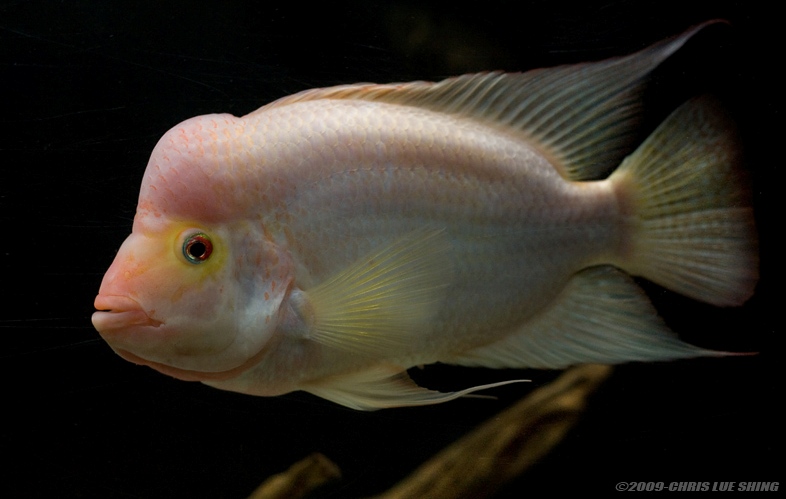
Amphilophus citrinellusMidas Cichlid
Cichlidae · Günther, 1864
Previously included as a member of the genus Cichlasoma, the midas cichlid is often confused with the red devil, A. labiatus. The two can be distinguished through differences in morphology. As suggested by its scientific name, A. labiatus often possesses characteristically large lips, although this is variable and should not be used as a defining indicator of species. More reliable differences include the bigger nuchal hump and more thick-set appearance in A. citrinellus. The midas exists in many n...
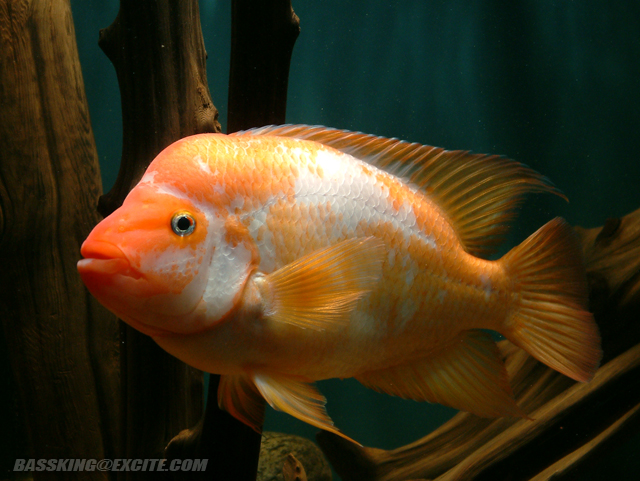
Amphilophus labiatusRed Devil Cichlid
Cichlidae · Günther, 1864
Previously included as a member of the genus Cichlasoma, the red devil is often confused with the midas cichlid, A. citrinellus. The two can be distinguished through differences in morphology. As suggested by its scientific name, A. labiatus possesses characteristically large lips, although in reality this is variable and should not be used as a defining indicator of species. Certainly, tank bred fish tend not to have these large lips. More reliable differences include the bigger nuchal hump and mo...
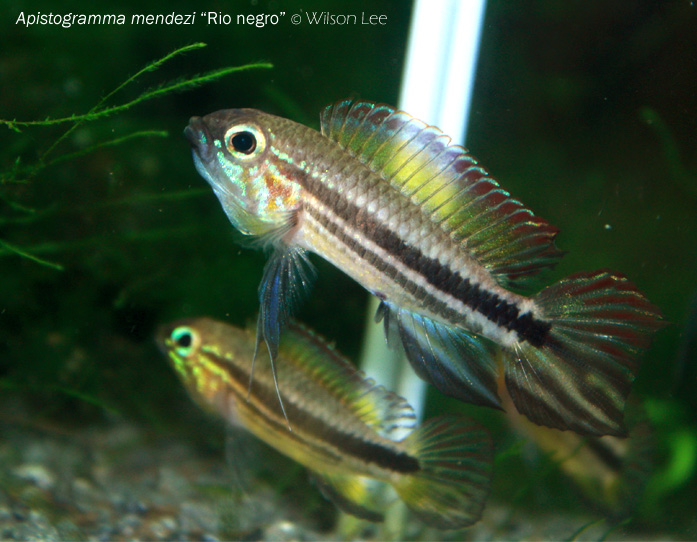
Apistogramma mendeziA220
Cichlidae · Römer, 1994
This species is assigned the codes A220, A221 and A222 under the DATZ 'A' number system with these referring to similar-looking, possibly conspecific, populations. These differ in some aspects of colour pattern, particularly the orientation of the caudal-fin markings which may be horizontal, vertical, or somewhere inbetween. One population displays an orange colouration on the belly and is som...
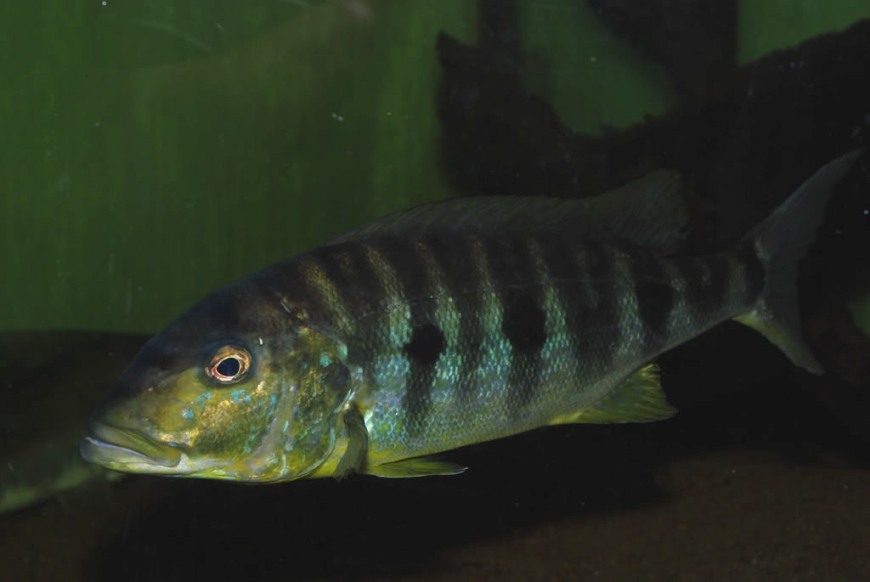
Boulengerochromis microlepisEmperor Cichlid
Cichlidae · Boulenger, 1899
Mostly inhabits littoral to sublittoral zones, habitats which normally comprise a mixture of rocky rubble and exposed sandy areas, but has been recorded to depths of around 100 m. When not breeding adults exhibit a more-or-less pelagic lifestyle and apparently tends to form small, foraging groups in open water, whereas juveniles inhabit shallower, sandy nursery zones with some rock cover. There exists some evidence to suggest that adults move inshore at night or during early morning in order to feed.
Cichla monoculusTucanare Peacock Bass
Cichlidae · authority not recorded
Due to their large size, Peacock Bass are only really recommended for the experienced fishkeeper that can house them adequately. That said, they are a hardy and robust species that will adapt to a variety of conditions. Peacock Bass are becoming much more available in the hobby and are often seen for sale as cute 2" babies, often tempting people into buying a fish they will not be able to care for in the long term. Peacock Bass are also fished as a sport fish....
Cichla ocellarisPeacock Bass
Cichlidae · authority not recorded
Due to their large size, Peacock Bass are only really recommended for the experienced fishkeeper that can house them adequately. That said, they are a hardy and robust species that will adapt to a variety of conditions. Peacock Bass are becoming much more available in the hobby and are often seen for sale as cute 2" babies, often tempting people into buying a fish they will not be able to care for in the long term. Peacock Bass are also fished as a sport fish....
Cichlasoma bolivienseBolivia Cichlid
Cichlidae · authority not recorded
Sometimes referred to (incorrectly) as cichlasoma boliviensis, the Bolivia cichlid is not commonly seen in the hobby. A good candidate for a community of medium sized cichlids, assuming aggression problems can be overcome.
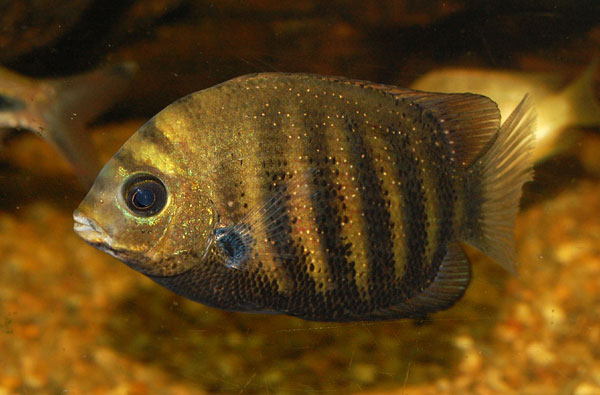
Etroplus suratensisGreen Chromide
Cichlidae · Bloch, 1790
This species is euryhaline and mostly inhabits brackish estuaries, coastal lagoons and the lower reaches of rivers. It also occurs in freshwater habitats, however, including a number of inland lakes in Sri Lanka although it appears to have been introduced intentionally.
Gymnogeophagus balzaniiParaguay Eartheater
Cichlidae · authority not recorded
A very interesting species that sadly is only recommended to the specialist able to provide it with the specific conditions it requires for its long term health. There are a couple of different colour forms available, dependant on locality.
Hemichromis elongatusFive Star General
Cichlidae · authority not recorded
A real bruiser of a cichlid, H. elongatus is not seen for sale very often, and with good reason. Pound for pound it must rank as one of the most aggressive cichlids available in the hobby. It is such an efficient predator that, in some of its native countries, it is used to control populations of Tilapia. As a result it's definitely not recommended for the inexperienced aquarist. The common name is derived from the row of 5 dark markings that run laterally along the flanks of the fish. I...
Herotilapia multispinosaRainbow Cichlid
Cichlidae · authority not recorded
Relatively common in the hobby, the Rainbow Cichlid makes an ideal CA cichlid for those who do not wish to manage the challenge of the more aggressive CA species.
Julidochromis marlieriMarlier's Julie
Cichlidae · authority not recorded
Julidochromis are commonly known as "Julies" in the hobby. This particular species may also be seen for sale as the Chequered Julie. A truly characterful cichlid exhibiting quirky behaviour, it will swim hugging the rock surfaces no matter what the angle is. As with other Julies, large water changes should be avoided as this can cause mated pairs to turn on one another. Several geographical morphs are available. However, no two species or morphs of Julidochromis should be kept togethe...
Mesonauta insignis
Cichlidae · authority not recorded
There is some debate that this species is actually the fish that finds its way into aquatic stores under the name of the Flag cichlid (normally attributed to m. festivus). The two fish look very similar and, in reality, it is likely that both species are sold under the same name - depending on the area where the fish were originally caught and exported from....
Nannacara anomalaGolden Dwarf Cichlid
Cichlidae · authority not recorded
Nannacara Anomala are widely available in the trade, and are generally regarded as an excellent beginner's fish. If a beginner is interested in keeping Cichlids and learning about breeding, then these fish are absolutely ideal. Anomala are attractive, hardy and usually quite cheap to purchase. Like some species of the Apistogramma genus, the mother may use fascinating body language to communicate with her fry when she is caring for them. If there is more than one male in a tank smalle...
Neolamprologus sexfasciatusSix-barred Lamprologus
Cichlidae · authority not recorded
Several geographical morphs of this species are available, including "Sambia" and "Kipili". These vary in base colour from blue to yellow to white. It is not recommended for the general Tanganyikan community due to its aggressive and predatory nature....
Pelvicachromis humilisYellow Kribensis
Cichlidae · authority not recorded
A rare species in the hobby, P. humilis is also the largest known species in the genus. Several morphs are available, including "Guinea" and "Liberia red". Some of these may eventually be described as distinct species, as they are quite different in colouration and, to a lesser extent, morphology. This has already occured with P. rubrolabiatus and P. signatus, both of which were originally assigned to the humilis complex but have recently been reclassified. The easiest wa...
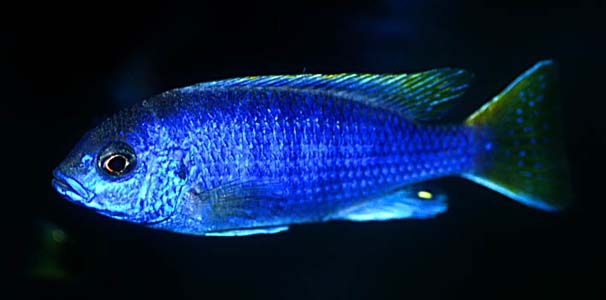
Pseudotropheus sp. 'acei'
Cichlidae · authority not recorded
This is an excellent beginner's species as it is relatively peaceful and easily bred. Despite being undescribed to science it is widely available in the hobby. It is sometimes sold as Gephyrochromis acei. Several colour forms are available, including "yellow tail acei" and "white tail acei". None of these should be kept together in aquaria to prevent hybridisation. In nature it feeds specifically on algae and other organisms growing on submerged wood, and is the only ...
Steatocranus tinanti
Cichlidae · authority not recorded
S. tinanti has a confused taxonomic history, having been previously classified in the genera Gobiochromis and then Leptotilapia, before being assigned to Steatocranus. Further taxonomic revision is likely, as it exhibits both behavioural and morphological differences to other species in the genus. It is a reophilic fish, meaning it inhabits fast waters. Its swimbladder is relatively small to reduce buoyancy and thus prevent it from being swept away by the strong currents in its natural habita...
Theraps bocourtiChisel-tooth cichlid
Cichlidae · authority not recorded
A rather elusive species in the hobby, this beautiful cichlid is sometimes referred to as the "Chisel-toothed" cichlid. Despite being described in 1902 it was not until the mid-1990s that it appeared in the aquarium trade, wild specimens being collected by American aquarists Ross Socolof, Harry Specht, and Rusty Wessel in 1994....
Tropheus brichardi
Cichlidae · authority not recorded
Like others in the genus, Tropheus brichardi is something of an enigma in the aquarium hobby, and is not a good species for the beginner. There has been much arguement and discussion about how best to maintain it in the aquarium, and some of these debates still rage on. We have provided the generally accepted method of keeping the fish, but in reality what works for one aquarist may not for another. One aspect which is always true is that water quality is of the utmost importance in a Tropheus t...
Tropheus duboisiWhite-Spotted Cichlid
Cichlidae · authority not recorded
Like others in the genus, Tropheus duboisi is something of an enigma in the aquarium hobby and despite it's popularity, is not a good species for the beginner. There has been much arguement and discussion about how best to maintain it in the aquarium, and some of these debates still rage on. We have provided the generally accepted method of keeping the fish, but in reality what works for one aquarist may not for another. One aspect which is always true, is that water quality is of the utmos...
Tropheus moorii
Cichlidae · authority not recorded
Like others in the genus, Tropheus moorii is something of an enigma in the aquarium hobby, and despite it's popularity is not a good species for the beginner. There has been much arguement and discussion about how best to maintain it in the aquarium, and some of these debates still rage on. We have provided the generally accepted method of keeping the fish, but in reality what works for one aquarist may not for another. One aspect which is always true, is that water quality is of the utmost...
Vieja synspilaRedhead Cichlid
Cichlidae · authority not recorded
Widely and incorrectly referred to as vieja synspillum, this colourful fish is the most commonly available of the vieja species to the hobby. Although not as aggressive as some of its family, it is still a fish to treat carefully. It can be found in mildly brackish waters in its natural range but this is not recommended or required in captivity....
Vieja zonataOaxaca Cichlid
Cichlidae · authority not recorded
A hardy and easy to keep cichlid, albeit a moderately aggressive one. Rarely available in aquatic stores, this fish is occasionally available through specialist cichlid dealers.
Herichthys cyanoguttatusTexas Cichlid
Cichlidae · authority not recorded
Like many cichlids, members of the genus Herichthys share something of a confused taxonomic past. Erected in 1854 with H. cyanoguttatus the type species, its members were moved into Cichlasoma by Regan in 1905. However following a reclassification of Cichlasoma by Kullander in 1983 it was once again deemed valid. In 1996 Kullander suggested Herichthys should only contain species "sharing a colour pattern of short vertical bars or black spots posteriorly from the middle of the side, and a un...
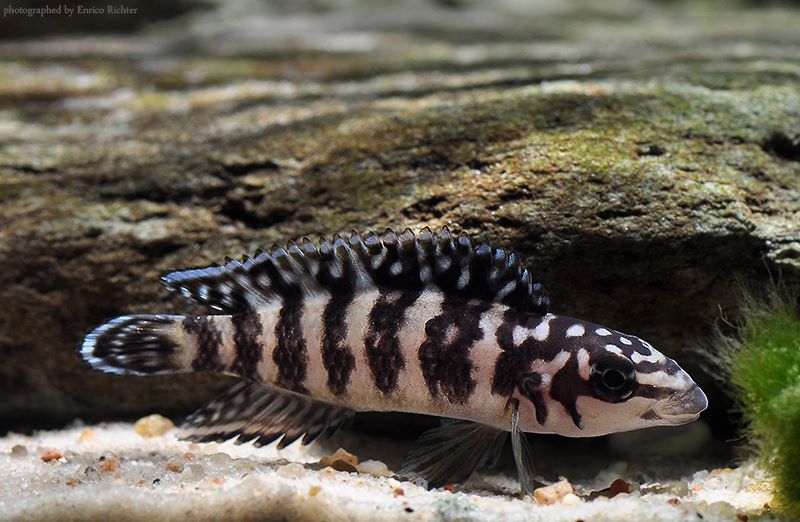
Julidochromis transcriptusMasked Julie
Cichlidae · Matthes, 1959
Julidochromis transcriptus
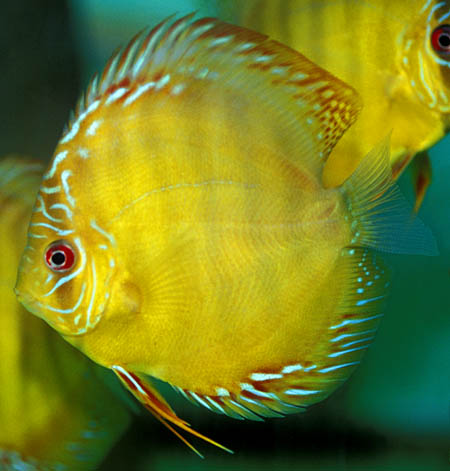
Symphysodon aequifasciatusDiscus
Cichlidae · Pellegrin, 1904
Symphysodon aequifasciatus
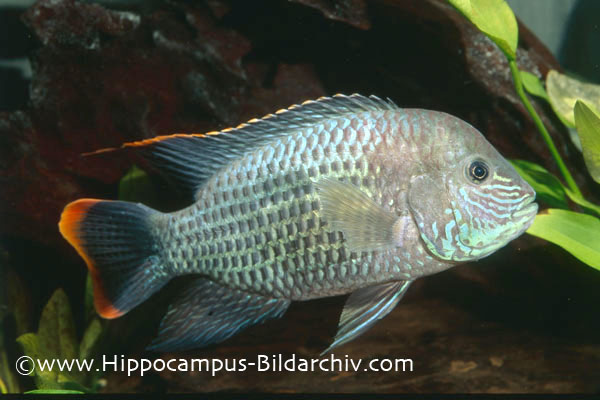
Andinoacara rivulatusGreen Terror Cichlid
Cichlidae · Günther, 1860
Native to extreme northern Peru and coastal drainages of western Ecuador as far north as the Río Esmereldas drainage and possibly beyond. The form from the Esmereldas and above may represent a different species (see 'notes').
Cyathopharynx furciferFeatherfin Cichlid
Cichlidae · authority not recorded
There are only two described species of Cyathopharynx, each with several colour forms. These should not be kept together in aquaria, as they can hybridise. They are among the most beautiful of all freshwater fish and are highly sought after in the hobby, although they are fairly delicate. The highest water quality is required for males to fully develop their stunning adult colouration, which happens when they are around 4" in length. This may take a good few months if you are buying young f...
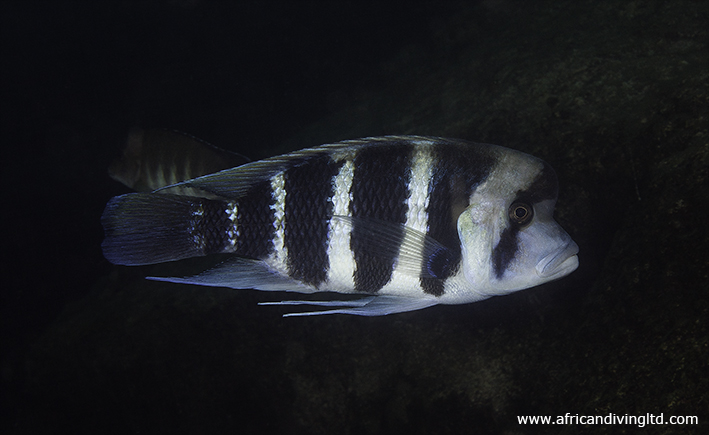
Cyphotilapia frontosaHumphead Cichlid
Cichlidae · Boulenger, 1906
Populations of C. frontosa from different localities are often labelled as such in order to maintain accuracy and preserve pure bloodlines. The majority possess 6 vertical bands on the body with the exception of the form from Kigoma on the eastern side of the lake, which has 7. Forms referred to as 'Blue Zaire' are sometimes misidentified as C. frontosa but are representative of its congener C. gibberosa.
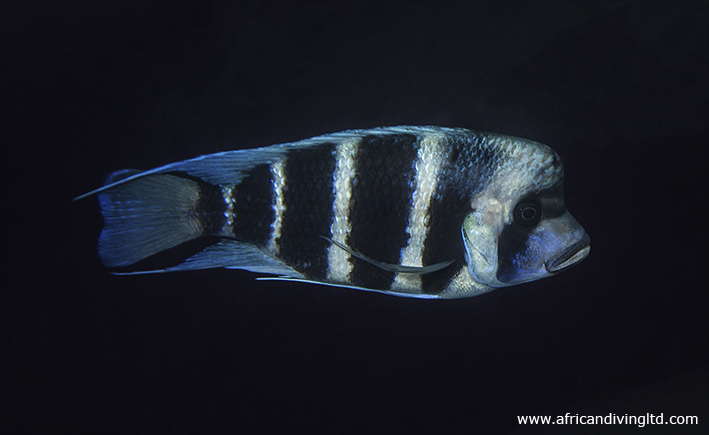
Cyphotilapia gibberosa
Cichlidae · Takahashi & Nakaya, 2003
Prior to the description of C. gibberosa in 2003 the genus Cyphotilapia was considered monotypic for almost a century. Members are separated from other cichlid taxa inhabiting Lake Tanganyika by possession of a hump on the forehead and broad vertical bands on the body, although the latter tend not to be visible in large males.
Cichla orinocensisOrinoco Peacock bass
Cichlidae · authority not recorded
Due to their large size, Peacock Bass are only really recommended for the experienced fishkeeper that can house them adequately. That said, they are a hardy and robust species that will adapt to a variety of conditions. Peacock Bass are becoming much more available in the hobby and are often seen for sale as cute 2" babies, often tempting people into buying a fish they will not be able to care for in the long term. Peacock Bass are also fished as a sport fish....
Cichla temensisSpeckled Pavon
Cichlidae · authority not recorded
One of the largest cichla species. Due to their large size, Peacock Bass are only really recommended for the experienced fishkeeper that can house them adequately. That said, they are a hardy and robust species that will adapt to a variety of conditions. Peacock Bass are becoming much more available in the hobby and are often seen for sale as cute 2" babies, often tempting people into buying a fish they will not be able to care for in the long term. Peacock Bass are also fished as...
Pterophyllum altumAltum Angel
Cichlidae · authority not recorded
Altum Angels are a lot less common in the trade than their well known (arguably the best known tropical fish) relatives Pterophyllum Scalare, the common Angelfish. However, they are still available from some of the better tropical fish suppliers. They are a challenge to keep - they share all of their relatives' difficulties (susceptible to hole-in-the-head disease, very weak to nitrate buildups, extremely prone to stress-related diseases, commonly eat their own spawns etc.) and have a fe...
Uaru amphiacanthoidesUaru
Cichlidae · authority not recorded
A large, peaceful South American cichlid. Uaru can make very interesting aquarium subjects. They require clean, well filtered water on the higher end of the temprature scale. Avoid keeping with overly aggressive fish, Uaru are happiest when kept in groups or pairs....
Vieja bifasciataRed-spotted Cichlid
Cichlidae · authority not recorded
Vieja bifasciata are often confused for vieja synspilum but can be told apart as bifasciata have two prominent horizontal lines running between their eyes (hence the name). They are a very colourful fish and respond to their owner's presence - usually looking for food! Bifasciata are not particularly demanding in terms of water parameters and easy to keep, especially if suitable tankmates can be found. It is sometimes the case that a pair of fish that will not live together in a tank on ...
Vieja reganiRegan's Cichlid
Cichlidae · authority not recorded
An attractive, if uncommonly seen cichlid. In common with many Central American cichlids, these fish can pose in a challenge in terms of accomodation and it not uncommon to end up having to house these fish individually. Previously described as cichlasoma regani, it is still occasionally sold under this name.
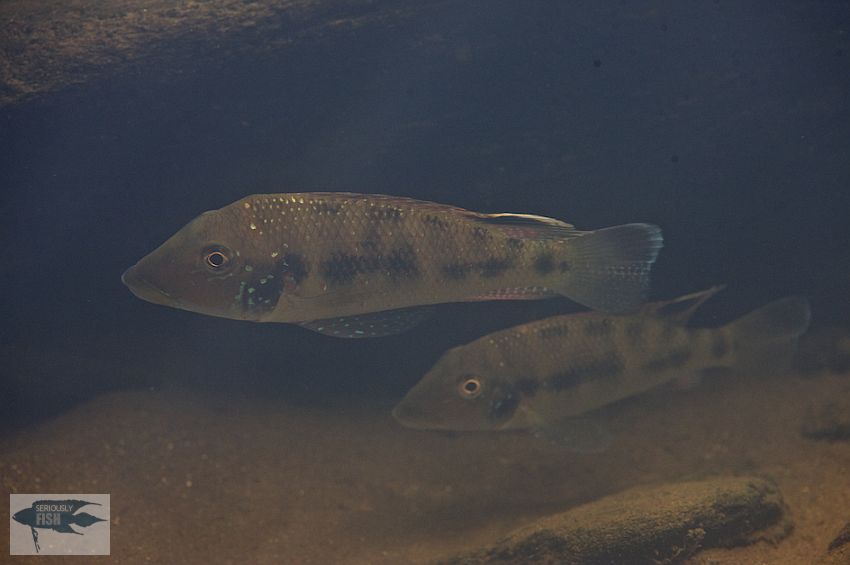
Retroculus acherontos
Cichlidae · Landin, Mareira & Figueiredo, 2015
Known only from affluents within the upper rio Tocantins basin draining into the enormous Serra da Mesa hydroelectric reservoir in Goiás state, Brazil. It has been collected from the rios Maranhão, das Almas, Traíras, and Palmerinha/Palmeira(?). Type locality is 'Brazil, Goiás, Rio Tocantins basin, Rio das Almas, tributary of left margin of Rio Maranhão, 14˚37′51.2″S, 49˚1′56.6″W'.
Crenicichla lugubrisAtabo Red Pike Cichlid
Cichlidae · authority not recorded
An attractive and colourful fish when small, this species quickly grows into a large aggressive adult, requiring a large tank.
Dicrossus filamentosusLyretail Checkerboard Cichlid
Cichlidae · authority not recorded
Dicrossus Filamentosa were once part of the Crenicara genus, but now share the Dicrossus genus with Dicrossus Maculata. The two species look similar, but the Maculata lack the lyretailed of the Filamentosa. Some say however, that the Maculata has even more striking body colouration than the already impressive Filamentosa. These fish aren't impossible to find, but aren't readily available in local fish shops either. They are seen as a challenge to breed, but plenty of breeders have h...
Mesonauta festivusFlag Cichlid
Cichlidae · authority not recorded
Flag Cichlids are enduringly popular in the hobby and can be found in most aquatic stores. Interestingly, this species is not the species most commonly sold as the Flag cichlid. It is usually m. insignis that makes it into dealers tanks....
Ctenochromis polli
Cichlidae · authority not recorded
...